Tag: Red-Winged Blackbirds

  • 2023-1: Big Mama Attacked

    2023-1: Big Mama Attacked

    2023 – What I Knew Then, What I Know Now – 2026

    The Bennets and Perfects arrived even earlier than the previous year. Big Mama arrived  March 18, Big Daddy two days later, they were mating by March 21.

    On March 26, far from the first time this season, Big Mama rocketed into the air to repulse an intruder. They became entangled and dropped into the water still intertwined. The intruder flew practically at the moment of the splash.

    Big Mama floated beneath her nest, head up and wings outstretched, surely no more than two or three minutes. It felt an hour watching. She struggled and failed to pull herself out of the water twice, every feather drenched, even her head, she’d clearly completely submerged. She lifted free on her third try and reached her nest. She had a brightly bleeding gash down her breast.

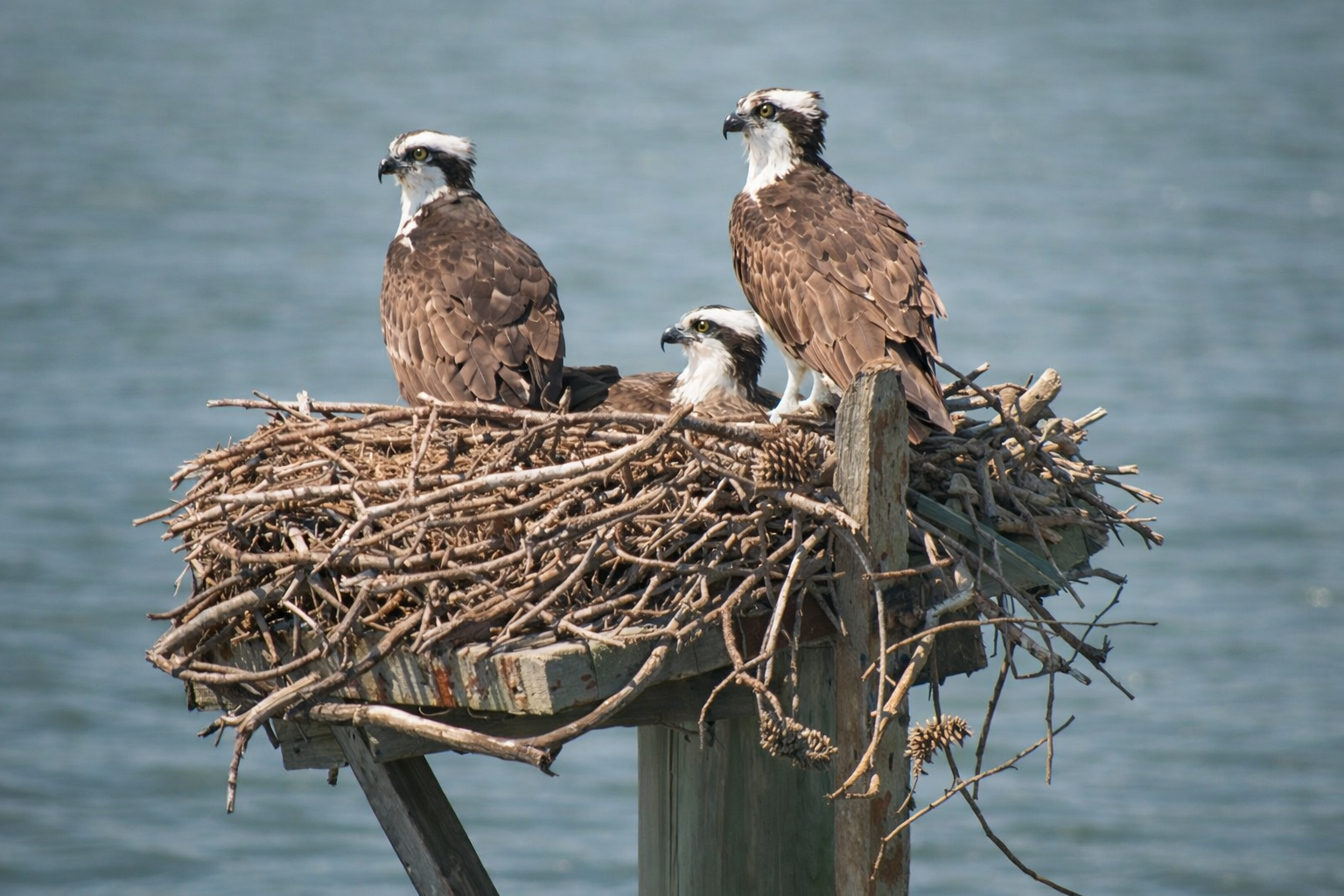
    Big Mama, left, has butterscotch colored eyes, Big Daddy on right.

    She healed within a month to no apparent ill effect, wasn’t so fierce and stopped rocketing off her nest.

    The Perfects and Bennets further than ever ahead of schedule, arrived the first week of March. Fishing was stupendous. I watched Mr. B deliver a fish in each foot mid-March. Later that day the male on the nest to the north of the Perfects did the same.

    Fish, tall pines, scores of man-made platforms continued to draw youngsters, this year’s from successful “Chesapeake” imprinted fledge classes of ’20 and ’21.

    Measured birds per square foot, St. George Island really might have been the Osprey Capital of the World.

    The day Big Mama got slashed, Mark-8 made his dramatic arrival, streaking out of the water bushes at the shore and smashing an intruder off Nest 1.

    At that eruption next door, Mrs. Bennet split and didn’t return to her Nest 2 until the next day. And then refused to resume the mating regiment of the past three weeks with Mr. Bennet. She relented the next day, March 28, the same day Ethel returned. And Mrs. B split again.

    Previous Episode 2022-5:  Ethel Was Liberated

    Next Episode 2023-2: Ethel Remains Liberated
  • 2022-5:  Ethel Was Liberated

    2022-5:  Ethel Was Liberated

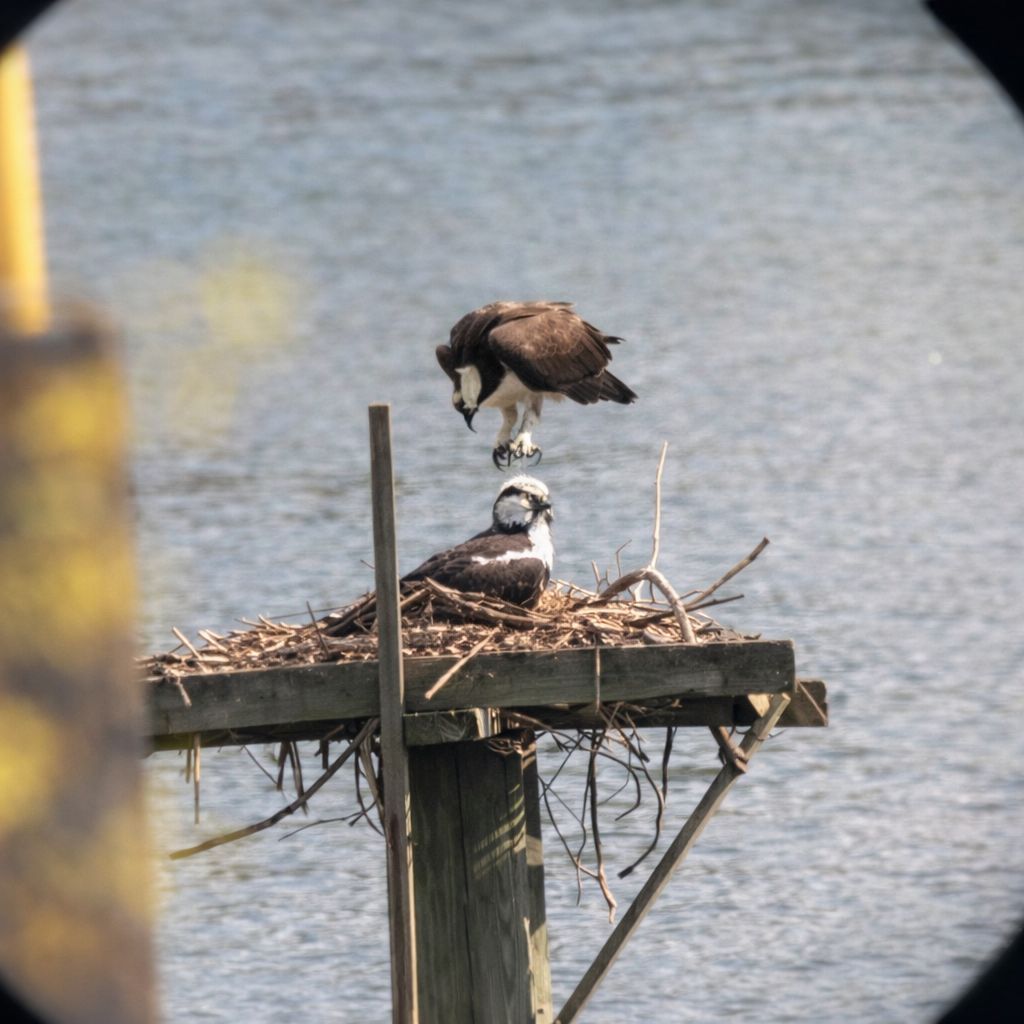
    Ethel, in the nest, and Mark-8 perched above, don’t seem to be really into one another.

    2022 – What I Knew Then, What I Know Now – 2026

    Osprey dung had become an obvious problem by 2022. It eats the paint off cars, porches, everything. A windshield count identified 60 nests on the island, add a conservative third again for nests invisible from the road and those invisible staring straight at them.

    The Captain, again, proclaimed St. George Island the Osprey Capital of the World.

    Even so, only two of the four nests out front creek fledged Ospreys that year. Ethel brooded a few days in April, abandoned that effort. In June, as eggs in Island Creek nests started hatching, Ethel and Mark-8 hunkered a second time for some serious incubation. Lasted a week. Ethel split when fish deliveries halted. She returned after geese spent a few hours stomping anything in the bottom of that nest to smithereens.

    Mark-6 continued to slide sticks down triangular Marker 6 and visited Nests 1 and 2 when the males were absent. Twice I saw Mrs. B and Mark-6 breezily land side by side on Nest 2, like they’d just flown in from grabbing a quick drink. Mark-6 loitered briefly, Mrs. B was friendly, he flew off.

    Likely Ethel’s chasing Mark-6 off her nest was actually following him into the South Copse. Although I hadn’t realized, in 2022, Ethel had returned from wintering in Central America as a free agent.

    On July 12, the same day, Mr. B gave Mrs. B a fish to welcome her return, Mark-8 gave a fish to Ethel. There was a full moon, daylight hours waning, fishing had picked up, for whatever it’s worth.

    Mark-8 had begun eating his fish on a low pier very near Nest 1. Ethel’s best chance for a piece was to wait in the nest. If she dropped down to the pier, he flew with his fish. The gulls, his ever present sentinels, cleaned up the pier. Once, with Ethel watching and calling, Mark-8 left a chunk of fish on the pier. The gulls were on it before his talons left the planking.

    Both remained committed to that nest, still battling as allies against any intruders eyeing Nest 1.

    The Osprey population increased every year, real estate naturally grew scarcer, and the trend continued into 2023. That season will have barely begun when an intruder rips Big Mama’s chest open, leaving her floating in the creek.

    Previous Episode:  2022-4: Best to Lay by Early May

    Upcoming Episode: 2023-1: Big Mama Attacked

  • 2022-4: Best to Lay by Early May

    2022-4: Best to Lay by Early May

    2022 – What I Knew Then, What I Know Now – 2026

    Note: In the Chesapeake, best to lay eggs by early May. It’s 37-ish days to hatch, another 55 to fledge. Then the kids have to learn enough about fishing and flying to survive migration.
    Osprey typically lay clutches of three, sometimes four eggs, frequently wait for the third to begin 24-7 incubation, which is performed primarily by the female. Males fish, deliver food to the nest, and to varying degrees help with incubation. Some males are assertively broody. Some are Indeed-by-God not.

     Mrs. Bennet had laid her third egg five days before George and Martha arrived. Ten days after their arrival she stopped incubating.

    Two weeks later an attempted resumption of affections between the Bennets faltered. For the next two months, Mrs. B absented herself for days at a time and then other females paraded through Nest 2. Mr. B was slow to escort them off but he ultimately did.

    Mrs. B returned July 12. Mr. B brought her the last fish I saw him deliver that season. She shooed any remaining females away and they shared the nest, platonic as far as I noted. Presumably they fished for themselves.

    Upstream was a different scene. By May 9, Mrs. Perfect was feeding a chick. By the 21st she had four chicks, the elders bullied the youngers. Mrs. Perfect configured the nest to separate the two youngers where they were no longer attacked but no longer competed for food. By the end of the month the pen was dismantled and the Perfects ultimately and efficiently fledged two chicks.

    Mrs Perfect and the two Perfect chicks await a fish delivery from Mr Perfect

    The Bigs hatched three chicks in the familiar pattern, the first a bully, the third quickly perished, the number two a survivor. The chicks were well fed, bullying diminished, and both fledged.

    The combined Big and Perfect chicks began fledging the second week in July with all four flying in early August. They landed in one another’s nests, wherever food arrived. The second Big to fledge flew straight into Mrs. Bennet on Nest 2, and got promptly booted home. But the adults in the nests upstream, after some initial consternation, fed whoever showed up.

    Ethel and Mark-8 handled the breeding season differently. Ethel had been liberated.

    Photo by author, taken with iPhone clamped to telescope. Version at top was “sharpened” by Copilot AI.

    Previous Episode 2022-3: Territorial Negotiations

    Next Episode:  2022-5:  Ethel Was Liberated

  • 2022-3: Territorial Negotiations

    2022-3: Territorial Negotiations

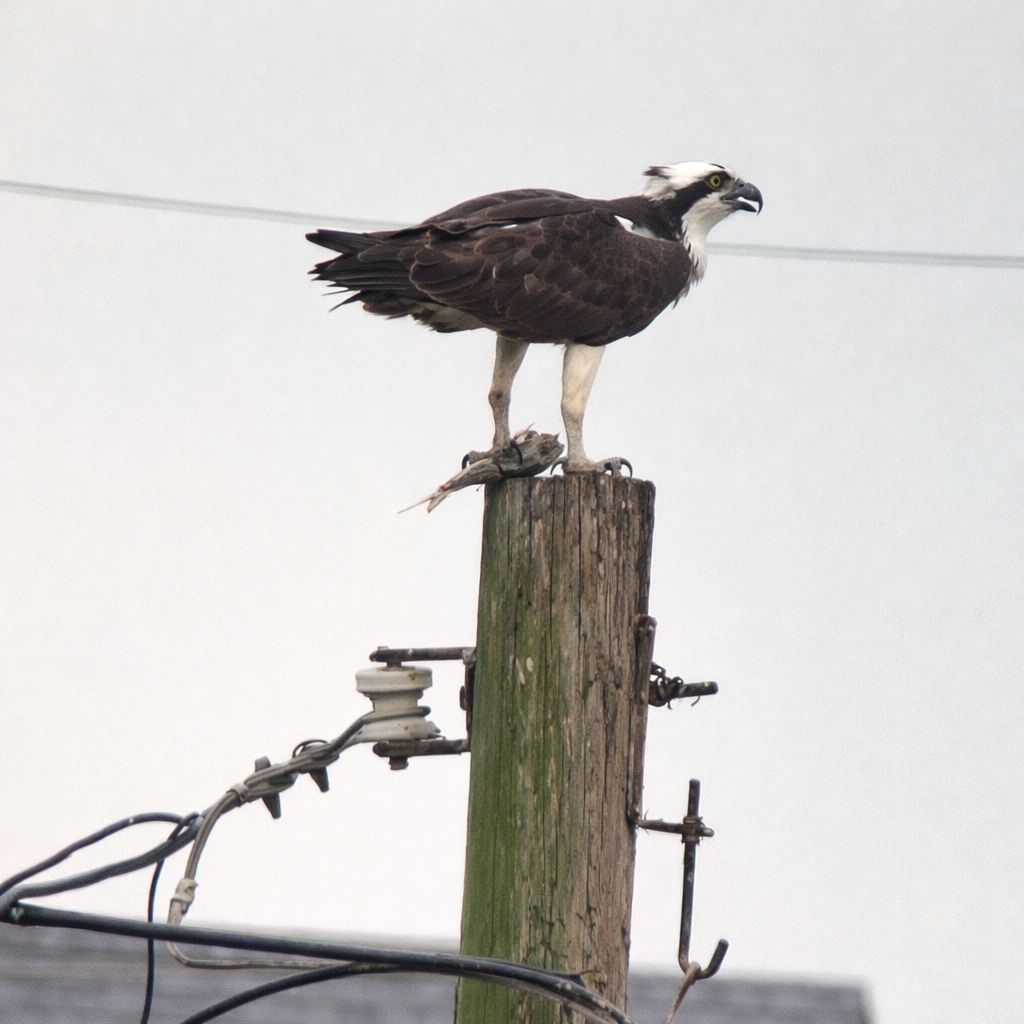
    Mr Bennet preferred the electric pole on the road to dine and to prepare a fish for nest delivery. He can see activity in Nests 1 and 2 from the pole, and probably action in nests across the creek to the south.

    2022 – What I Knew Then, What I Know Now – 2026


    The Bennets controlled territory beyond Nest 2. At least two loblollies in the middle of Parcel 157 Copse across the road belonged to Mr. and Mrs. Bennet; all four man-made poles surrounding the oyster house belonged to Mr. Bennet, and all the pilings along the lower side of the pier belonged to Mrs. Bennet. She selected her dining spot among them, perhaps based upon vessel configurations. Regardless, except for Mr. B, she allowed no other Osprey to perch on any of them.

    Upon George’s arrival, the Bennets made clear that their territorial jurisdiction covered the entire pier, including the pilings on the upper side and the toe at the bottom of the “L,” where George was constructing his split-level nest.

    The Bennet’s swooping and diving and squeeing opposition did not come close to the vigor of the Bigs’ hostility, their tenor reflected outrage of ancestral proportion against unpardonable nouveau.

    Then again, for all I know, George’s installation at the end of the pier amounted to Osprey voodoo. Watermen avoided it.

    Most likely George’s effrontery, squeezing between established territories, shoved property rights straight up those males’ beaks. Even Mr. Perfect, whose boundary lines were not impacted, joined the attacks.

    Mrs. B and Big Mama stuck tight on their nests but rocketed into the air if Martha flew overhead, which usually Martha did not. At the first sign of aggression, Martha split, flew across the creek. When the locals came at George she’d absent herself, quick to leave the Purple Martin hotel to any invader.

    Martha liked George to deliver her fish to pilings across the creek. And mating worked better on the pilings than George’s hot-mess nests of ’22. Martha did hang in the neighborhood, perched around the expanding split-level. But the only risk I ever saw her take was getting caught investigating other nests. When nest owners were absent — and the nests were empty of eggs or chicks — she’d hop in and look around.

    But George did not abandon his split-level. Certainly not after holding his claim against the elder males. When matters calmed, Martha stood on the Purple Martin hotel, walked among George’s circular collection on the pier, and particularly liked perching on crossbars between a few pilings around the pier’s foot.

    George preening, Martha taking her time eating the fish he’d delivered to her on the crossbar at the end of their pier.

    Neither George or Martha ventured farther up the pier than the foot. They’d additionally been granted five loblollies in my side yard, which, as the Osprey flies, is a straight shot off the toes to the trees, no invasion of airspace above the leg of the pier. Even so, Mrs. B left her early eggs. It was touch and go all season if she’d stick with Nest 2. She never did dine again on a piling along the oyster house pier.

    Previous Episode: 2022-2: Building Code Spat
    Upcoming Episode: 2022-4: Best to Lay by Early May


    Photos by author with iPhone clamped to middling telescope; versions above of these two at the bottom are AI “sharpened” by Copilot. The others in the post are iPhone clamped to telescope.


  • 2022-2:  Building Code Spat over Split-Level

    2022-2:  Building Code Spat over Split-Level

    2022 – What I Knew Then, What I Know Now – 2026

    In 2022 the fledge classes of 2019 and 2020 roared into town, as obstreperous as ever the old Gang of Six. Youngsters canvased Island Creek through the summer, dipping into nests to attempt a claim, some ready to fight then and there.

    Mark 8 balancing and Ethel not cooperating.

    Mark-8 and Ethel remained adamant about their possession of Nest 1, although neither were into nestorations. They persevered as non-traditionalists. Mark-8 wasn’t into fish delivery. And Ethel wasn’t into mating.

    When Mark-8 zoomed in for a mating attempt—an approach favored by most lower-creek males—he’d have to walk Ethel’s shoulders down to force her tail up. If he succeeded with that, he’d have to walk his way back up to position his tail beneath hers. If all of this was accomplished, Ethel would swish her tail like she was all in, but whenever I caught a glimpse, she was all out of alignment.

    Note: Ornithologists say Osprey do not trade fish for copulation, not in a tit for tat kind of way. The male necessity is to override his own survival instinct and give his fish away. So, while the giving is a huge thing, possibly even tied to his perception of masculinity, the female needs to calculate, Is it enough? He must feed her, her chicks, and himself. A miscalculation could trap her into a lifetime of begging calls and drudgery.

    A new couple arrived in mid-April. I named them George and Martha for no reason at all. George began building a split-level atop a Purple Martin hotel rusted hollow. It was mounted at the toe of the L-shaped pier that separated the old Osprey nests from the new.

    While George’s efforts sometimes appeared within the realm of possibility, they also smacked of the style of Mark-6, who in 2022 continued sliding sticks down Marker 6. George incorporated the sticks that fell off the Purple Martin hotel into the circle of rope, fabric, and various detritus comprising the garden level of his castle sprawled across the pier.

    Just like that, the Bennets got another atypical neighbor, this couple flanking them on the north.

    None of the neighborhood took it well.

    Previous episode: 2022-1: Time Speeds Up

    Upcoming episode 2022-3:  Territorial Negotiations


    All photos by author, taken with iPhone clamped to telescope. Top and bottom versions in post above were “sharpened” by Copilot AI.


  • 2022-1: Time Speeds Up for Island Creek Osprey

    2022-1: Time Speeds Up for Island Creek Osprey

    Mrs. Perfect, above, devises a sorting system for her chicks this year, in the vein of Hunger Games or Theseus and the Minotaur.

    2022 – What I Knew Then, What I Know Now – 2026

    2022 took off early and held a fast pace. Some of the named 10 showed up a month ahead of their previous year’s arrival. The Perfects dropped into place March 7, perched side by side as if a single, ceramic unit had been lowered onto the rim of their nest. They hatched four chicks in 2022 and subdivided their nest to jettison the younger two from the feeding schedule, as required.

    Mr. and Mrs. Bennet arrived the day after the Perfects, Mrs. B mid-morning and Mr. B careening up the creek early evening, landing gently on Mrs. B and mating. She greeted him head down, tail high, and their breeding season began.

     Note:  Ospreys don’t carry full-sized reproductive baggage year round. Initial mating efforts—the failures and successes—expand the gear to production size and drop it into place. Experienced couples can pack these preliminaries into seven to 10 days of concentrated and consummated mating to deliver a fertilized egg. Newer pairings take more time. Weeks. Longer. Maybe not until next season. Timing is the essence.
    Big Mama (L) and Big Daddy

    Big Mama arrived the same day as the Bennets. I didn’t clock Big Daddy’s arrival, but he was taking a turn incubating eggs by April 1, so he’d arrived close on Big Mama’s tail.

    Ethel and the two Marks arrived mid-March and resumed skirmishes between the two nests south of the dock; they flew tandem and as a synchronized trio above the creek, they buzzed nests close enough to cause small fracases.

    Ethel and Mark-8 reclaimed Nest 1 and resumed squabbling with Nest 2 using the same old tricks: Mark 8 buzzed the Bennets as they began mating. Mr. B stole stick after stick from Mark-8’s nest.

    Mrs. B, a tenacious and relentless defender of Nest 2, could yet be surprised by Ethel quickly touching down on Nest 1 behind Mrs. Bennet’s back, only to spring over to her own nest as Mrs. B realizes. It drove Mrs. Bennet nuts.

    Mrs. B once rocketed off Nest 2, talons raised, hit Ethel square on the back, tumbling her overboard off Nest 1’s perch.

    The four of them looked more prankish than hazardous. This was their third year back. They worked together to drive off intruders, which I considered to be those I had not named, but their definitions were narrower.

    Matters still looked to be leveling out to a neighborly season. Mrs. B properly settled in and started laying eggs on March 25, still an early bird well ahead of the standard Chesapeake Osprey calendar. She had plenty of time if something should go awry.

    Previous Episode: 2021.6  Mark-8, What Else?

    Upcoming Episode: 2022.2  Building Code Spat over Split-Level

    Photo by author, taken with iPhone clamped to telescope. Version at top was “sharpened” by Copilot AI.
  • 2021-6: Mark-8, What Else?

    2021-6: Mark-8, What Else?

    Mark-8 perches above Ethel, probably sitting on eggs in April 2021.

    2021 – What I Knew Then, What I Know Now – 2026

    Following Osprey etiquette, Ethel’s nest mate perched on Marker 8, close to Nest 1, to decapitate the fish in advance of presenting the meal at his family’s nest. Squeeing, squeeing, squeeing came nonstop from Ethel and then Ethel and chicks as he prepped the meal.

    Note: Ornithologists describe the high pitched, ceaseless, nagging hunger cries of females and chicks as Food Begging Calls, hardwired into the Osprey survival drive. The pitch and intensity rise when delivery is in sight and do not end until the female has fish in her mouth. Noteworthy: Relinquishing food is difficult. It requires overriding the survival instinct. Fishing with talons is also really difficult.

    But Ethel’s mate kept eating the entire fish, again and again. He preened on Marker 8 as if his family’s Begging Calls were Mozart. I saw him twice deliver food to Nest 1 after the chicks could feed themselves, which happens nearer 2 months than 1 month old. Ethel was absent both times.

    What else could his name have been other than Mark-8, right next door to Mark-6, the neighborhood’s first cavalier to leave a lady in the lurch.

    As a first time mother with scant support, Ethel fledged two difficult chicks, increasingly having to feed them by her own fishing efforts. She fledged a bully on the scale of Grendel or Frankenstein. She also kept alive a tortured and malnourished second hatch who fledged 10 days after Bully, finally escaping. Ethel immediately followed.

    Bully had fledged straight into the Bennet’s next door, which startled Jane right out of the nest, forcing her to fledge. Elizabeth Bennet had fledged the day before but wouldn’t conquer a return landing to the natal nest for a few more days. Mr. Bennet, who had been staying near Elizabeth,  joined the fray to remove Bully from Nest 2. And  the accidentally fledged Jane returned with a perfect landing. Through all the commotion, Bully held on and remained.

    Elizabeth nailed her landing and next to Jane found Bully also lined up to be fed by Mrs. B. After that Bully grabbed Mr. B’s deliveries for herself. She stole a fish out of Big Daddy’s talons with bravado and stupendous timing. She ate it, still perched next to Big Daddy, the Bigs’ fledgling begging from the nest below.

    I suspect Bully worked nests all over the island, but when Ethel delivered a fish to her second hatch, Bully landed nearly instantaneously on Nest 1, fought Ethel, and took the fish.

    As the creek emptied of Ospreys headed south, Bully hung around Nest 1 squeeing, then she disappeared too.

    She made the seventh fledgling to migrate in 2021 from four nests in front of the island house. I thought matters were looking up.

    Author’s iPhone via telescope capture of the original photo that was AI “sharpened” by Copilot in the version at the top

    Previous Episode: 2021-5:  Mr. Bennet Was My Favorite

    Upcoming Episode: 2022-1: Time Speeds Up


  • 2021-4: Pride and Prejudice

    2021-4: Pride and Prejudice

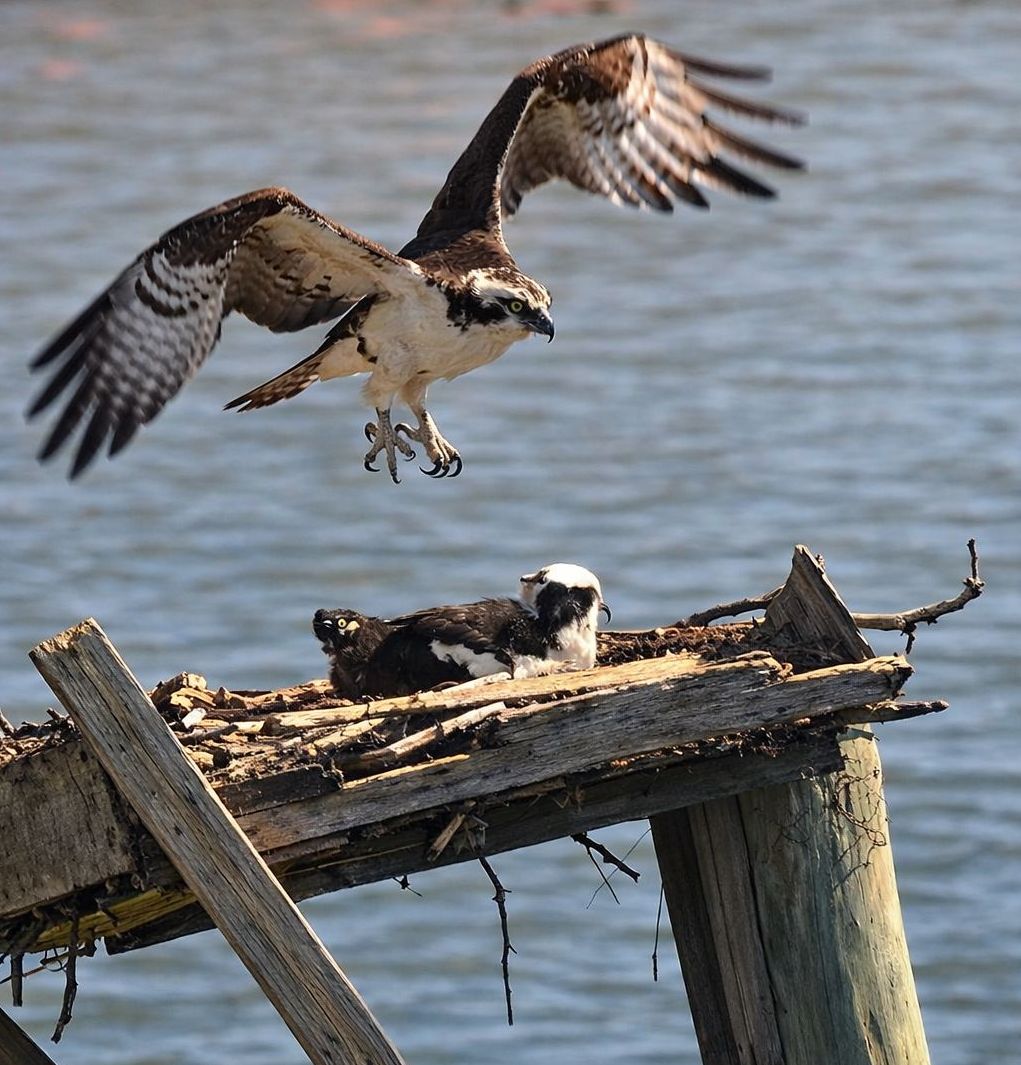
    Mr. Bennet is landing on Nest 2, probably aiming for Mrs. Bennet’s back.

    2021 – What I Knew Then, What I Know Now – 2026

    The accommodating and unaccommodating Osprey pair of Nest 2 will be named Mr. and Mrs. Bennet, after their chicks hatch. The chicks will look like big, healthy girls when they fledge. But when Natasha dropped in, Mrs. Bennet hadn’t yet laid an egg, though she was ready. She stuck close to the nest except to dine at a nearby piling, within sight of the nest. She ignored the Cuckoo egg.

    Not Mr. B. When he next delivered a fish to the nest, he brooded Natalie’s egg while Mrs. B dined on her piling.

    He carried on like this until Mrs. B began laying eggs a few days later, in the bowl she and Mr. B had carefully prepared, up and apart from the lip where Natasha had laid. Mr. Bennet’s attention transferred quickly to the eggs of the future Misses Bennet.

    Incubation can be pretty dull, viewed at the lip of the nest. The first surmise of a living hatch is an adult with food in its beak leaning into the nest bowl. Counting begins when heads start bobbing, which depending upon nest construction, takes at least a week.

    Big Mama and Big Daddy

    Only one head ever popped above the lip of the Bigs’ nest in 2021. Anyone’s guess the parentage. The Bigs had begun the season on bad terms, Big Daddy a month late, not showing until well into April while Big Mama had battled daily intruders.

    Mrs. Perfect

    Some assistance came occasionally from the upstream neighbors, their nest also attracting intruders. These neighbors to the north were the exception to my 2021 naming. The Captain and I had years before named this pair the Perfects, practically the day they arrived. We named them after family, whose lawn we’d long commented upon.

    In 2021, the experienced Perfects, the novice Bennets, and a beleaguered Ethel fledged two chicks apiece from three vastly different nests.

    Image at top of post is taken from this photo by author via iPhone attached to a middling telescope. Copilot “sharpened” the image used at the top.

    Previous Episode2021.3: Birds Labor Too 

    Upcoming Episode2021.5  Mr. Bennet Was My Favorite

  • 2021-3: Birds Labor Too

    2021-3: Birds Labor Too

    Natasha, between Big Daddy (L) and Big Mama, takes a breather after laying another egg in another Osprey pair’s nest.

    2021-What I Knew Then, What I Know Now-2026

    A bird about to lay an egg resembles most animals going through labor, intensely focused on the pressing situation, jumpy even in the comfort of her own nest. The subsequent melodrama of laying an egg, for the first time, without a nest, looked pitiable and shameful. Wanton. [Refer to anthropomorphism 2021-1.] She needed a notorious name: Natasha.

    I conjured Natasha Fatale, spy of the Moose and Squirrel show, something edgy to offset my awfulness of practicing voyeurism on trauma. This gal deserved a spicy name.

    Natasha’s debacle began at dusk the third week of April when Ethel alerted the neighborhood of disaster. Natasha had landed in Nest 1, Ethel’s nest, ready to lay an egg.

    Ethel hadn’t yet been named nor had the nests been numbered, but well prior to all of that, it was universally known, even by me,  that the bird I would come to call Ethel possessed the nest to later be designated Nest 1. And before Natasha had a chance to push an egg out, Ethel pushed her off it.

    Natasha flapped her way 50 feet to Nest 2, where the accommodating male and less accommodating female backed away. Natasha set upon the platform’s lower edge, closest to Nest 1, and laid her egg. Then the resident Nest 2 female pushed her off that nest, too.

    Three days later—right on Osprey-laying-target, Natasha landed in the oldest nest, occupied for many years by the Bigs. These two remain the biggest, respectively, male and female Ospreys I’ve ever seen. Big Daddy, big and blustering, was easy naming.

    Big Mama seemed a stretch, until both Bigs let Natasha labor, lay her egg, and this older, aggressive female let Natasha incubate alongside her and rest after her ordeal.

    I appended “Mama” because of that kindness. Plus, given her less than traditional mothering behavior, there was a tad of sarcasm.

    Big Mama was aggressive and hair-triggered when repelling intruders from her nest. Much more in character, once Natasha had rested sufficiently to be standing, Big Mama threw her off.

    As soon as Natasha quit circling, Big Mama tidied up and settled into incubating, possibly the Cuckoo egg as well.

    I have no further record of Natasha.

    Big Mama settles in after Natasha quits circling, enhances the nest bowl with a twig and sets to incubating.


    Previous Episode 2021.2: An Exotic Girlfriend

    Upcoming Episode 2021.4: Pride and Prejudice 


  • 2021-2: An Exotic Girlfriend

    2021-2: An Exotic Girlfriend

    Mark-6, although finding Marker 6 an awkward nest platform, has unobstructed views out the mouth and up to the head of Island Creek.

    2021-What I Knew Then, What I Know Now-2026

    Note: With Ospreys, it’s all about the nest. Male Ospreys select the site, maybe gussy it up a bit with some sticks, then keen and circle above, advertising. They plunge toward the nest, swooping out of the dive as near as nerves allow. At first, in courtship, the dive is to convince a female to lay her eggs there. Once she’s in the nest, dives accompany fish deliveries and announce his prowess as far as his keening can reach. If matters progress to egg laying, this nest will imprint an exact address on both of them. Nest Site Fidelity, according to ornithologists, is a bigger deal to Osprey pairs than one another. They’ll meet back up next spring and the next and the next. But it’s not necessarily a forever after pact between the two of them. It has more to do with the success of the nest, measured by chicks fledged.

    Nest Site Fidelity might define thereafter, but partnering proved the Gang of Six’s winning strategy. The two prevailing males fought for their claim to a platform alongside a female, also staking her claim.

    Mark-6 had a partner. Perhaps less aggressive than the two females who allied with a male to claim a nest platform, or more poorly informed about the importance of a nest. Mark-6’s nest consisted of an occasional bundle of sticks poking from the top of the triangle. His girlfriend gamely visited, but preferred Marker 7, which as an odd-number was square, with the added advantage of being the other side of the creek from the rest of the gang.

    She was small for a female, compact like Mark 6. And also like him, a beauty. Her markings differed from the others, more dark feathers about her face, down her breast and stomach. She looked exotic next to the familiar, whiter faced, lacey necklaced females of Island Creek, including Mrs. Perfect and Mrs. Bennet. Ethel had a more pronounced bib than her neighbors, but it barely feathered her crop.

    Mating on Marker 6 proved tricky, but possible, unlike nest building, or transferring fish, which had a significantly greater success rate atop Marker 7. So they mated there as well. She even brought a few sticks to the square marker. But Mark-6 did not relocate. So, the inevitable occurred. In late April, the exotic little female went into labor without a nest.

    Previous Episode 2021-1: A Telescope, Anthropomorphism 

    Upcoming Episode 2021-3: Birds Labor Too  

    Photo by author taken with an i-Phone clamped to the eye-piece of a telescope; photo at top is an AI Copilot “sharpened” version of this image