Tag: Red-Winged Blackbirds

  • 2025-3:  Ethel, Solo

    2025-3: Ethel, Solo

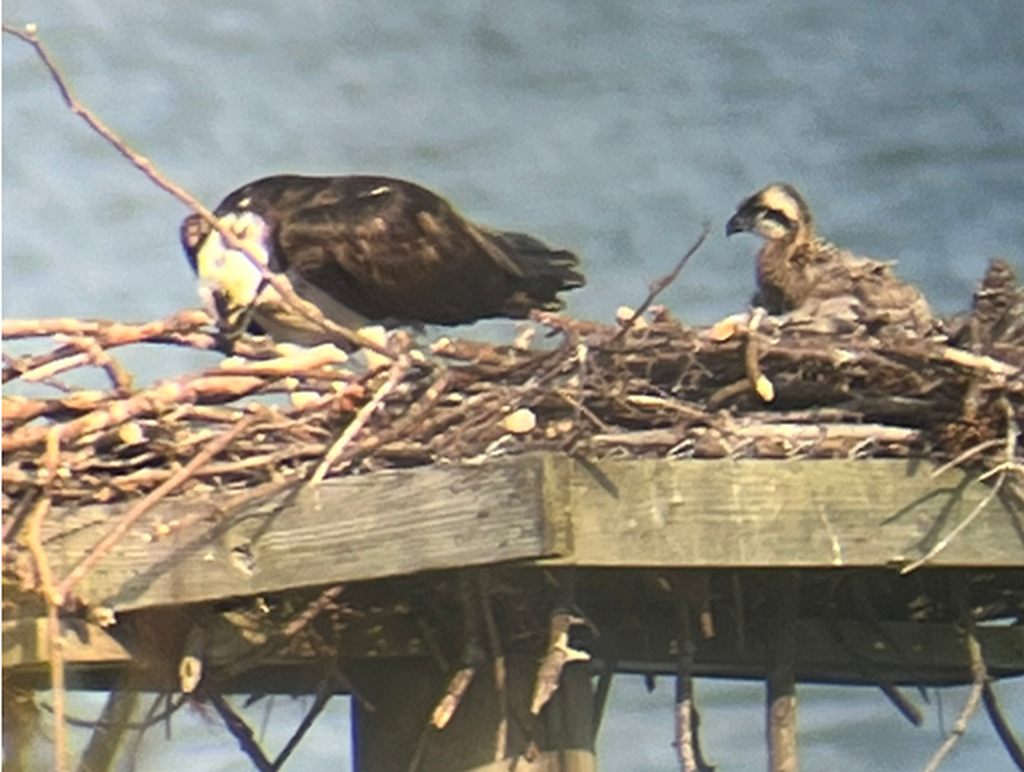
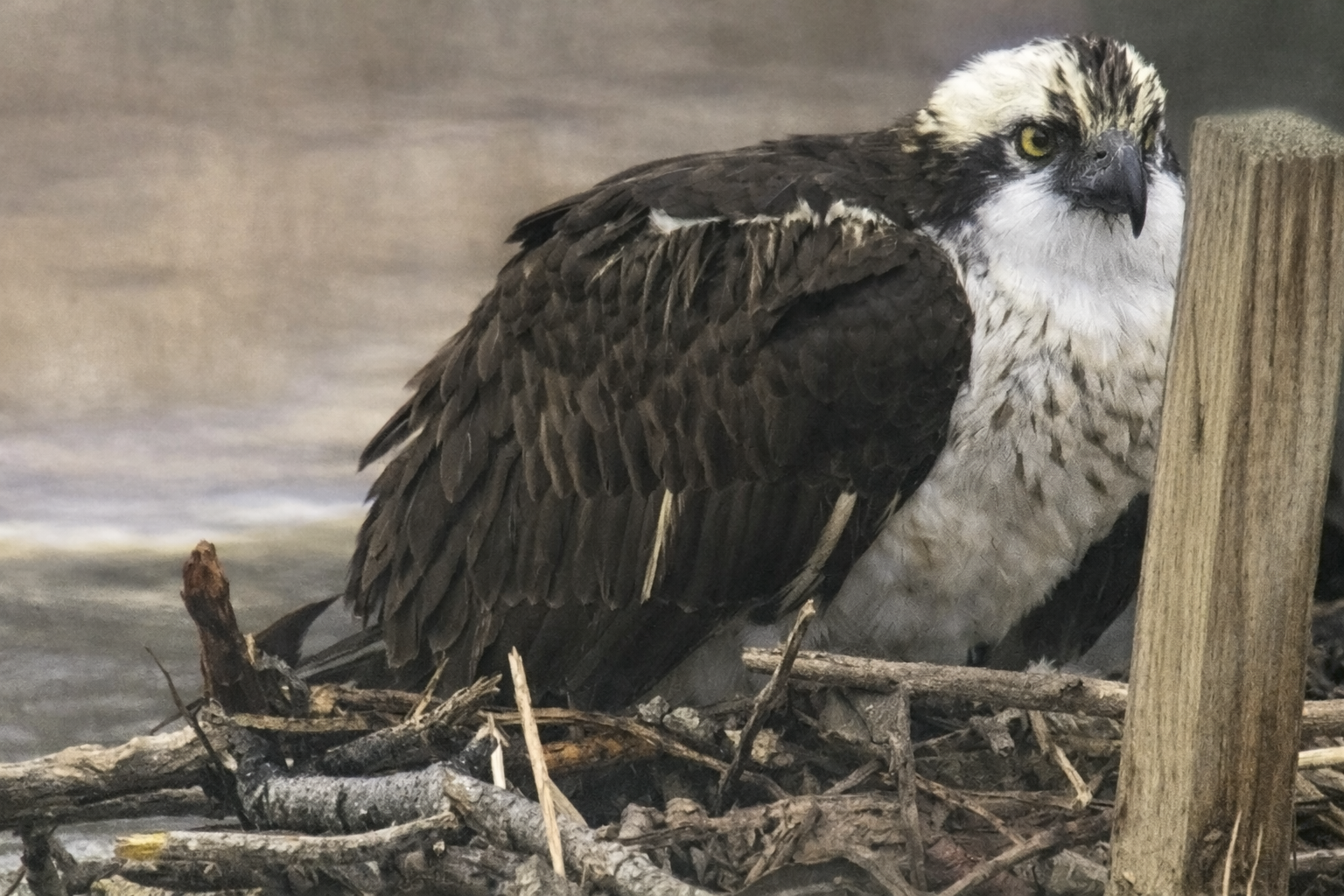
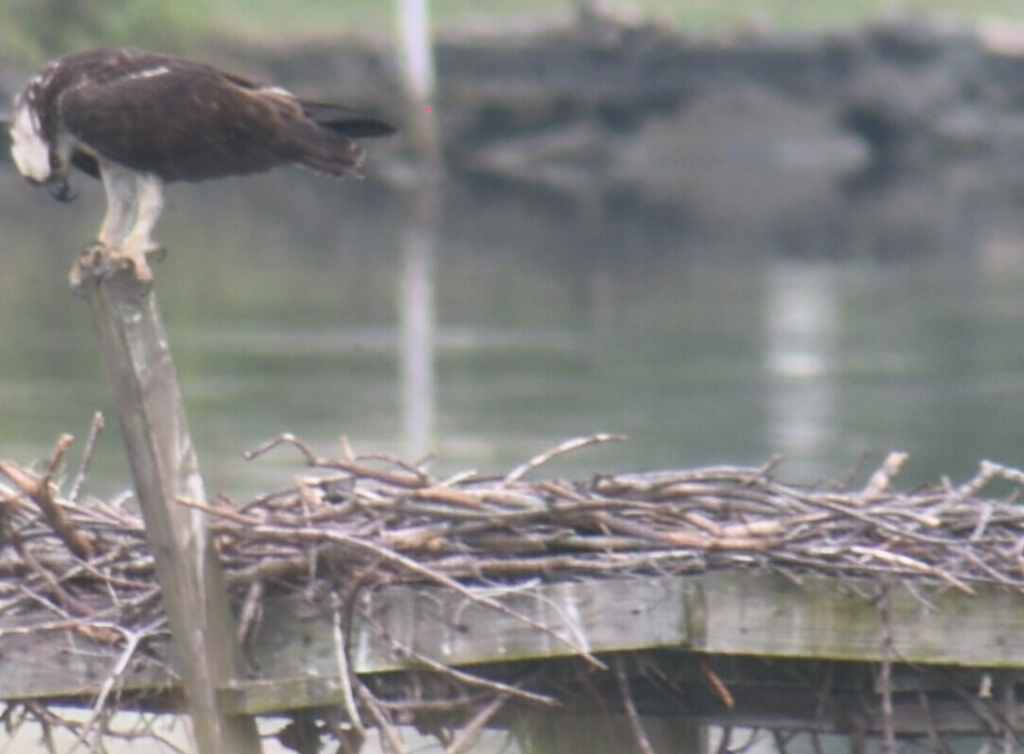
    Mark-8 was last sighted at Island Creek on June 2, 2025. This photo from April 2025 with focus sharpened by AI.

    The loss of his and Ethel’s eggs proved the end of the line for Mark-8. He left within the first few days of June. Mr. Bennet had remained banished and neither male returned to Nest 1 or Nest 2.

    So, around the middle of June, Ethel invited Little Boy over for dinner, which he delivered. They did a bit of Nest 1/Nest 2 hopping, but Ethel preferred her meals delivered to Nest 2.

    LB also kept delivering fish to Lily on Nest 4 for a while, which she accepted, and then immediately threw him off the nest. When those deliveries tapered off, Lily became a self sufficient fisher. She dined on the top branch of the dead loblollies at the southern corner of North Copse, also part of her Nest 3/Nest 4 territory. She handily chased off Ethel, LB, and any other intruder on any piece of her territory.

    LB settled in with Ethel for the rest of the season and delivered fish. Ethel performed her unsynchronized swishing and at one point, after a mating visit with LB, shot out something that didn’t quite look like a regular PS—Poop Shoot, in the vernacular of online bird-cam chatterers.

    Note: Patricia Brennan, Associate Professor of Biological Science at Mount Holyoke, discovered, this century, that some birds have genitals. Previously, scientists believed a “kiss” of the multipurpose cloaca beneath each gender’s tail did the fertilization trick for all birds. The cloaca does it for Ospreys, giving the female significant control over the outcome.
    In response to my query about Ethel’s expulsion, Professor Brennan replied, “[F]emale cloacal control for sure! One of the consequences of most birds lacking a penis is that males really have to convince females to accept sperm and females really have to gape their cloaca. Otherwise they can eject it easily after mating as you have seen.”

    None of the Ospreys I watched acted like they planned to gear-up the reproductive equipment for a second try. They looked like hawks with the summer off. The 24/7 nest confinement had been lifted. They didn’t have to mate, feed chicks, or teach them to fly.


    At the end of 2025, two females held possession of two nests apiece on Island Creek.


    This made for the second year without a fledge class from Island Creek. In 2024, I had plenty of reasons explaining the loss of all the hatchlings. They’d been late hatches, unable to temperature regulate when parching weather hit, already diminishing fish supplies threatened dehydration. Lots of reasons.

    Not in 2025. What would inspire vast numbers of “Chesapeake” imprinted Ospreys, within the same fortnight, to abandoned their eggs?

    I also don’t know about Red-Winged Blackbirds, there were so many they’d cast a 10-acre shadow across the marsh as they readied themselves to feed. Now, a half-dozen are quick to the winter feeders on the back porch.


    Previous Episode 2025-02: Young Female Overturns Tradition

    Next Episode  2026-01: Almost Summer

  • 2025-2:  Young Female Overturns Tradition

    2025-2: Young Female Overturns Tradition

    A surprisingly bold female acquired the recently vacated Bigs’ Nest 4 upon her March arrival. She was young, with dark feathers about her face and a full bib, reminiscent of Natasha. She quickly showed her intent to extend Nest 4’s territory to include Nest 3.

    I considered Little Lady as commentary on Ospreys’ reactions to a female claiming solo primacy of a nest. But amended that to Lily once she’d succeeded, officially F3 and F4 on the Excel chart. She deserved to be named Victory. She’d singularly laid claim and held the oldest nest in the creek the first season it had ever been fully vacated. Then doubled her holdings with a little help from some friends.

    George was so proud of his nest in 2024, but lost it in 2025.

    George, sadly confused without Martha, briefly courted Lily, who perhaps allowed his misperception while she made inroads into attaching Nest 3 possession to her Nest 4. Little Boy arrived and helped.

    He lost his chance for a name upgrade after Ethel entered his realm. Yes, it is always Ethel. He remained LB in the chart, he couldn’t claim a nest address.

    Lily had enlisted his help in early April. They hit it off, big time, many times. Many, many times. They were probably 2- or 3-years old, building their first nest—and it looked like it. They argued which platform to use but concurred that both nests were on the same deed.

    George maintained possession of a particular loblolly across the road, after losing his rights to Nest 3 and seemingly the pier’s crossbar as well.

    He visited the loblollies in the side yard that had provided perches for him and Martha. The five trees were down to three by 2025, so the perches more exposed. He preferred the copse across the street, with a sight line to his former nest.

    The Osprey parents returned to their nests after the gulls and crows were sure to have been through scouring. The pairs guarded their nests, tidied them, repaired and expanded them, and I saw a few lackadaisical attempts at mating. Probably only “bonding,” the catch-all verb for when males stand on females’ backs and do nothing but canvas the view or for the times mating fails to consummate.

    For a while, males kept up fish deliveries to females, tapering off on a timetable presumably established by each pair’s chemistry.

    Of course, that wasn’t how the year tapered out for Ethel.

    Previous episode  2025-01: Where Are the Gulls?

    Upcoming episode  2025.3:  Ethel, Solo

  • 2025-01: Where Are the Gulls?

    2025-01: Where Are the Gulls?

    I didn’t think 2025 would arrive so quickly. I can delay the news with two romantic spring tales. For one, Mark-8 and Ethel met up at Nest 1, then Ethel hopped back to Nest 2 and Mr. Bennet. But Mark-8 persisted, won her back, and banished Mr. B.

    Ethel retained possession of Nest 1 and Nest 2.

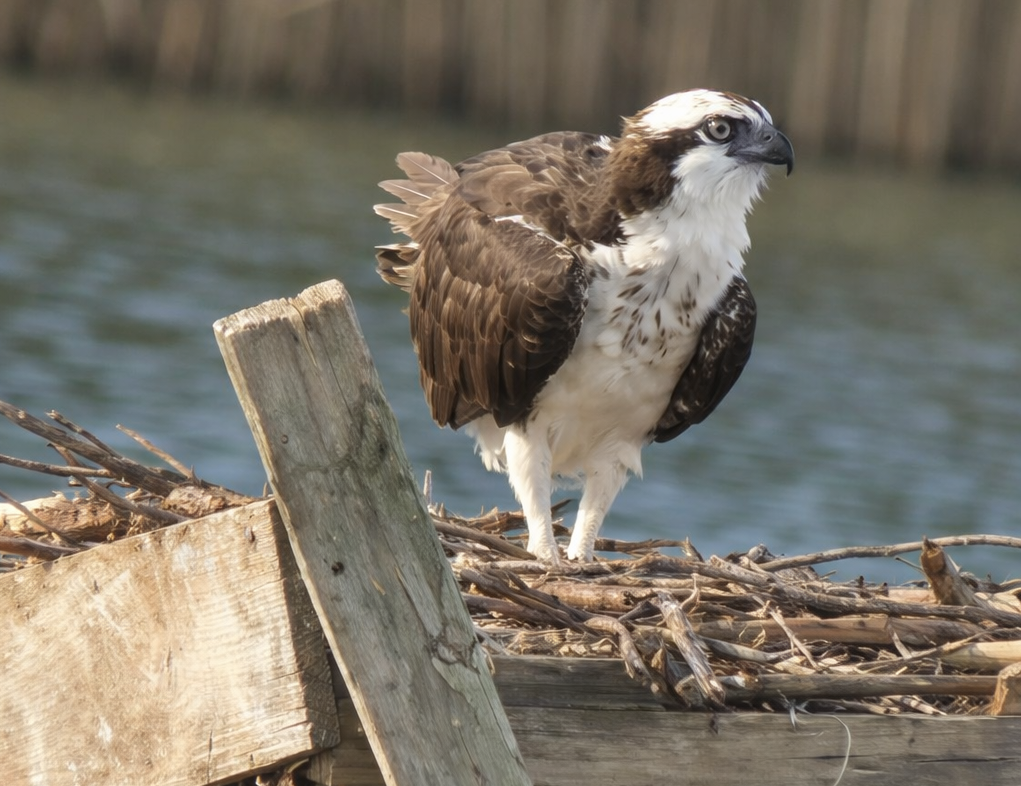
    At the top Ethel is with Mr. B on Nest 2, within the hour she hopped over to check on Nest 1, her distinctive topnotch shown here.

    Another tale, a new, young couple, Lily and Little Boy, took possession of the Bigs’ abandoned Nest 4 and also took Nest 3 from George.

    But the rest is mere real estate tittle tattle. The only news boils down to this, all the Ospreys on St. George Island abandoned their eggs in May.

    That ended the real estate shortage. The population crisis looked to be over.

    The catastrophe stretched up the Potomac, only subsiding as the river approached Washington, DC, which reported a boom year for Osprey fledglings.

    But online nests in New Jersey and Australia also experienced unexpected abandonment of eggs that parents had incubated to within a week or two of their hatching range. It felt like a DDT flashback.

    Note: Charter boat and conservation organizations have long blamed huge trawlers in the Atlantic for taking too many menhaden, the mainstay food of Ospreys and also Rockfish, a popular Chesapeake sport and commercial Bass. Current regulatory wrangling is following the historic tradition of wildlife preservation, indeed all conservation efforts, and many people are meeting about how too little, too late, if at all has been done.

     In the absence of either Perfect parent, I watched a big gull swallow an entire egg standing in the Perfects’ nest. What I wondered was, Where are all the gulls?

    For decades gulls had stopped my breath, turned my blood cold, peppered summers with screams of “maw-maw-maw” sounding for all the world like a child calling desperately for me.

    The 2025 episode of the enduring melodrama of Mark-8 and Ethel included a clutch of eggs they’d both incubated, in their extraordinarily casual manners, which might never have produced a chick. Regardless, they’d laid them late, remained some days beyond the general abandonment, then left. A gull got those eggs, too.

    Really. Where were all the gulls?

    Previous Episode  2024-4:  Weather Suspected

    Upcoming Episode 2025-2: Young Female Overturns Tradition

  • 2024-4:  Weather Suspected

    2024-4:  Weather Suspected

    Mrs. Perfect auditioned intruders and accepted a second Mr. Perfect the end of March, who was pretty perfect about Osprey male performance on all counts I could see. They hatched two chicks by June 11. The chicks didn’t survive past July 8, the date of the photo above, Mrs. Perfect on her nest.

    Beyond the five nests in front of the island house, the telescope reached the lips of four others. Nothing bobbed in 2024 above the lip of one, but hatchling heads had bobbed in the other three. Then they did not. Heat got tagged the culprit, abetting dehydration, a constant threat from the ever dwindling size of the also dwindling numbers of fish reaching the nests.

    Ospreys who had remained paired through the back-to-back years of nest failures fiddled with their nests for another few weeks and then, again, migrated early.

    Ethel had laid at least one egg in Mr. Bennet’s Nest 2 by the end of April, a clutch both had abandoned by mid-May, but neither abandoned the nest.

    Ethel visits Nest 2 in early- and mid-June. Mr. Bennet tolerates her but is not receptive.

    Mr. Bennet took to building a nest increasingly difficult to land or perch upon. Nevertheless, Ethel treated Nest 2 as her property as well as Nest 1. She called for fish from Nest 2 and from Mark-8’s pier. This produced no immediate results.

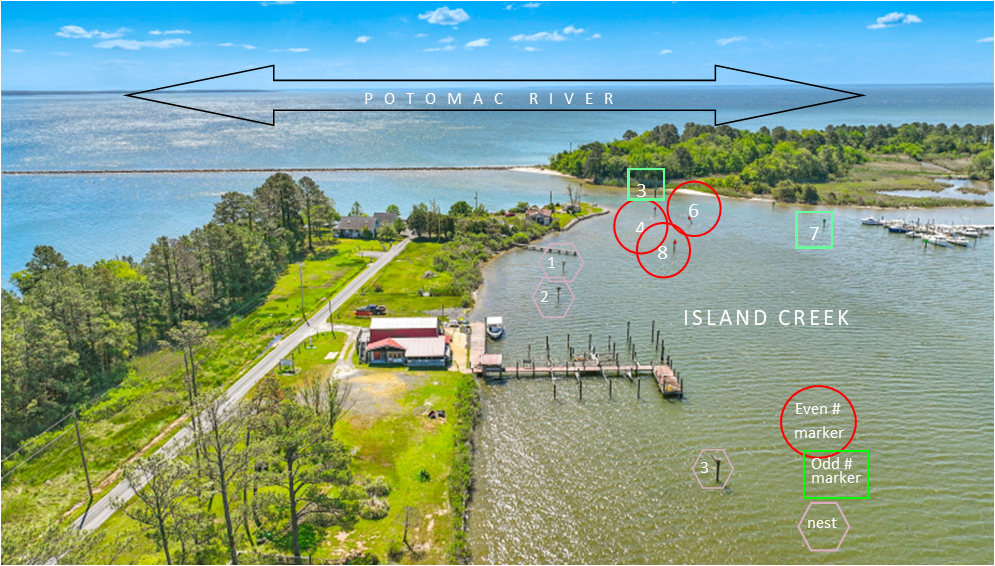
    I think she spent much of her time in the South Copse, a stand of tall pines the other side of the creek mouth that stretched to the river. I suspected Mark-6 had settled there after abandoning Marker 6 as a nesting platform as well as abandoning Marker 3, which has structural selling points, but because it operates a bright blinking light in its center.

    As the summer wore on, Mr. B began giving Ethel fish again.

    In 2022, Mr. B had fed Mrs. B, bite by bite, unhelpful and endearing. Mrs. B took each bite from him, turned and fed it to a hatchling, probably their bully. Watching had felt more intrusive than watching them mate.

    In 2024, a telescope wasn’t needed to follow Mr. B’s endearing and somewhat unhelpful building a nest approximating the shape of a beehive. He sky-danced above it, spiraling and squeeing. But it didn’t matter. Any interested female would be chased off by Ethel.

    Mr. B defends his nest toward the end of June.
    July 21, perch still visible

    So Mr. Bennet remained my favorite, long-suffering on top of many merits. He added to his nest through early September when he migrated.

    His nest lasted the winter to greet him in the spring. And, of course, greet Ethel as well.

    Previous episode 2024-3:  A Nest Too Far

    Upcoming Episode: 2025-1:  Where Are the Gulls?

  • 2021-2: An Exotic Girlfriend

    2021-2: An Exotic Girlfriend

    Mark-6, although finding Marker 6 an awkward nest platform, has unobstructed views out the mouth and up to the head of Island Creek.

    2021-What I Knew Then, What I Know Now-2026

    Note: With Ospreys, it’s all about the nest. Male Ospreys select the site, maybe gussy it up a bit with some sticks, then keen and circle above, advertising. They plunge toward the nest, swooping out of the dive as near as nerves allow. At first, in courtship, the dive is to convince a female to lay her eggs there. Once she’s in the nest, dives accompany fish deliveries and announce his prowess as far as his keening can reach. If matters progress to egg laying, this nest will imprint an exact address on both of them. Nest Site Fidelity, according to ornithologists, is a bigger deal to Osprey pairs than one another. They’ll meet back up next spring and the next and the next. But it’s not necessarily a forever after pact between the two of them. It has more to do with the success of the nest, measured by chicks fledged.

    Nest Site Fidelity might define thereafter, but partnering proved the Gang of Six’s winning strategy. The two prevailing males fought for their claim to a platform alongside a female, also staking her claim.

    Mark-6 had a partner. Perhaps less aggressive than the two females who allied with a male to claim a nest platform, or more poorly informed about the importance of a nest. Mark-6’s nest consisted of an occasional bundle of sticks poking from the top of the triangle. His girlfriend gamely visited, but preferred Marker 7, which as an odd-number was square, with the added advantage of being the other side of the creek from the rest of the gang.

    She was small for a female, compact like Mark 6. And also like him, a beauty. Her markings differed from the others, more dark feathers about her face, down her breast and stomach. She looked exotic next to the familiar, whiter faced, lacey necklaced females of Island Creek, including Mrs. Perfect and Mrs. Bennet. Ethel had a more pronounced bib than her neighbors, but it barely feathered her crop.

    Mating on Marker 6 proved tricky, but possible, unlike nest building, or transferring fish, which had a significantly greater success rate atop Marker 7. So they mated there as well. She even brought a few sticks to the square marker. But Mark-6 did not relocate. So, the inevitable occurred. In late April, the exotic little female went into labor without a nest.

    Previous Episode 2021-1: A Telescope, Anthropomorphism 

    Upcoming Episode 2021-3: Birds Labor Too  

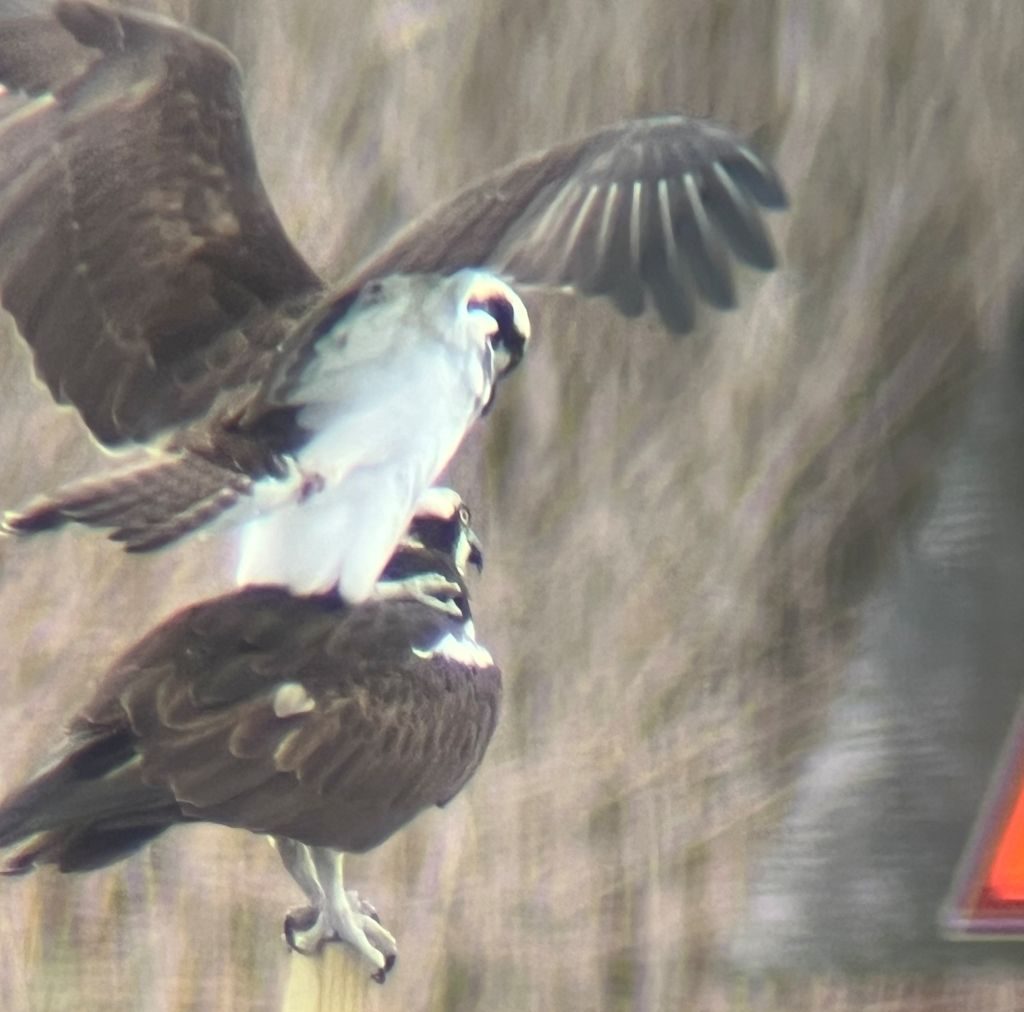
    Photo by author taken with an i-Phone clamped to the eye-piece of a telescope; photo at top is an AI Copilot “sharpened” version of this image
  • 2021-1: A Telescope, Anthropomorphism

    2021-1: A Telescope, Anthropomorphism

    2021-What I Knew Then, What I Know Now-2026

    In 2021 I acquired a telescope sufficient to discern particulars above the lips of the four nests out front. The 10 Osprey I’d erratically watched in 2020 returned and became distinct. So, I named them.

    I named them not only with anthropomorphic intent, but ignoble intent, matching an Osprey’s observed behavior to a reductive human stereotype. Speaking for myself, rude nicknames proved a helpful identification nomenclature.

    Note: Anthropomorphism is the attribution of human traits, emotions, or intentions to non-human entities. The inverse is the attribution of non-human entities’ traits, emotions, or intentions to humans, like boxers’ nicknames such as Pitbull and Tiger, according to a Stack Exchange Inc. contribution licensed by CC BY-SA. Then another contribution speculated inverse anthropomorphism was merely a mirror effect of our own anthropomorphism.

    The telescope confirmed three males and three females returned as the Gang of Six. Skirmishes resumed immediately for a nest site and perhaps also for a mate. But, really, I had no idea. Permanent pairing would seem to have gelled, or seemed near gelling, more or less, then everyone switched around. I second-guessed every identification, a rank amateur at birdwatching, at focusing, at all of this. And yet, unskilled, untrained, and undisciplined, even I saw that these birds were not monogamous.

    A good-looking banty male was exceptionally popular. He wound up odd-male out when the partnering and nest sorting did gel. He hightailed over to Intracoastal Marker 6, same side of the channel, centered in the two nests’ viewshed.

    He perched majestically at the tip of a red triangle of Red-Right-Returning fame. He dropped sticks down its 60-degree slope all season. He retrieved some he saw fall overboard, before they waterlogged. He dropped more sticks than all four of the gang members dropped on their two starter nests combined.

    He became Mark-6, as a bit of mockery. Later, learning more about birds’ individualized reproductive controls, I anthropomorphized that Mark-6’s building strategy opted him out of fatherhood, which must be thoroughly exhausting. It left time for Mark-6 to visit females on their nests as well as bring fish to a girlfriend of his own.

    His girlfriend could be spotted on Marker 6, making a go of what could be done at the tip of a triangle. And she also spent time on Marker 7, a square marker more stable. Who knows where else they mated, but the outcome presented a notorious name for Mark-6’s girlfriend. It really wasn’t female shaming. She simply needed something powerful working on her side.  


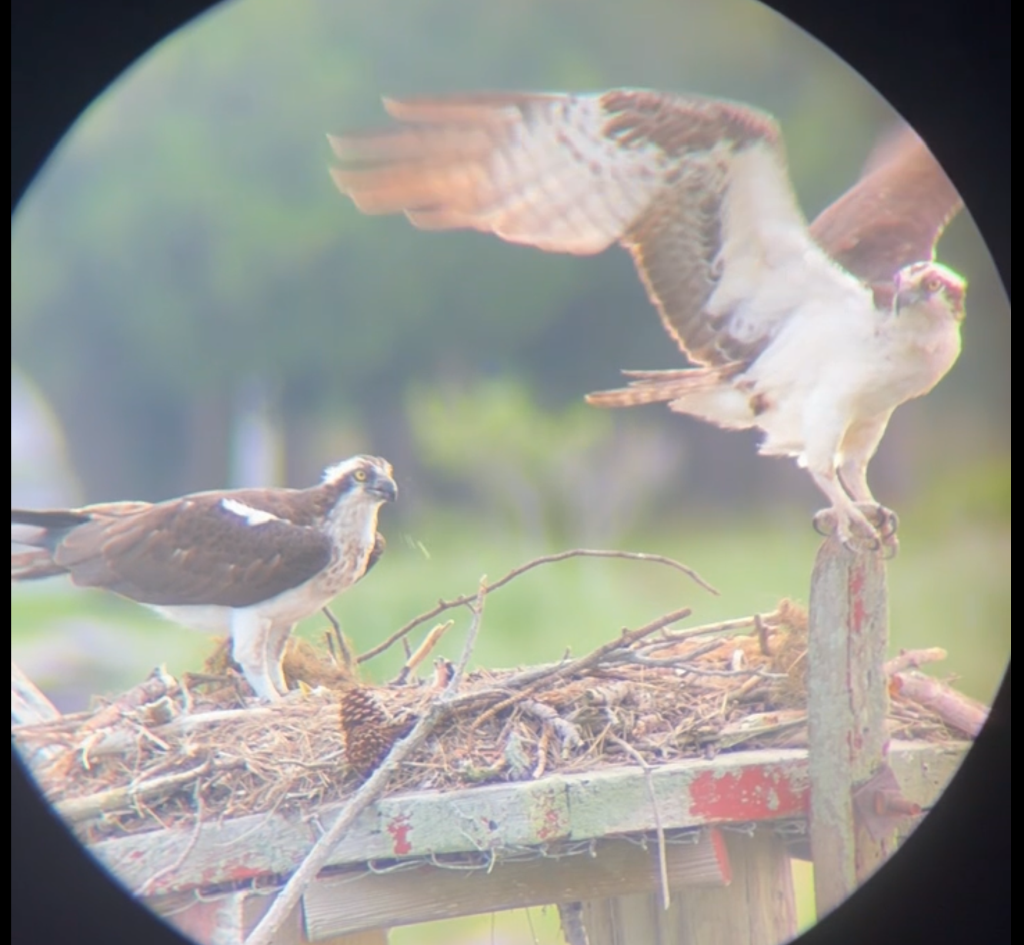
    These photos the author took with an i-Phone clamped to the eye-piece of a telescope. The photos at top and in the story were “sharpened” by AI Copilot.


  • 2020-3:  Feeding Ospreys

    2020-3:  Feeding Ospreys

    Photo by Paul Leibe, 1991, first Osprey nest installed in Island Creek in front of the island house.

    2020-What I Knew Then, What I Know Now-2026

    The returning Osprey grown-ups in nests out front of the island house performed their traditional seasonal tasks in my peripheral vision, beyond practical reach of the oystering binoculars. I wasn’t taking notes, but mentions of oddities made it to the dinner table.

    Note: The oystering binoculars were too large and heavy to hold steadily, let alone simultaneously focus. The Captain had used them to locate bird activity above water which suggests fish below, which might portend oysters beneath the fish. They were also used in the ancient waterman tradition of spying on the catches of other working boats. Powerful.

    The two nests out front traditionally fledged three chicks. The oldest nest had fledged four chicks a few times over its three occupied decades. The younger nest probably 15 years old by 2020, had fledged four at least once. The Captain insists the oldest nest fledged five one year, with his assistance.

    He’d rigged the top of a now-forbidden Styrofoam cooler to a line threaded through a pulley running from the shore to the nest’s piling. When the workboats landed their various catches at the dock, the Captain took junk fish, the waste from filets, even left over bait if it was fresh enough, and hauled it out to the piling.

    Once, the Captain tells, the Osprey dropped a stick on the head of a Seagull trying to steal the fish off the lid. The Seagull flew, the Osprey retrieved the fish and fed it to the kids.

    I didn’t think to take notes. This was dinner conversation. Like seeing flocks and flocks and flocks of Red-winged Blackbirds above their undulating shadow gliding along the tips of the marsh grass. We noted when they’d dwindled to only flocks. We noticed the Purple Martins return to the little white buckets the Captain strung along the pier, but failed for a long time to notice they no longer provoked crack-of-dawn noise complaints. We noticed the Ospreys return, laughed at their funny fledglings learning to fly, discussed the population increase.

    In 2019 a Bald Eagle made its way across the road to the side yard, appearing uninjured but unable to fly, and placidly waited in the yard as I called for assistance. I had to convince the intake ranger I could discern an Eagle from an Osprey for the dispatch of qualified help, which shortly arrived. Due to an over-abundant population in the region, injured Osprey no longer warranted official rescue.

    Note: Ospreys are going on 2 or 3 years old when they first attempt a return to their imprinted natal region. Ornithologist say only one in three makes it. Survival rate improves significantly after that.

     The jumped-up six-pack at the mouth of Island Creek represented the top third of the banner fledgling classes of 2017 and 2018. They’d contributed nothing to the 2020 fledge class. But in 2021, they will out fledge the older two nests. Among those fledglings will emerge a bully of legendary proportion, who will terrorize all occupants of Osprey nests up and down Island Creek.

    Bully came from Ethel’s nest. She always has the best stories.