Tag: Pine Borer beetles

  • 2025-3:  Ethel, Solo

    2025-3: Ethel, Solo

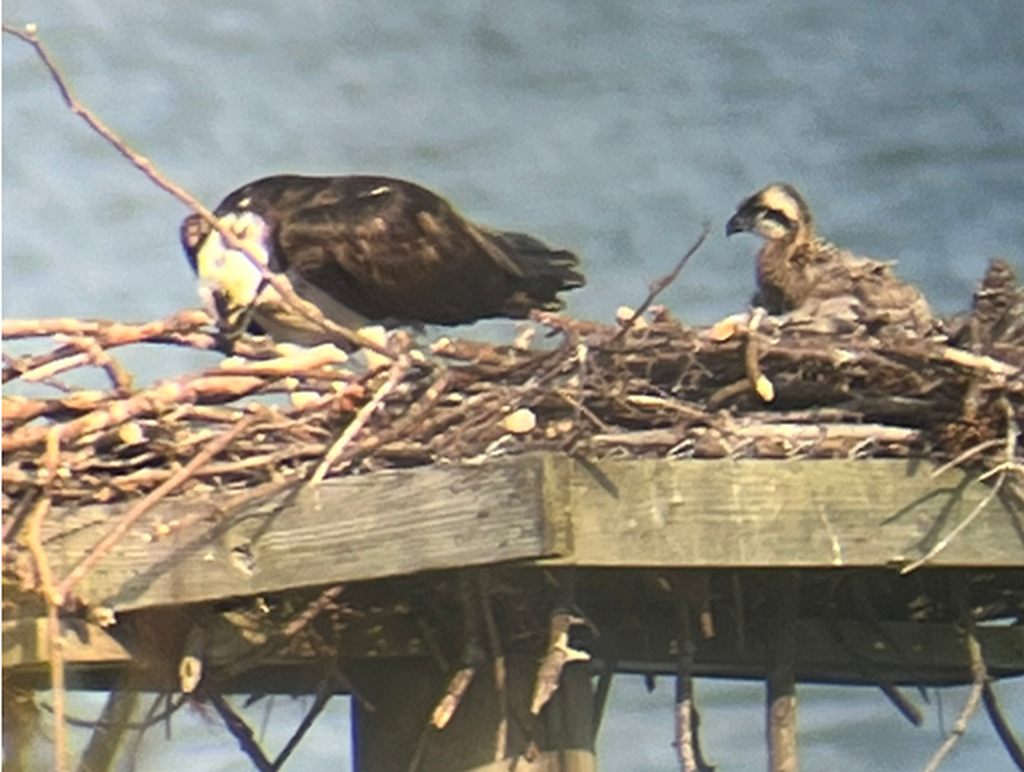
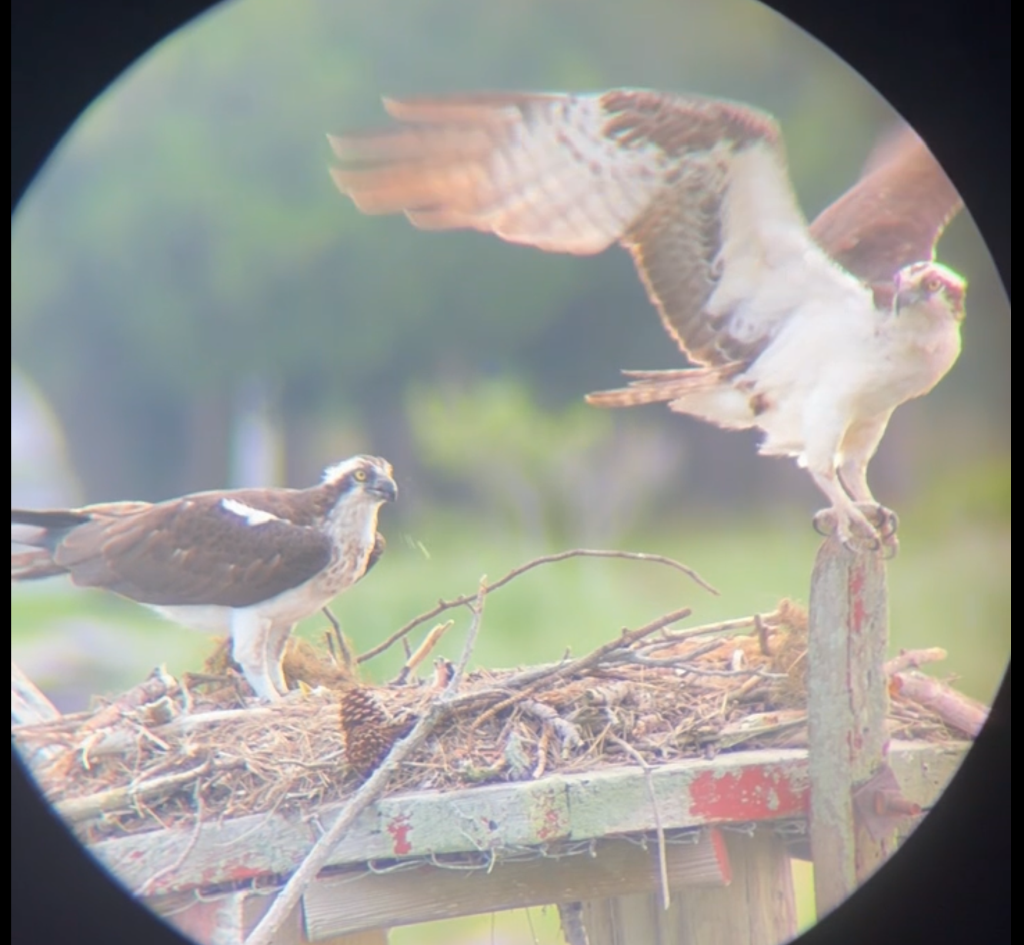
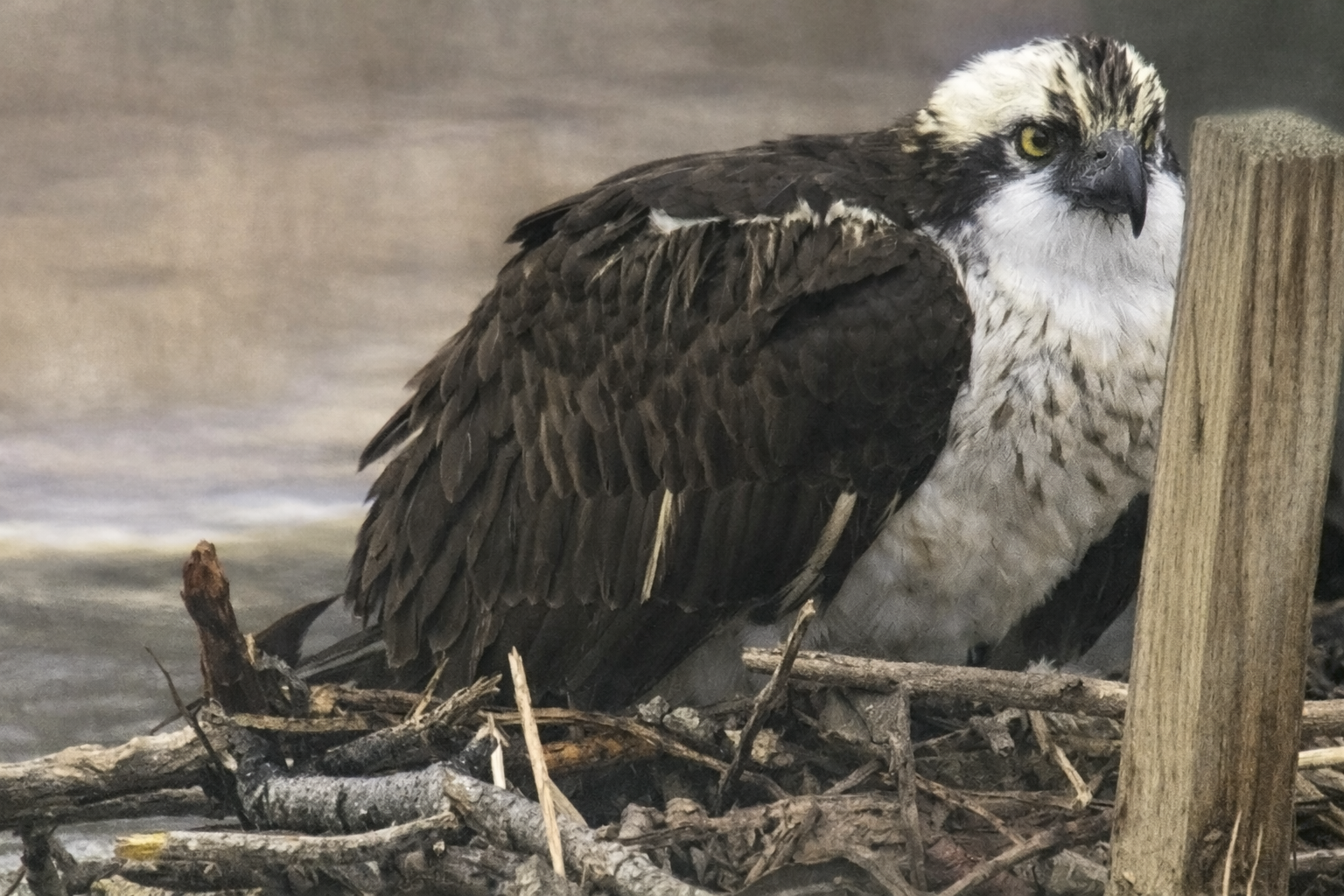
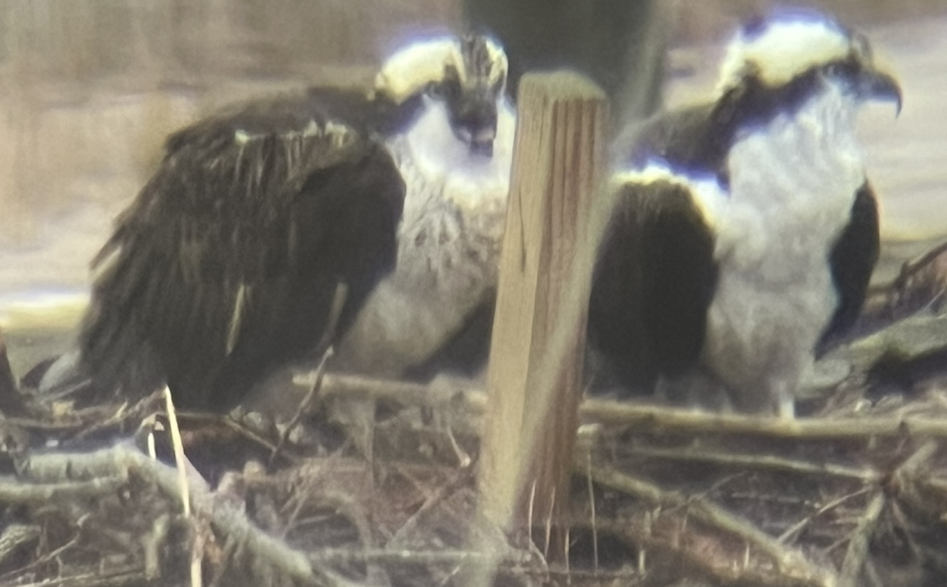
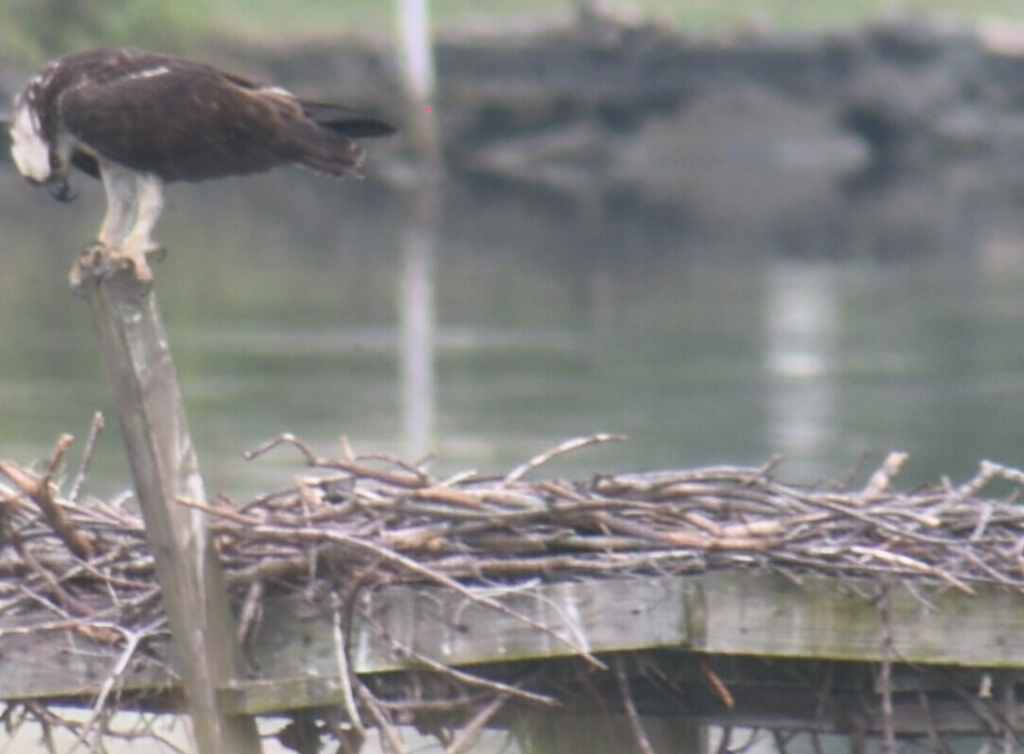
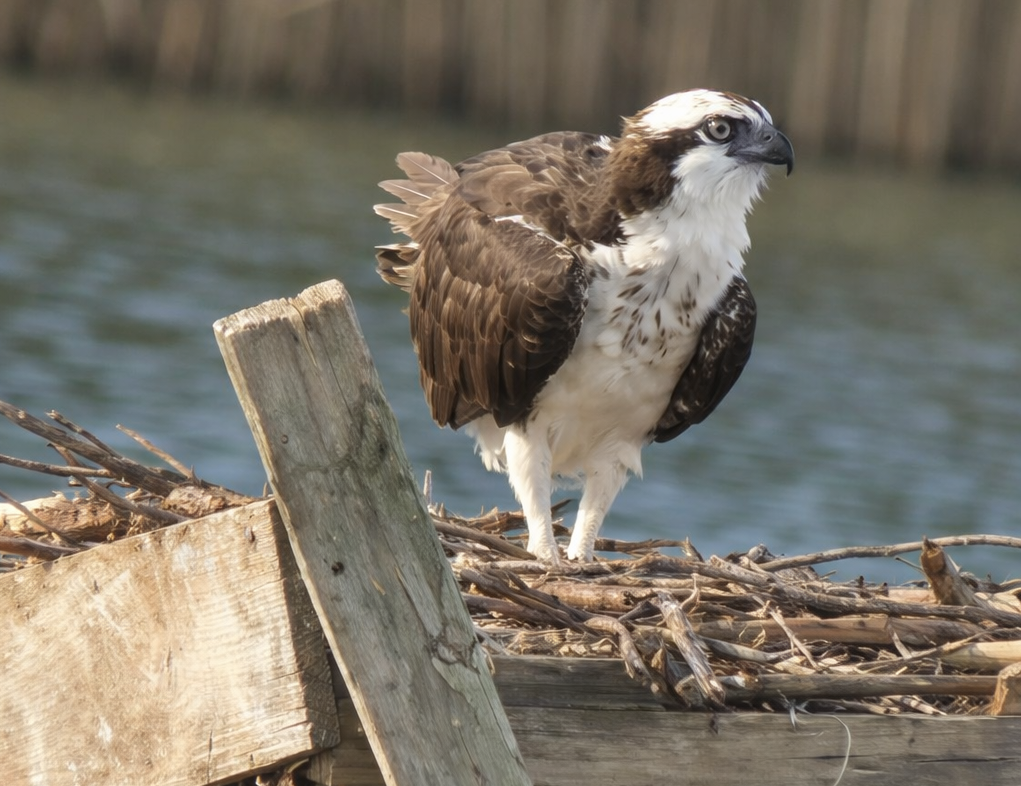
    Mark-8 was last sighted at Island Creek on June 2, 2025. This photo from April 2025 with focus sharpened by AI.
    Ethel on Nest 2.

    2025 – What I Knew Then, What I Know Now – 2026

    The loss of his and Ethel’s eggs proved the end of the line for Mark-8. He left within the first few days of June. Mr. Bennet had remained banished and neither male returned to Nest 1 or Nest 2.

    So, around the middle of June, Ethel invited Little Boy over for dinner, which he delivered. They did a bit of Nest 1/Nest 2 hopping, but Ethel preferred her meals delivered to Nest 2.

    LB also kept delivering fish to Lily on Nest 4 for a while, which she accepted, and then immediately threw him off the nest. When those deliveries tapered off, Lily became a self sufficient fisher. She dined on the top branch of the dead loblollies at the southern corner of North Copse, also part of her Nest 3/Nest 4 territory. She handily chased off Ethel, LB, and any other intruder on any piece of her territory.

    LB settled in with Ethel for the rest of the season and delivered fish. Ethel performed her unsynchronized swishing and at one point, after a mating visit with LB, shot out something that didn’t quite look like a regular PS—Poop Shoot, in the vernacular of online bird-cam chatterers.

    Note: Patricia Brennan, Associate Professor of Biological Science at Mount Holyoke, discovered, this century, that some birds have genitals. Previously, scientists believed a “kiss” of the multipurpose cloaca beneath each gender’s tail did the fertilization trick for all birds. The cloaca does it for Ospreys, giving the female significant control over the outcome.
    In response to my query about Ethel’s expulsion, Professor Brennan replied, “[F]emale cloacal control for sure! One of the consequences of most birds lacking a penis is that males really have to convince females to accept sperm and females really have to gape their cloaca. Otherwise they can eject it easily after mating as you have seen.”

    None of the Ospreys I watched acted like they planned to gear-up the reproductive equipment for a second try. They looked like hawks with the summer off. The 24/7 nest confinement had been lifted. They didn’t have to mate, feed chicks, or teach them to fly.


    At the end of 2025, two females held possession of two nests apiece on Island Creek.


    This made for the second year without a fledge class from Island Creek. In 2024, I had plenty of reasons explaining the loss of all the hatchlings. They’d been late hatches, unable to temperature regulate when parching weather hit, already diminishing fish supplies threatened dehydration. Lots of reasons.

    Not in 2025. What would inspire vast numbers of “Chesapeake” imprinted Ospreys, within the same fortnight, to abandoned their eggs?

    I also don’t know about Red-Winged Blackbirds, there were so many they’d cast a 10-acre shadow across the marsh as they readied themselves to feed. Now, a half-dozen are quick to the winter feeders on the back porch.

    Previous Episode 2025-02: Young Female Overturns Tradition
    Next Episode  2026-01: Almost Summer

  • 2025-2:  Young Female Overturns Tradition

    2025-2: Young Female Overturns Tradition

    2025 – What I Knew Then, What I Know Now – 2026

    A bold female acquired the recently vacated Bigs’ Nest 4 upon her March arrival. She was young, with dark feathers about her face and a full bib, reminiscent of Natasha. She quickly showed her intent to extend Nest 4’s territory to include Nest 3.

    I called her Little Lady, sexist commentary on a female commanding a traditionally male venue, anticipating her somehow toppled. I amended to Lily once she’d succeeded. Otherwise she’d confusingly be both F3 and F4 on the Excel chart. She’d singularly laid claim to the oldest nest its first fully-vacant season. Then she used two males to double her holdings.

    George was so proud of his nest in 2024, but lost it in 2025.

    George, muddled without Martha, courted Lily, who perhaps allowed his misperception while she made inroads into lassoing Nest 3 into her Nest 4 territory. Then she lassoed LB to evict George, cinching her new territorial boundaries.

    I’d actually named this new male Little Boy. LB in the new nomenclature since in a reversal of Lily, he had no nest. Not after Ethel entered his realm.

    Yes, Ethel truly is always in the story.

    Lily and LB met in early April, and hit it off big time, many times. Many, many times. They were probably 2- or 3-years old, building their first nest—and it looked like a first nest—arguing which platform to use. Lily insisted on Nest 4, which is of course where it went. But they did not relinquish Nest 3, treating it as a veranda to the main nest.

    George only maintained possession of a particular loblolly across the road. Losing his rights to Nest 3 seemed to have included the crossbar at the end of the pier as well.

    He visited the loblollies in the side yard–out my pandemic office windows–that had provided perches for him and Martha. The five trees were down to three by 2025, the perches a great deal more exposed. He preferred the copse across the street, with a sight line to his former nest.

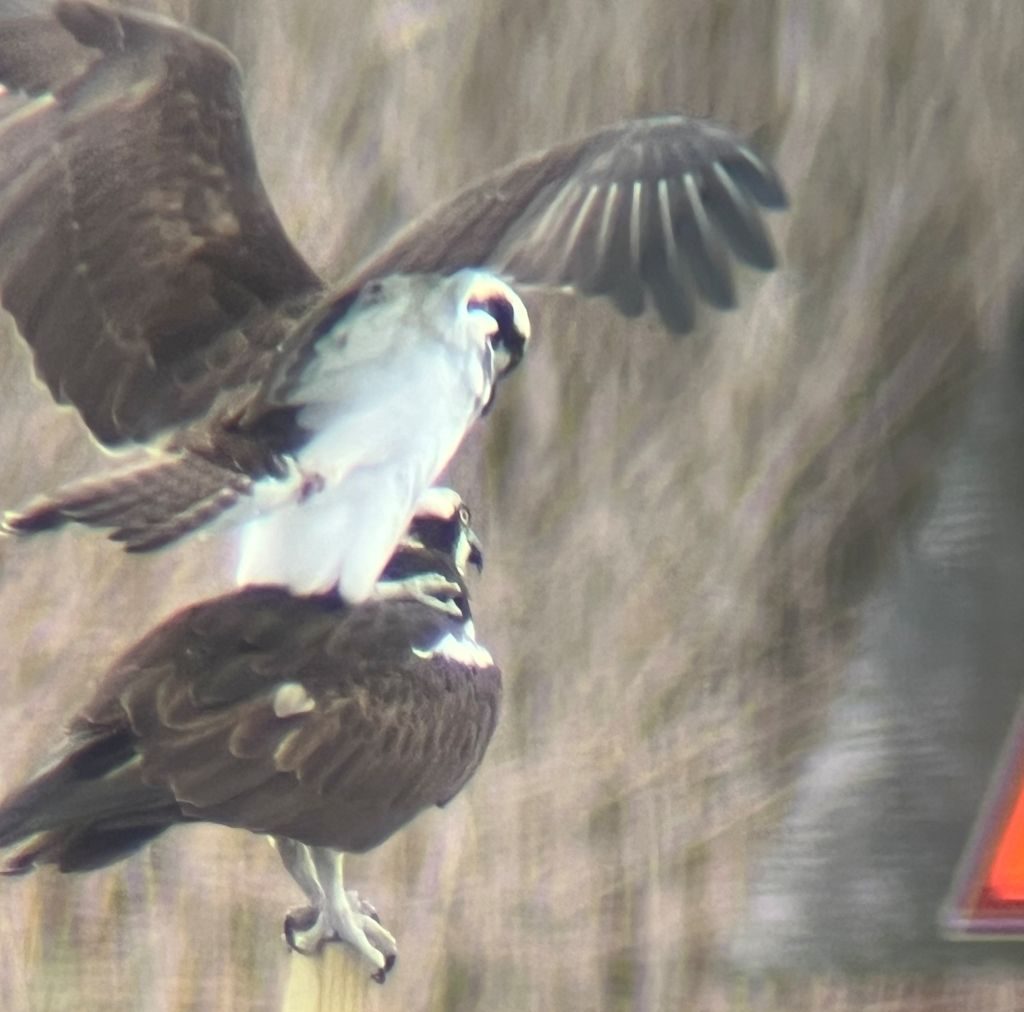
    The Osprey parents returned to their nests after the Gulls and Crows were sure to have scoured them. The pairs guarded their nests, tidied them, repaired and expanded them, and I saw a few lackadaisical attempts at mating. Probably only “bonding,” the catch-all verb for when males stand on females’ backs and do nothing but canvas the view or for the times mating fails to consummate.

    For a while, males kept up fish deliveries to females, tapering off on a timetable presumably established by each pair’s chemistry.

    Of course, that wasn’t how the year tapered out for Ethel.

    Previous episode  2025-01: Where Are the Gulls?

    Next episode  2025.3:  Ethel, Solo

  • 2025-01: Where Are the Gulls?

    2025-01: Where Are the Gulls?

    2025 – What I Knew Then, What I Know Now – 2026

    I didn’t think 2025 would arrive so quickly. I can delay its news with two romantic spring tales. For one, Mark-8 and Ethel met up at Nest 1. But this time when Ethel hopped back to Nest 2 and Mr. Bennet, Mark-8 persisted. Mark-8 won her back and banished Mr. B.

    Ethel retained possession of Nest 1 and Nest 2.

    At the top Ethel is with Mr. B on Nest 2, within the hour she hopped over to check on Nest 1, her distinctive topnotch shown here.

    For the other, a new, young couple, Lily and LB, took possession of the Bigs’ abandoned Nest 4 and also took Nest 3 from George.

    There’s a bit more to those tales, here and there, but most the rest is mere real estate tittle tattle. The only actual news boils down to this, the Ospreys on St. George Island abandoned their eggs the second half of May 2025.

    That ended the real estate shortage, the population crisis quenched. And the catastrophe stretched up the Potomac, only subsiding as the river approached Washington, DC, which reported a boom year for Osprey fledglings.

    But online nests in New Jersey and Australia also experienced unexpected abandonment of eggs  within a week or two of their hatching range. It felt like a DDT flashback.

    Note: Charter boat and conservation organizations have long blamed huge trawlers in the Atlantic for taking too many menhaden, the mainstay food of Ospreys and also Rockfish, a popular Chesapeake sport and commercial Bass. Current regulatory wrangling is following the historic tradition of wildlife preservation, indeed all conservation efforts, and many people are meeting about how too little, too late, if at all has been done.

     In the absence of either Perfect parent, I watched a big Seagull swallow an entire egg standing in the Perfects’ nest. What I wondered was, Where are all the Gulls?

    For decades Gulls had stopped my breath, turned my blood cold, peppered summers with screams of “maw-maw-maw” sounding for all the world like a child calling desperately for me.

    The 2025 episode of the enduring melodrama of Mark-8 and Ethel included a clutch of eggs they’d both incubated, in their extraordinarily casual manners, which might never have produced a chick. Regardless, they’d laid them late, remained some days beyond the general abandonment, then they also left. A Gull got those eggs, too.

    Really. Where were all the Gulls?

    Previous Episode  2024-4:  Weather Suspected

    Next Episode 2025-2: Young Female Overturns Tradition

  • 2024-4:  Weather Suspected

    2024-4:  Weather Suspected

    Mrs Perfect on the Nest 5 perch, after losing her chicks.

    2024 – What I Knew Then, What I Know Now – 2026

    Mrs. Perfect auditioned intruders and accepted a second Mr. Perfect the end of March. He was pretty perfect about Osprey male performance on all counts I could see. Two chicks were bobbing above the nest lip by June 11 but didn’t survive past July 8, the date of the photo above.

    Beyond the five nests in front of the island house, the telescope reached the lips of four others. Hatchling heads had bobbed in three. Then they did not. None had appeared in the fourth. Heat got tagged the culprit, abetting dehydration, a constant threat from the ever dwindling size of the also dwindling numbers of fish reaching the Ospreys’ nests.

    Ospreys who had remained paired through the back-to-back years of nest failures fiddled with their nests for another few weeks and then, again, migrated early.

    Although Ethel and Mr. Bennet had abandoned their egg in Nest 2, neither abandoned the nest.

    Ethel visits Nest 2 in early- and mid-June. Mr. Bennet tolerates her but is not receptive.

    Mr. Bennet took to constructing an increasingly inaccessible nest, difficult to land or perch upon. Nevertheless, Ethel treated Nest 2 as her property as well as Nest 1. She called for fish from Nest 2 and from Mark-8’s pier. This produced no immediate results.

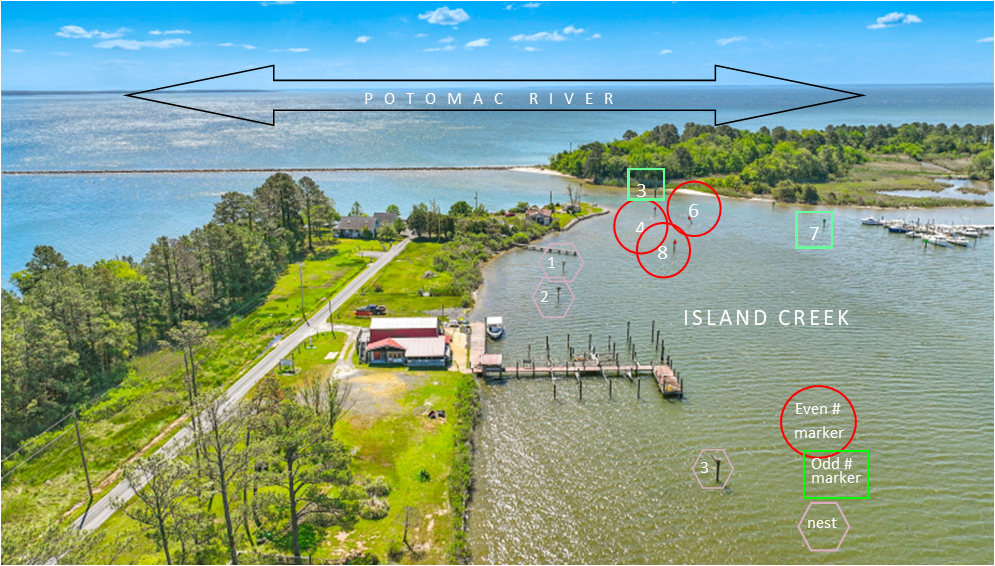
    Mark-6 atop Marker 3, which holds a substantial number of sticks. Mark-8 in his Nest 1.

    I think she spent much of her time in the South Copse, a stand of tall pines the other side of the creek mouth that stretched to the river. I had suspected Mark-6 settled there after abandoning Marker 6 as a nesting platform as well as abandoning Marker 3, which has structural selling points but also a blinking light at its center, perhaps why numerous past attempts failed at producing an active nest.

    As the summer wore on, Mr. B began giving Ethel fish again.

    In 2022, Mr. B had fed Mrs. B, bite by bite, unhelpful and endearing. Mrs. B took each bite from him, turned and fed it to a hatchling, probably their bully. Watching had felt more intrusive than watching them mate.

    In 2024, a telescope wasn’t needed to follow Mr. B’s endearing and somewhat unhelpful building of a nest approximating the shape of a beehive. He sky-danced above it, spiraling and squeeing. But it didn’t matter. Any interested female would be chased off by Ethel.

    Mr. B defends his nest toward the end of June.
    July 21, perch still visible

    So Mr. Bennet remained my favorite, long-suffering on top of many merits. He added to his nest through early September when he migrated.

    His nest lasted the winter to greet him in the spring. And, of course, greet Ethel as well.

    Previous episode 2024-3:  A Nest Too Far

    Next Episode: 2025-1:  Where Are the Gulls?

  • 2024-2:  Good for the Gander

    2024-2:  Good for the Gander

    Ethel, on Nest 2, calls out her greetings to the New Female on Nest 1. Mr. Bennet stands behind Ethel.

    After Mark-8 threw her off Nest 1, Ethel settled into Nest 2 and Mr. Bennet brought her fish. Then Mark-8 brought a new female to Nest 1. Ethel freaked out. She flew between Nest 2 and Marker 8 over and over and over. Mr. B finally calmed her with more fish.

    The new female settled into Nest 1. Ethel laid an egg in Nest 2. Mark-8 dive bombed Ethel as she incubated. Henceforth, New Female followed every time Ethel left Nest 2; followed her out, followed her back. A few times New Female dive bombed Ethel on Nest 2, as Mark-8 had done.

    Mr. Bennet and Ethel failed to form a commitment.

    Mr. B split a day or two before Mother’s Day when Ethel left Nest 2 long enough for two Canada geese to stomp flat anything inside before going on their way. Ethel split the next day. Thus began something akin to the musical chairs game.

    Mr. B returned a few days later to a whirl of popularity, including food begging from Mark-8’s New Female.

    Mark-8 “mantling” his food to protect it from theft. Probably New Female on the pier with him. The female on Nest 1 is unknown, she could even be Natasha, she has a dark bib and face. But she’s not Ethel who is screaming at them from Nest 2, shown in photo above.

    Ethel reappeared, shooed New Female and Yet Another female off Nest 2. She and Mr. B tried again to commit. Mr. B tried again to dump her. But Ethel never severed ties with a male who had once delivered fish.

    And Ethel had laid an egg in Nest 2, which has appeared to Osprey observers to impart a sense of proprietorship. Mr. B appeared to accept Ethel’s presence in his nest as legitimate, though he no longer treated her as a mate, he also didn’t try to push her off.

    I named Mark-8’s new mate, a bit awkward, like your friend’s ex-husband’s new wife. They’d laid no eggs but they lasted the season. Plus, I wanted to try out my new nomenclature. I named her NF1 for New Female, Nest 1.

    In weird 2024, it had seemed the right time to funnel into an Excel doc my variously detailed (and not) observations regarding the 10 Ospreys I’d named. As I’ve done regarding everything for my entire life, the notes were jotted on paper scraps, my phone, in  blah-blah-blah yuk on the laptop, even in quasi organized logs in random and unorganized notebooks.

    Previous Episode: 2024-1: A Population Blip
    Next Episode: 2024.3:  A Nest Too Far

  • 2024-1:  A Population Blip

    2024-1:  A Population Blip

    2024 – What I Knew Then, What I Know Now – 2026

    Note: Pine borer beetles are always with us, arborists explain, but healthy trees fight them off. Trees stressed by drought, salt water intrusion, or soil compaction will lose.

    By 2024, the pine borers on St. George Island had been at it a quarter century, quietly thinning the copses one or two spindly loblollies at a time, such as in the foreground above. Gaps had started to show among the pines on the lower side of the island. Among the trees shone towering skeletons of trunks and branches stripped of bark and bleached white as bone. Turned out the beetles had been thinning the copses to death.

    Something else. In 2024, the Osprey population of St. George Island probably wasn’t the largest ever for probably the first time since the outlawing of DDT in 1972. For one, Mrs. Bennet didn’t return. Neither did Mr. Perfect. Which, in retrospect, might explain why the earliest early birds didn’t arrive early: Mrs. Perfect on March 12 and Mr. Bennet not until April 7.

    Ethel arrived the day after Mrs. Perfect and immediately began soliciting for a new mate, which she got. He delivered sticks and fish to the nest until Mark-8 showed up a couple weeks later and threw him off.

    Ethel returns to Nest 1 after Mark-8 arrived and chased off the male who made the nest’s  foundation of sticks seen here.

    Ethel had watched from Nest 2, not yet occupied, and returned promptly to Nest 1 once Mark-8 banished her suitor. Then Ethel and Mark-8 had an interlude. He sky-danced above her. They mated. He delivered lots of fish, which Ethel carried to Nest 2 to dine upon. Mark-8 brought sticks to Nest 1. They even got broody, hunkering down as if incubating. Until Mr. Bennet returned on April 7.

    Ethel stayed on Nest 1, called for fish as usual, until the sun went down. Unusual was that Mark-8 also remained all day on Nest 1, watching Mr. B instead of fishing.

    By the end of his arrival day, Mr. Bennet had brought numerous fresh sticks to Nest 2 and eaten three fish on his traditional Dining Pole, nothing like the hovering Dock Pole, but still an unobstructed view of Nests 1 and 2 as he dined.

    Mark-8 fished the next morning and ate his entire fish on the small pier by Nest 1 as Ethel called. Once Mark-8 had swallowed the fishtail, Ethel jumped to Nest 2.

    She hopped from one nest to the other all day, begging from the nest of whichever male was in the neighborhood with a fish. She once allowed Mr. B to mate, which did not produce a fish. She  was uncooperative at his second attempt.

    She headed home to Nest 1 in the afternoon and Mark-8 kicked her out, by which I mean, lifted his talons in the air and shoved them against her back and sent her overboard.

    Previous Episode 2023.3:  Mrs. Bennet Guts It Out

    Next Episode  2024-2: Good for the Gander

  • 2023-2: Ethel Remains Liberated

    2023-2: Ethel Remains Liberated

    Ethel waits patiently for Mark-8 to abandon his efforts at seduction.

    When Mrs. Bennet split upon the arrival of Ethel back to Island Creek, Ethel took the opportunity to fly right into Nest 2 that Mrs. B had abandoned. Nearly immediately, Ethel began fighting a female intruder hopping between Nest 1 and Nest 2.

    Mr. Bennet did not engage in the battle, he perched at the lip of his Nest 2 and let Ethel handle the pushing and shoving.

    Note: Ospreys more enthusiastically remove an intruder of their own gender than the opposite, but they will ultimately get rid of any intruder imposing upon their territory.

    Mark-8 wasn’t anywhere to be seen. And when the intruding female hopped to Nest 1, Ethel fought her off that nest  as well. But Ethel mostly remained on Nest 2. She allowed Mr. B to mount her a few times and presented him with the same noncompliant behavior she’d given Mark-8.

    By shifting her weight, Ethel could knock a male off balance and sometimes off her back entirely. Often that was the end of matters. When she leaned forward with a flat back, flat as a tabletop, she did not drop her head or lift her tail. Flat. When matters chanced to reach the stage of tail swishing, every view I caught, suggested she swished counterpoint to the needs of the male’s flailing tail.

    Mr. Bennet, who had been happily mating away with Mrs. Bennet, had been abandoned by his preferred mate, twice, and was now being messed with by the bird who’d possibly caused it. He went fishing.


    He returned with his fish and ate it all, perched atop the Dock Pole, where he could look down into Nest 2, not 50 feet away. He ate the fish as he watched Ethel beg from the nest below. When he’d finished the fish he left and returned with another fish and did it again. And then he did it all yet again.

    The day after Mr. B’s solo fish feast, on April 1, Mrs. Bennet returned and sent the females packing, which included not only Ethel but the recently arrived Martha. Although George had also returned, Martha hadn’t yet touched down on the hot mess of his beloved Purple Martin hotel.

    Previous episode 2023-2: Big Mama Attacked

    Next Episode 2023.3  Mrs. Bennet Guts It Out

  • 2023-1: Big Mama Attacked

    2023-1: Big Mama Attacked

    2023 – What I Knew Then, What I Know Now – 2026

    The Bennets and Perfects arrived even earlier than the previous year. Big Mama arrived  March 18, Big Daddy two days later, they were mating by March 21.

    On March 26, far from the first time this season, Big Mama rocketed into the air to repulse an intruder. They became entangled and dropped into the water still intertwined. The intruder flew practically at the moment of the splash.

    Big Mama floated beneath her nest, head up and wings outstretched, surely no more than two or three minutes. It felt an hour watching. She struggled and failed to pull herself out of the water twice, every feather drenched, even her head, she’d clearly completely submerged. She lifted free on her third try and reached her nest. She had a brightly bleeding gash down her breast.

    Big Mama, left, has butterscotch colored eyes, Big Daddy on right.

    She healed within a month to no apparent ill effect, wasn’t so fierce and stopped rocketing off her nest.

    The Perfects and Bennets further than ever ahead of schedule, arrived the first week of March. Fishing was stupendous. I watched Mr. B deliver a fish in each foot mid-March. Later that day the male on the nest to the north of the Perfects did the same.

    Fish, tall pines, scores of man-made platforms continued to draw youngsters, this year’s from successful “Chesapeake” imprinted fledge classes of ’20 and ’21.

    Measured birds per square foot, St. George Island really might have been the Osprey Capital of the World.

    The day Big Mama got slashed, Mark-8 made his dramatic arrival, streaking out of the water bushes at the shore and smashing an intruder off Nest 1.

    At that eruption next door, Mrs. Bennet split and didn’t return to her Nest 2 until the next day. And then refused to resume the mating regiment of the past three weeks with Mr. Bennet. She relented the next day, March 28, the same day Ethel returned. And Mrs. B split again.

    Previous Episode 2022-5:  Ethel Was Liberated

    Next Episode 2023-2: Ethel Remains Liberated

  • 2022-5:  Ethel Was Liberated

    2022-5:  Ethel Was Liberated

    Ethel, in the nest, and Mark-8 perched above, don’t seem to be really into one another.

    2022 – What I Knew Then, What I Know Now – 2026

    Osprey dung had become an obvious problem by 2022. It eats the paint off cars, porches, everything. A windshield count identified 60 nests on the island, add a conservative third again for nests invisible from the road and those invisible staring straight at them.

    The Captain, again, proclaimed St. George Island the Osprey Capital of the World.

    Even so, only two of the four nests out front creek fledged Ospreys that year. Ethel brooded a few days in April, abandoned that effort. In June, as eggs in Island Creek nests started hatching, Ethel and Mark-8 hunkered a second time for some serious incubation. Lasted a week. Ethel split when fish deliveries halted. She returned after geese spent a few hours stomping anything in the bottom of that nest to smithereens.

    Mark-6 continued to slide sticks down triangular Marker 6 and visited Nests 1 and 2 when the males were absent. Twice I saw Mrs. B and Mark-6 breezily land side by side on Nest 2, like they’d just flown in from grabbing a quick drink. Mark-6 loitered briefly, Mrs. B was friendly, he flew off.

    Likely Ethel’s chasing Mark-6 off her nest was actually following him into the South Copse. Although I hadn’t realized, in 2022, Ethel had returned from wintering in Central America as a free agent.

    On July 12, the same day, Mr. B gave Mrs. B a fish to welcome her return, Mark-8 gave a fish to Ethel. There was a full moon, daylight hours waning, fishing had picked up, for whatever it’s worth.

    Mark-8 had begun eating his fish on a low pier very near Nest 1. Ethel’s best chance for a piece was to wait in the nest. If she dropped down to the pier, he flew with his fish. The gulls, his ever present sentinels, cleaned up the pier. Once, with Ethel watching and calling, Mark-8 left a chunk of fish on the pier. The gulls were on it before his talons left the planking.

    Both remained committed to that nest, still battling as allies against any intruders eyeing Nest 1.

    The Osprey population increased every year, real estate naturally grew scarcer, and the trend continued into 2023. That season will have barely begun when an intruder rips Big Mama’s chest open, leaving her floating in the creek.

    Previous Episode:  2022-4: Best to Lay by Early May

    Upcoming Episode: 2023-1: Big Mama Attacked

  • 2022-4: Best to Lay by Early May

    2022-4: Best to Lay by Early May

    2022 – What I Knew Then, What I Know Now – 2026

    Note: In the Chesapeake, best to lay eggs by early May. It’s 37-ish days to hatch, another 55 to fledge. Then the kids have to learn enough about fishing and flying to survive migration.
    Osprey typically lay clutches of three, sometimes four eggs, frequently wait for the third to begin 24-7 incubation, which is performed primarily by the female. Males fish, deliver food to the nest, and to varying degrees help with incubation. Some males are assertively broody. Some are Indeed-by-God not.

     Mrs. Bennet had laid her third egg five days before George and Martha arrived. Ten days after their arrival she stopped incubating.

    Two weeks later an attempted resumption of affections between the Bennets faltered. For the next two months, Mrs. B absented herself for days at a time and then other females paraded through Nest 2. Mr. B was slow to escort them off but he ultimately did.

    Mrs. B returned July 12. Mr. B brought her the last fish I saw him deliver that season. She shooed any remaining females away and they shared the nest, platonic as far as I noted. Presumably they fished for themselves.

    Upstream was a different scene. By May 9, Mrs. Perfect was feeding a chick. By the 21st she had four chicks, the elders bullied the youngers. Mrs. Perfect configured the nest to separate the two youngers where they were no longer attacked but no longer competed for food. By the end of the month the pen was dismantled and the Perfects ultimately and efficiently fledged two chicks.

    Mrs Perfect and the two Perfect chicks await a fish delivery from Mr Perfect

    The Bigs hatched three chicks in the familiar pattern, the first a bully, the third quickly perished, the number two a survivor. The chicks were well fed, bullying diminished, and both fledged.

    The combined Big and Perfect chicks began fledging the second week in July with all four flying in early August. They landed in one another’s nests, wherever food arrived. The second Big to fledge flew straight into Mrs. Bennet on Nest 2, and got promptly booted home. But the adults in the nests upstream, after some initial consternation, fed whoever showed up.

    Ethel and Mark-8 handled the breeding season differently. Ethel had been liberated.

    Photo by author, taken with iPhone clamped to telescope. Version at top was “sharpened” by Copilot AI.

    Previous Episode 2022-3: Territorial Negotiations

    Next Episode:  2022-5:  Ethel Was Liberated