Tag: Mrs B

  • 2021-3: Birds Labor Too

    2021-3: Birds Labor Too

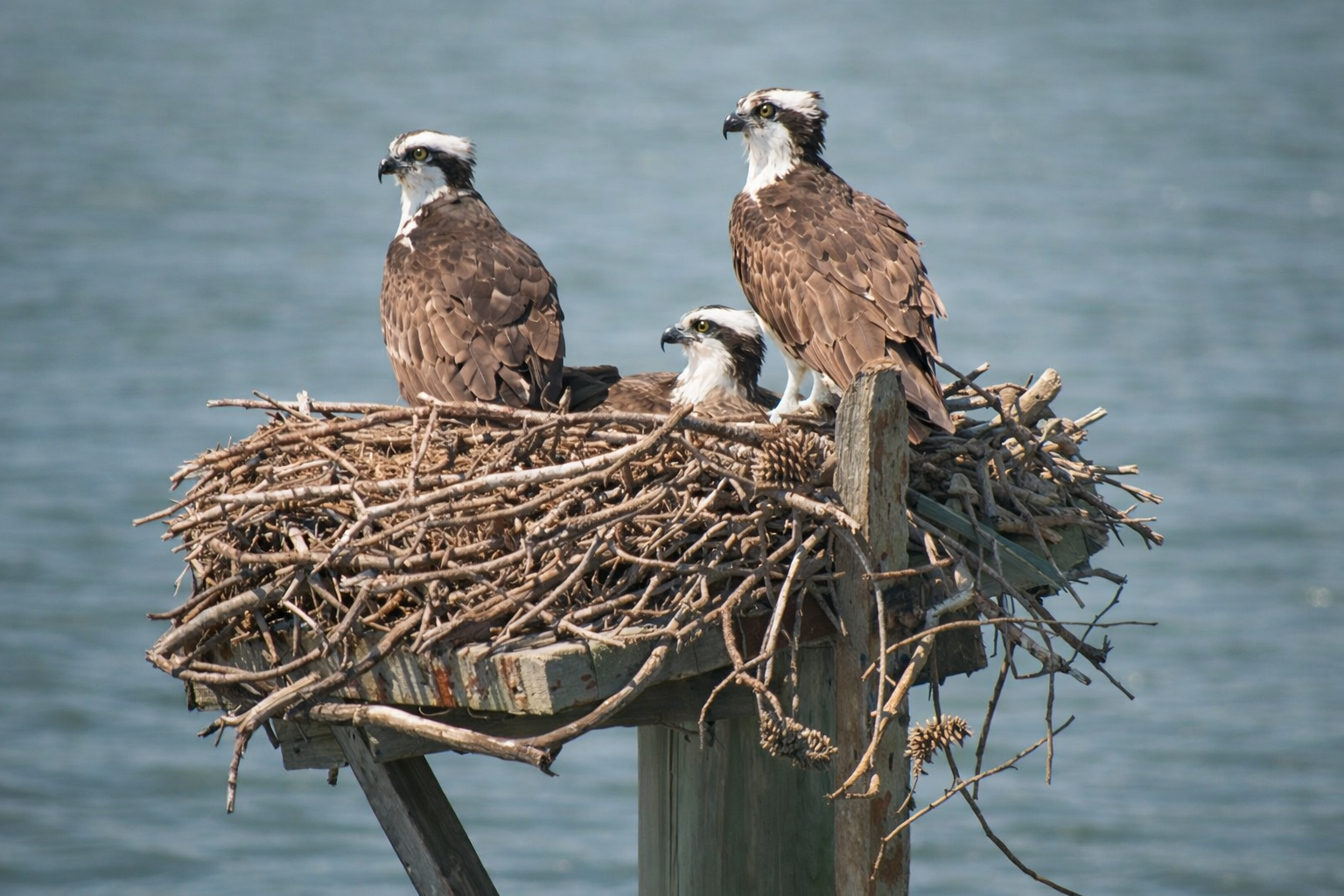
    Natasha, between Big Daddy (L) and Big Mama, takes a breather after laying another egg in another Osprey pair’s nest.

    2021-What I Knew Then, What I Know Now-2026

    A bird about to lay an egg resembles most animals going through labor, intensely focused on the pressing situation, jumpy even in the comfort of her own nest. The subsequent melodrama of laying an egg, for the first time, without a nest, looked pitiable and shameful. Wanton. [Refer to anthropomorphism 2021-1.] She needed a notorious name: Natasha.

    I conjured Natasha Fatale, spy of the Moose and Squirrel show, something edgy to offset my awfulness of practicing voyeurism on trauma. This gal deserved a spicy name.

    Natasha’s debacle began at dusk the third week of April when Ethel alerted the neighborhood of disaster. Natasha had landed in Nest 1, Ethel’s nest, ready to lay an egg.

    Ethel hadn’t yet been named nor had the nests been numbered, but well prior to all of that, it was universally known, even by me,  that the bird I would come to call Ethel possessed the nest to later be designated Nest 1. And before Natasha had a chance to push an egg out, Ethel pushed her off it.

    Natasha flapped her way 50 feet to Nest 2, where the accommodating male and less accommodating female backed away. Natasha set upon the platform’s lower edge, closest to Nest 1, and laid her egg. Then the resident Nest 2 female pushed her off that nest, too.

    Three days later—right on Osprey-laying-target, Natasha landed in the oldest nest, occupied for many years by the Bigs. These two remain the biggest, respectively, male and female Ospreys I’ve ever seen. Big Daddy, big and blustering, was easy naming.

    Big Mama seemed a stretch, until both Bigs let Natasha labor, lay her egg, and this older, aggressive female let Natasha incubate alongside her and rest after her ordeal.

    I appended “Mama” because of that kindness. Plus, given her less than traditional mothering behavior, there was a tad of sarcasm.

    Big Mama was aggressive and hair-triggered when repelling intruders from her nest. Much more in character, once Natasha had rested sufficiently to be standing, Big Mama threw her off.

    As soon as Natasha quit circling, Big Mama tidied up and settled into incubating, possibly the Cuckoo egg as well.

    I have no further record of Natasha.

    Big Mama settles in after Natasha quits circling, enhances the nest bowl with a twig and sets to incubating.


    Previous Episode 2021.2: An Exotic Girlfriend

    Upcoming Episode 2021.4: Pride and Prejudice 


  • 2021-2: An Exotic Girlfriend

    2021-2: An Exotic Girlfriend

    Mark-6, although finding Marker 6 an awkward nest platform, has unobstructed views out the mouth and up to the head of Island Creek.

    2021-What I Knew Then, What I Know Now-2026

    Note: With Ospreys, it’s all about the nest. Male Ospreys select the site, maybe gussy it up a bit with some sticks, then keen and circle above, advertising. They plunge toward the nest, swooping out of the dive as near as nerves allow. At first, in courtship, the dive is to convince a female to lay her eggs there. Once she’s in the nest, dives accompany fish deliveries and announce his prowess as far as his keening can reach. If matters progress to egg laying, this nest will imprint an exact address on both of them. Nest Site Fidelity, according to ornithologists, is a bigger deal to Osprey pairs than one another. They’ll meet back up next spring and the next and the next. But it’s not necessarily a forever after pact between the two of them. It has more to do with the success of the nest, measured by chicks fledged.

    Nest Site Fidelity might define thereafter, but partnering proved the Gang of Six’s winning strategy. The two prevailing males fought for their claim to a platform alongside a female, also staking her claim.

    Mark-6 had a partner. Perhaps less aggressive than the two females who allied with a male to claim a nest platform, or more poorly informed about the importance of a nest. Mark-6’s nest consisted of an occasional bundle of sticks poking from the top of the triangle. His girlfriend gamely visited, but preferred Marker 7, which as an odd-number was square, with the added advantage of being the other side of the creek from the rest of the gang.

    She was small for a female, compact like Mark 6. And also like him, a beauty. Her markings differed from the others, more dark feathers about her face, down her breast and stomach. She looked exotic next to the familiar, whiter faced, lacey necklaced females of Island Creek, including Mrs. Perfect and Mrs. Bennet. Ethel had a more pronounced bib than her neighbors, but it barely feathered her crop.

    Mating on Marker 6 proved tricky, but possible, unlike nest building, or transferring fish, which had a significantly greater success rate atop Marker 7. So they mated there as well. She even brought a few sticks to the square marker. But Mark-6 did not relocate. So, the inevitable occurred. In late April, the exotic little female went into labor without a nest.

    Previous Episode 2021-1: A Telescope, Anthropomorphism 

    Upcoming Episode 2021-3: Birds Labor Too  

    Photo by author taken with an i-Phone clamped to the eye-piece of a telescope; photo at top is an AI Copilot “sharpened” version of this image
  • 2020-3:  Feeding Ospreys

    2020-3:  Feeding Ospreys

    Photo by Paul Leibe, 1991, first Osprey nest installed in Island Creek in front of the island house.

    2020-What I Knew Then, What I Know Now-2026

    The returning Osprey grown-ups in nests out front of the island house performed their traditional seasonal tasks in my peripheral vision, beyond practical reach of the oystering binoculars. I wasn’t taking notes, but mentions of oddities made it to the dinner table.

    Note: The oystering binoculars were too large and heavy to hold steadily, let alone simultaneously focus. The Captain had used them to locate bird activity above water which suggests fish below, which might portend oysters beneath the fish. They were also used in the ancient waterman tradition of spying on the catches of other working boats. Powerful.

    The two nests out front traditionally fledged three chicks. The oldest nest had fledged four chicks a few times over its three occupied decades. The younger nest probably 15 years old by 2020, had fledged four at least once. The Captain insists the oldest nest fledged five one year, with his assistance.

    He’d rigged the top of a now-forbidden Styrofoam cooler to a line threaded through a pulley running from the shore to the nest’s piling. When the workboats landed their various catches at the dock, the Captain took junk fish, the waste from filets, even left over bait if it was fresh enough, and hauled it out to the piling.

    Once, the Captain tells, the Osprey dropped a stick on the head of a Seagull trying to steal the fish off the lid. The Seagull flew, the Osprey retrieved the fish and fed it to the kids.

    I didn’t think to take notes. This was dinner conversation. Like seeing flocks and flocks and flocks of Red-winged Blackbirds above their undulating shadow gliding along the tips of the marsh grass. We noted when they’d dwindled to only flocks. We noticed the Purple Martins return to the little white buckets the Captain strung along the pier, but failed for a long time to notice they no longer provoked crack-of-dawn noise complaints. We noticed the Ospreys return, laughed at their funny fledglings learning to fly, discussed the population increase.

    In 2019 a Bald Eagle made its way across the road to the side yard, appearing uninjured but unable to fly, and placidly waited in the yard as I called for assistance. I had to convince the intake ranger I could discern an Eagle from an Osprey for the dispatch of qualified help, which shortly arrived. Due to an over-abundant population in the region, injured Osprey no longer warranted official rescue.

    Note: Ospreys are going on 2 or 3 years old when they first attempt a return to their imprinted natal region. Ornithologist say only one in three makes it. Survival rate improves significantly after that.

     The jumped-up six-pack at the mouth of Island Creek represented the top third of the banner fledgling classes of 2017 and 2018. They’d contributed nothing to the 2020 fledge class. But in 2021, they will out fledge the older two nests. Among those fledglings will emerge a bully of legendary proportion, who will terrorize all occupants of Osprey nests up and down Island Creek.

    Bully came from Ethel’s nest. She always has the best stories.