Tag: Mr. Perfect

  • 2026-05: Losing Big Sis; Gaining the Sky

    2026-05: Losing Big Sis; Gaining the Sky

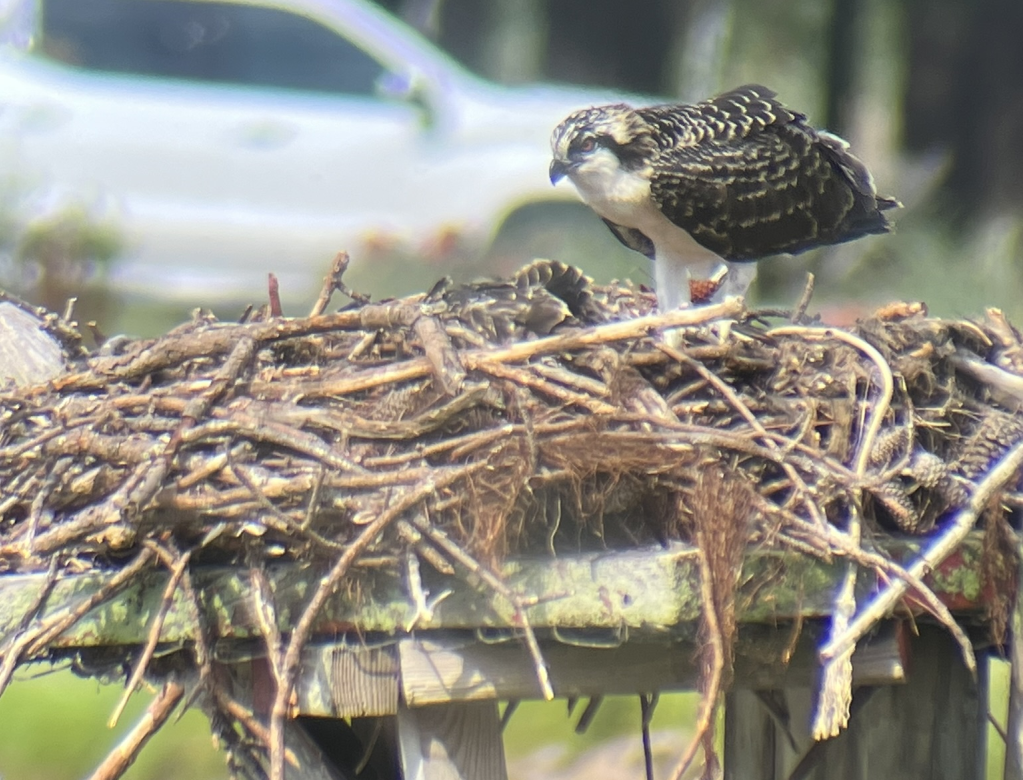
    Junior perched above the remains of Big Sis.

    Note: There are cautions on nest cam sites warning of potential violence on bird nests and the emotional toll. By “emotional toll” I mean “sadness.” Life frequently ends unpleasantly on nests.

    The night following Lily’s grab of a lobbed Alewife, a violent storm left only her youngest chick, Junior, alive. He’d nearly reached his elder sibling’s size with three days of bait-fish supplements. Big Sis had grown so substantial her feathers mounded above the lip for a week before assimilating into the nest.

    LB lands with a fish, Junior goes straight for it. Feathers in the foreground belong to Big Sis.

    LB delivered a frozen Alewife to Junior, the first fish he’d ever faced opening for himself.He’d likely survived on pieces Big Sis dropped while learning to feed herself. It can take an Osprey longer to get the hang of self feeding than of flying. Their beaks grip and tear, they don’t saw or slash. And fish skin is tough.

    The trick to opening a fish, it appears from cams and telescope, is to eat the head first. Dead or alive, fresh or frozen, doesn’t appear to matter. The head is the quickest way in, provides the biggest nutritional hit, and eases the subsequent unzipping of the scales to access the rest of the meat.

    Lily returned to Nest 4 the morning after the storm. Lying next to the pile of feathers she fed pieces of the Alewife to Junior, lying on her other side. Later LB delivered another fish to Junior, which Lily also took, feeding fewer bites to Junior this time.

    The next day, July 23, LB flew his fresh, decent-sized fish over the nest where Lily stood and Junior Fish Called. LB took the fish into North Copse, and on a branch above the nest ate the entire fish.

    Lily hangs around the North Copse, but not Nest 4. She grabs a bait-fish every other day or so. She only shares her fresh catches with Junior, dropping them so quickly I only identify her by knowing that’ not LB’s behavior.

    If LB sees a bait fish tossed into the creek, if he is not already occupied with another fish in his talons, he’ll go for that Alewife. He’ll share what he gets almost 50/50 with Junior. The technique sent Junior flying on July 28, 2026.

    Junior’s first flight was to the dead loblolly in the side yard, then a hop to the live one once I’d spotted him. He headed back to his nest, overshot it for a spot-on landing on Nest 5. No one home at Nest 5. Good thing. A few days later, Mr. Perfect chased Junior who had merely taken a shortcut across air belonging to Nest 5.

    But no trouble om his first flight. Junior flew from Nest 5 to Nest 4 just as soon as LB landed there with a fish. Another quite good landing.

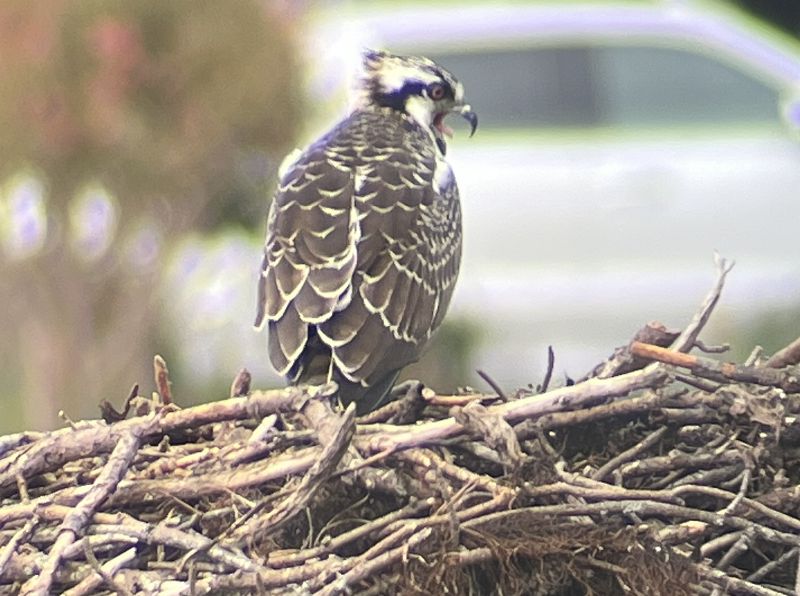
    Junior accomplishes flying and landing July 28, 2026.
  • 2026-4: Fish Disappeared; Ospreys Starving

    2026-4: Fish Disappeared; Ospreys Starving

    2026-4 – What I Know Now – July

    Note: There are cautions on nest cam sites warning of potential violence on bird nests and the emotional toll. Let me be clearer, by “emotional toll” I mean “sadness.”  Life frequently ends unpleasantly on nests.

    July closed with only one Island Creek Osplet alive. He is alive because his dad, LB, will retrieve Alewives peeled from a flash-frozen cube of bait-fish and lobbed into the creek. LB shares his retrievals roughly 50/50 with Junior, the first Island Creek chick since 2022 to live long enough to fly.

    Junior in front and Big Sis behind on July 21, 2026.

    LB has been far and away the best fisher of Island Creek. Unaided, he fed himself and Lily through spring, added chicks in June and kept two alive for 7 weeks, up to the brink of flying. Five other nests in Island Creek hatched chicks and only two chicks, both in Nest 5, ever reached the lip of their nest, where that final survivor perished, emaciated, mid-July.

    LB had looked haggard by then, he was dragging, making fewer and fewer deliveries of smaller and smaller fish. Junior was becoming gaunt, bullied by Big Sis, the larger chick, already actively wingercizing–building muscles to fly.

    LB retrieves an Alewife

    But by July 18, the extended lack of fish had even slowed Big Sis’s hopping and flapping. In late afternoon, Lily left. She did not return that night to the branch overlooking her nest. She was not around the next morning.

    This is what I know now: It is time to ditch anthropomorphism. Nests significantly differ from nurseries. Ospreys perform an egg-to-fledge drama every year and their species survival is not dependent on that nest. Their survival is dependent upon returning next year.

    This is what I know now: Starvation stops the show, no matter if it’s Act One or Three. The survival message is: You cannot fall short of your body’s needs for a successful migration.

    This is what I know now: Fish are jumping in Island Creek from March through May. Males verily crow, circling the lower Potomac with long, fat, tail-waving fish in their talons. Chicks hatch late May through early June. coinciding with an abrupt, devastating reduction of fish.

    LB with Alewife in talons

    The morning after Lily left, LB perched on a loblolly above my porch, looking into his nest with a small fish in his talons. His two squeeing, starving chicks hit a frenzied pitch each time he touched down in the nest. Twice he lurched back out as Big Sis chick went for the fish but the third time she grabbed it and LB released it. Big Sis adapted immediately to self-feeding.

    Junior, by now automatically submissive to Big Sis, didn’t fight for the fish. But he’d kept growing as he reached 7 weeks, so he’d figured out some way to get fed something. All that day and the next day he stood sturdily beside his sister squeeing for more fish. By evening of the second day of squeeing, LB retrieved a frozen Alewife bobbing beneath his nest.

    By the next evening, July 21, LB had bulked-up and so had the kids. Lily, absent for three days, swooped beneath LB as he launched off his North Copse branch to snatch another bobbing Alewife, which she grabbed for herself. She looked awful. She was starving.

    Previous Episode: 2026-3: Island Creek, Hot and Dry

    Next Episode: 2026-5: The Whole Family Is Here

  • 2022-1: Time Speeds Up for Island Creek Osprey

    2022-1: Time Speeds Up for Island Creek Osprey

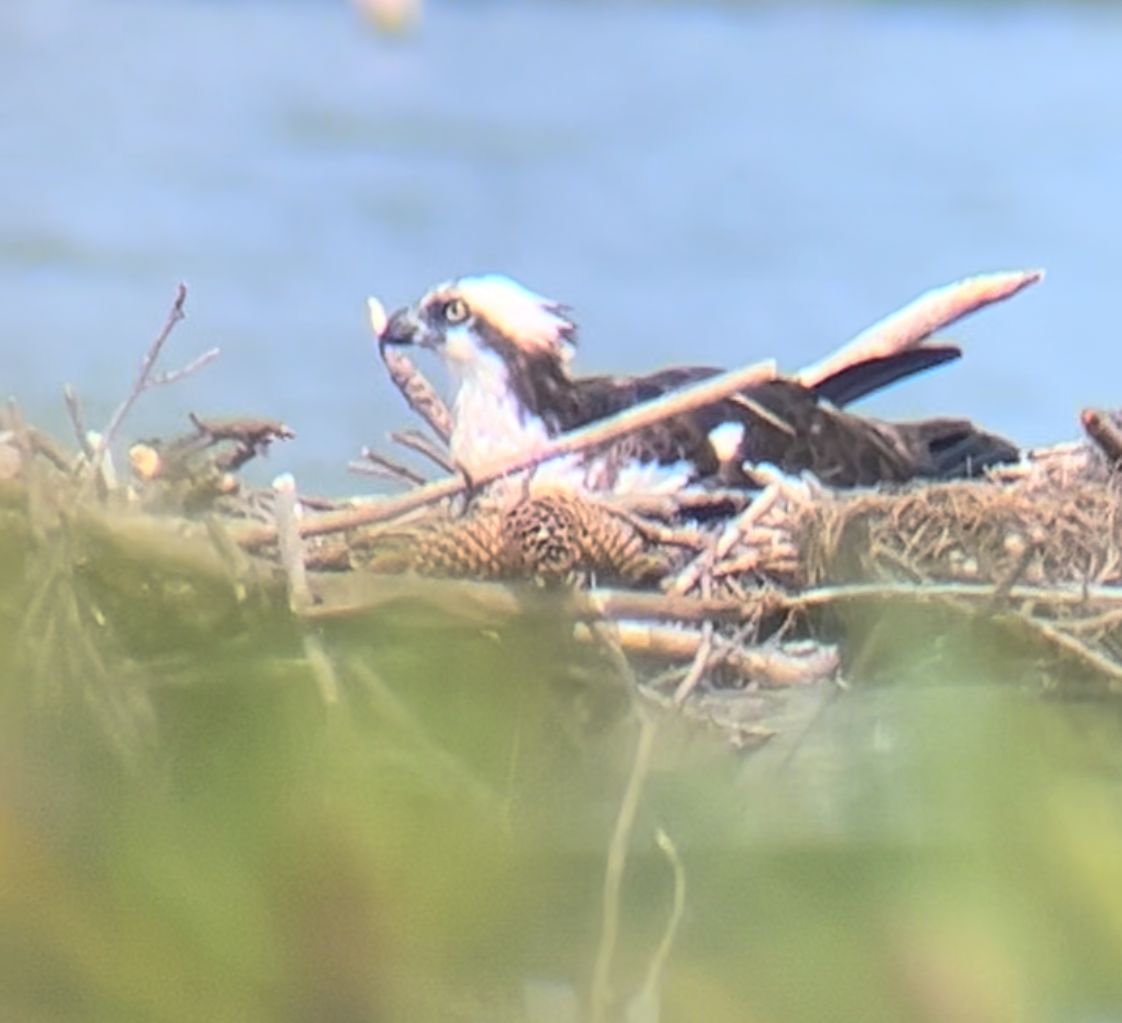
    Mrs. Perfect, above, devises a sorting system for her chicks this year, in the vein of Hunger Games or Theseus and the Minotaur.

    2022 – What I Knew Then, What I Know Now – 2026

    2022 took off early and held a fast pace. Some of the named 10 showed up a month ahead of their previous year’s arrival. The Perfects dropped into place March 7, perched side by side as if a single, ceramic unit had been lowered onto the rim of their nest. They hatched four chicks in 2022 and subdivided their nest to jettison the younger two from the feeding schedule, as required.

    Mr. and Mrs. Bennet arrived the day after the Perfects, Mrs. B mid-morning and Mr. B careening up the creek early evening, landing gently on Mrs. B and mating. She greeted him head down, tail high, and their breeding season began.

     Note:  Ospreys don’t carry full-sized reproductive baggage year round. Initial mating efforts—the failures and successes—expand the gear to production size and drop it into place. Experienced couples can pack these preliminaries into seven to 10 days of concentrated and consummated mating to deliver a fertilized egg. Newer pairings take more time. Weeks. Longer. Maybe not until next season. Timing is the essence.
    Big Mama (L) and Big Daddy

    Big Mama arrived the same day as the Bennets. I didn’t clock Big Daddy’s arrival, but he was taking a turn incubating eggs by April 1, so he’d arrived close on Big Mama’s tail.

    Ethel and the two Marks arrived mid-March and resumed skirmishes between the two nests south of the dock; they flew tandem and as a synchronized trio above the creek, they buzzed nests close enough to cause small fracases.

    Ethel and Mark-8 reclaimed Nest 1 and resumed squabbling with Nest 2 using the same old tricks: Mark 8 buzzed the Bennets as they began mating. Mr. B stole stick after stick from Mark-8’s nest.

    Mrs. B, a tenacious and relentless defender of Nest 2, could yet be surprised by Ethel quickly touching down on Nest 1 behind Mrs. Bennet’s back, only to spring over to her own nest as Mrs. B realizes. It drove Mrs. Bennet nuts.

    Mrs. B once rocketed off Nest 2, talons raised, hit Ethel square on the back, tumbling her overboard off Nest 1’s perch.

    The four of them looked more prankish than hazardous. This was their third year back. They worked together to drive off intruders, which I considered to be those I had not named, but their definitions were narrower.

    Matters still looked to be leveling out to a neighborly season. Mrs. B properly settled in and started laying eggs on March 25, still an early bird well ahead of the standard Chesapeake Osprey calendar. She had plenty of time if something should go awry.

    Previous Episode: 2021.6  Mark-8, What Else?

    Upcoming Episode: 2022.2  Building Code Spat over Split-Level

    Photo by author, taken with iPhone clamped to telescope. Version at top was “sharpened” by Copilot AI.