Tag: Martha

  • 2022-5:  Ethel Was Liberated

    2022-5:  Ethel Was Liberated

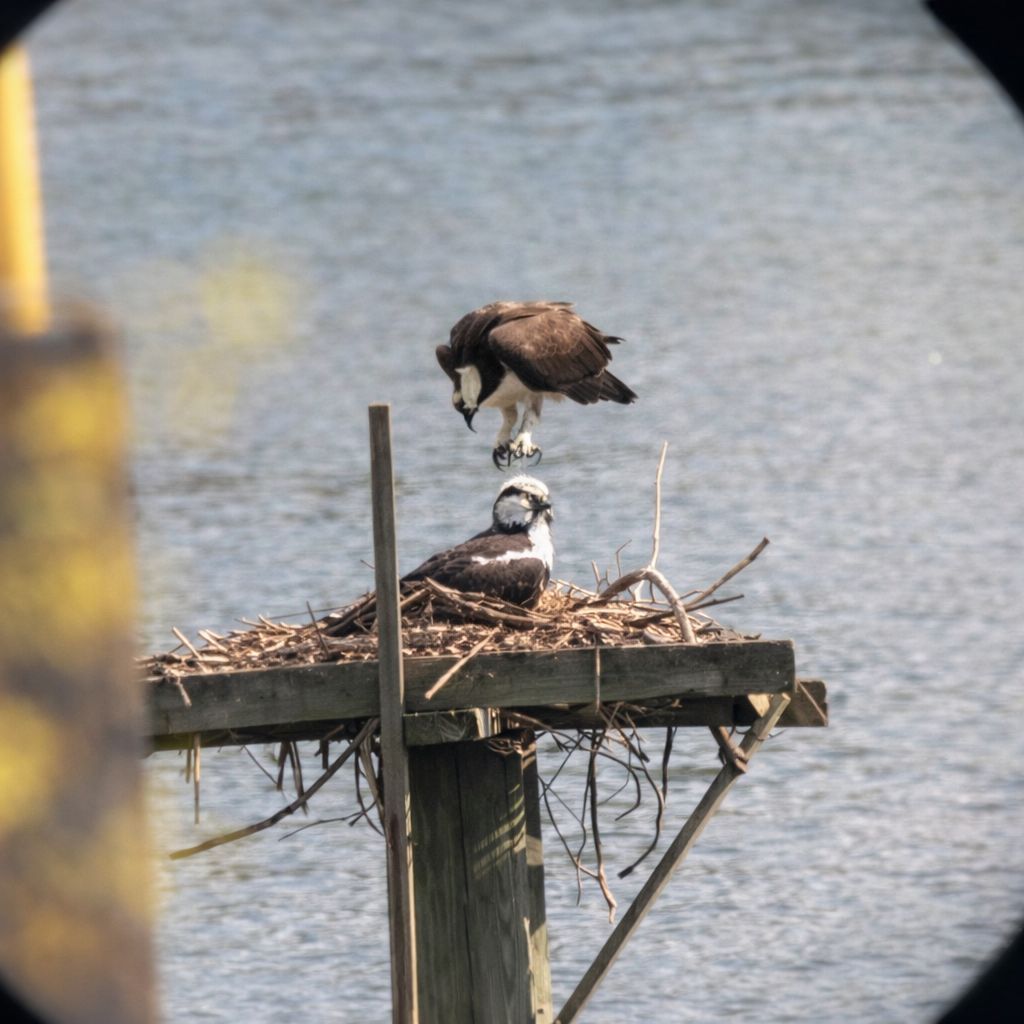
    Ethel, in the nest, and Mark-8 perched above, don’t seem to be really into one another.

    2022 – What I Knew Then, What I Know Now – 2026

    Osprey dung had become an obvious problem by 2022. It eats the paint off cars, porches, everything. A windshield count identified 60 nests on the island, add a conservative third again for nests invisible from the road and those invisible staring straight at them.

    The Captain, again, proclaimed St. George Island the Osprey Capital of the World.

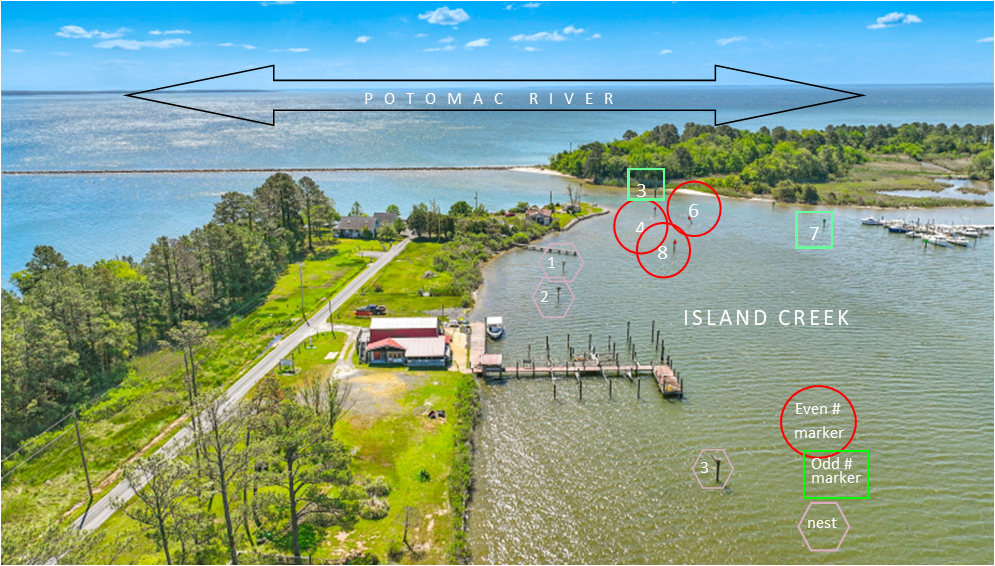
    Even so, only two of the four nests out front creek fledged Ospreys that year. Ethel brooded a few days in April, abandoned that effort. In June, as eggs in Island Creek nests started hatching, Ethel and Mark-8 hunkered a second time for some serious incubation. Lasted a week. Ethel split when fish deliveries halted. She returned after geese spent a few hours stomping anything in the bottom of that nest to smithereens.

    Mark-6 continued to slide sticks down triangular Marker 6 and visited Nests 1 and 2 when the males were absent. Twice I saw Mrs. B and Mark-6 breezily land side by side on Nest 2, like they’d just flown in from grabbing a quick drink. Mark-6 loitered briefly, Mrs. B was friendly, he flew off.

    Likely Ethel’s chasing Mark-6 off her nest was actually following him into the South Copse. Although I hadn’t realized, in 2022, Ethel had returned from wintering in Central America as a free agent.

    On July 12, the same day, Mr. B gave Mrs. B a fish to welcome her return, Mark-8 gave a fish to Ethel. There was a full moon, daylight hours waning, fishing had picked up, for whatever it’s worth.

    Mark-8 had begun eating his fish on a low pier very near Nest 1. Ethel’s best chance for a piece was to wait in the nest. If she dropped down to the pier, he flew with his fish. The gulls, his ever present sentinels, cleaned up the pier. Once, with Ethel watching and calling, Mark-8 left a chunk of fish on the pier. The gulls were on it before his talons left the planking.

    Both remained committed to that nest, still battling as allies against any intruders eyeing Nest 1.

    The Osprey population increased every year, real estate naturally grew scarcer, and the trend continued into 2023. That season will have barely begun when an intruder rips Big Mama’s chest open, leaving her floating in the creek.

    Previous Episode:  2022-4: Best to Lay by Early May

    Upcoming Episode: 2023-1: Big Mama Attacked

  • 2022-4: Best to Lay by Early May

    2022-4: Best to Lay by Early May

    2022 – What I Knew Then, What I Know Now – 2026

    Note: In the Chesapeake, best to lay eggs by early May. It’s 37-ish days to hatch, another 55 to fledge. Then the kids have to learn enough about fishing and flying to survive migration.
    Osprey typically lay clutches of three, sometimes four eggs, frequently wait for the third to begin 24-7 incubation, which is performed primarily by the female. Males fish, deliver food to the nest, and to varying degrees help with incubation. Some males are assertively broody. Some are Indeed-by-God not.

     Mrs. Bennet had laid her third egg five days before George and Martha arrived. Ten days after their arrival she stopped incubating.

    Two weeks later an attempted resumption of affections between the Bennets faltered. For the next two months, Mrs. B absented herself for days at a time and then other females paraded through Nest 2. Mr. B was slow to escort them off but he ultimately did.

    Mrs. B returned July 12. Mr. B brought her the last fish I saw him deliver that season. She shooed any remaining females away and they shared the nest, platonic as far as I noted. Presumably they fished for themselves.

    Upstream was a different scene. By May 9, Mrs. Perfect was feeding a chick. By the 21st she had four chicks, the elders bullied the youngers. Mrs. Perfect configured the nest to separate the two youngers where they were no longer attacked but no longer competed for food. By the end of the month the pen was dismantled and the Perfects ultimately and efficiently fledged two chicks.

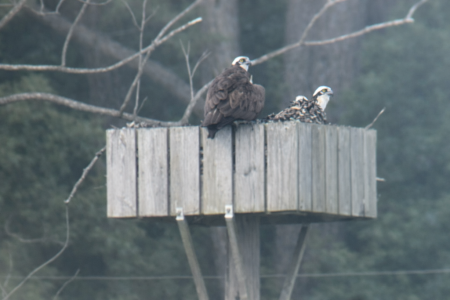
    Mrs Perfect and the two Perfect chicks await a fish delivery from Mr Perfect

    The Bigs hatched three chicks in the familiar pattern, the first a bully, the third quickly perished, the number two a survivor. The chicks were well fed, bullying diminished, and both fledged.

    The combined Big and Perfect chicks began fledging the second week in July with all four flying in early August. They landed in one another’s nests, wherever food arrived. The second Big to fledge flew straight into Mrs. Bennet on Nest 2, and got promptly booted home. But the adults in the nests upstream, after some initial consternation, fed whoever showed up.

    Ethel and Mark-8 handled the breeding season differently. Ethel had been liberated.

    Photo by author, taken with iPhone clamped to telescope. Version at top was “sharpened” by Copilot AI.

    Previous Episode 2022-3: Territorial Negotiations

    Next Episode:  2022-5:  Ethel Was Liberated

  • 2022-3: Territorial Negotiations

    2022-3: Territorial Negotiations

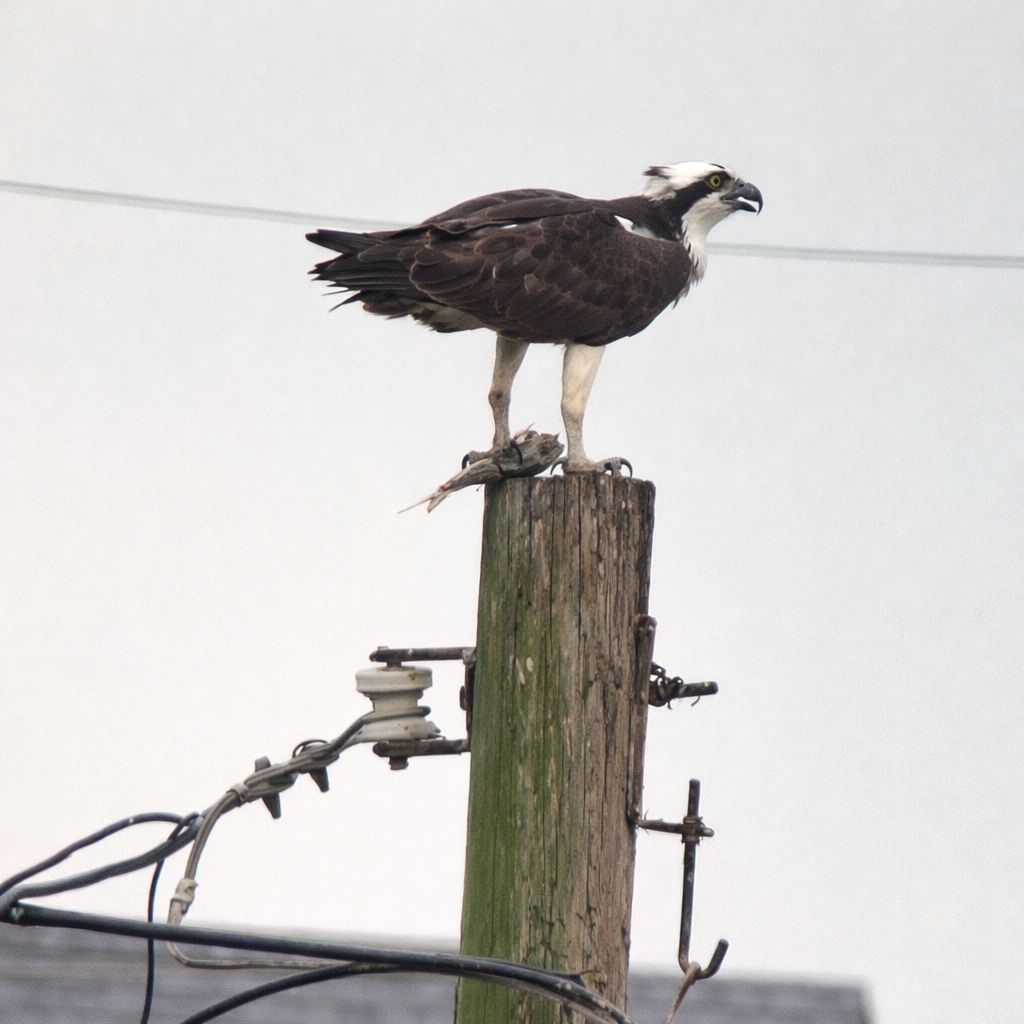
    Mr Bennet preferred the electric pole on the road to dine and to prepare a fish for nest delivery. He can see activity in Nests 1 and 2 from the pole, and probably action in nests across the creek to the south.

    2022 – What I Knew Then, What I Know Now – 2026


    The Bennets controlled territory beyond Nest 2. At least two loblollies in the middle of Parcel 157 Copse across the road belonged to Mr. and Mrs. Bennet; all four man-made poles surrounding the oyster house belonged to Mr. Bennet, and all the pilings along the lower side of the pier belonged to Mrs. Bennet. She selected her dining spot among them, perhaps based upon vessel configurations. Regardless, except for Mr. B, she allowed no other Osprey to perch on any of them.

    Upon George’s arrival, the Bennets made clear that their territorial jurisdiction covered the entire pier, including the pilings on the upper side and the toe at the bottom of the “L,” where George was constructing his split-level nest.

    The Bennet’s swooping and diving and squeeing opposition did not come close to the vigor of the Bigs’ hostility, their tenor reflected outrage of ancestral proportion against unpardonable nouveau.

    Then again, for all I know, George’s installation at the end of the pier amounted to Osprey voodoo. Watermen avoided it.

    Most likely George’s effrontery, squeezing between established territories, shoved property rights straight up those males’ beaks. Even Mr. Perfect, whose boundary lines were not impacted, joined the attacks.

    Mrs. B and Big Mama stuck tight on their nests but rocketed into the air if Martha flew overhead, which usually Martha did not. At the first sign of aggression, Martha split, flew across the creek. When the locals came at George she’d absent herself, quick to leave the Purple Martin hotel to any invader.

    Martha liked George to deliver her fish to pilings across the creek. And mating worked better on the pilings than George’s hot-mess nests of ’22. Martha did hang in the neighborhood, perched around the expanding split-level. But the only risk I ever saw her take was getting caught investigating other nests. When nest owners were absent — and the nests were empty of eggs or chicks — she’d hop in and look around.

    But George did not abandon his split-level. Certainly not after holding his claim against the elder males. When matters calmed, Martha stood on the Purple Martin hotel, walked among George’s circular collection on the pier, and particularly liked perching on crossbars between a few pilings around the pier’s foot.

    George preening, Martha taking her time eating the fish he’d delivered to her on the crossbar at the end of their pier.

    Neither George or Martha ventured farther up the pier than the foot. They’d additionally been granted five loblollies in my side yard, which, as the Osprey flies, is a straight shot off the toes to the trees, no invasion of airspace above the leg of the pier. Even so, Mrs. B left her early eggs. It was touch and go all season if she’d stick with Nest 2. She never did dine again on a piling along the oyster house pier.

    Previous Episode: 2022-2: Building Code Spat
    Upcoming Episode: 2022-4: Best to Lay by Early May


    Photos by author with iPhone clamped to middling telescope; versions above of these two at the bottom are AI “sharpened” by Copilot. The others in the post are iPhone clamped to telescope.


  • 2022-2:  Building Code Spat over Split-Level

    2022-2:  Building Code Spat over Split-Level

    2022 – What I Knew Then, What I Know Now – 2026

    In 2022 the fledge classes of 2019 and 2020 roared into town, as obstreperous as ever the old Gang of Six. Youngsters canvased Island Creek through the summer, dipping into nests to attempt a claim, some ready to fight then and there.

    Mark 8 balancing and Ethel not cooperating.

    Mark-8 and Ethel remained adamant about their possession of Nest 1, although neither were into nestorations. They persevered as non-traditionalists. Mark-8 wasn’t into fish delivery. And Ethel wasn’t into mating.

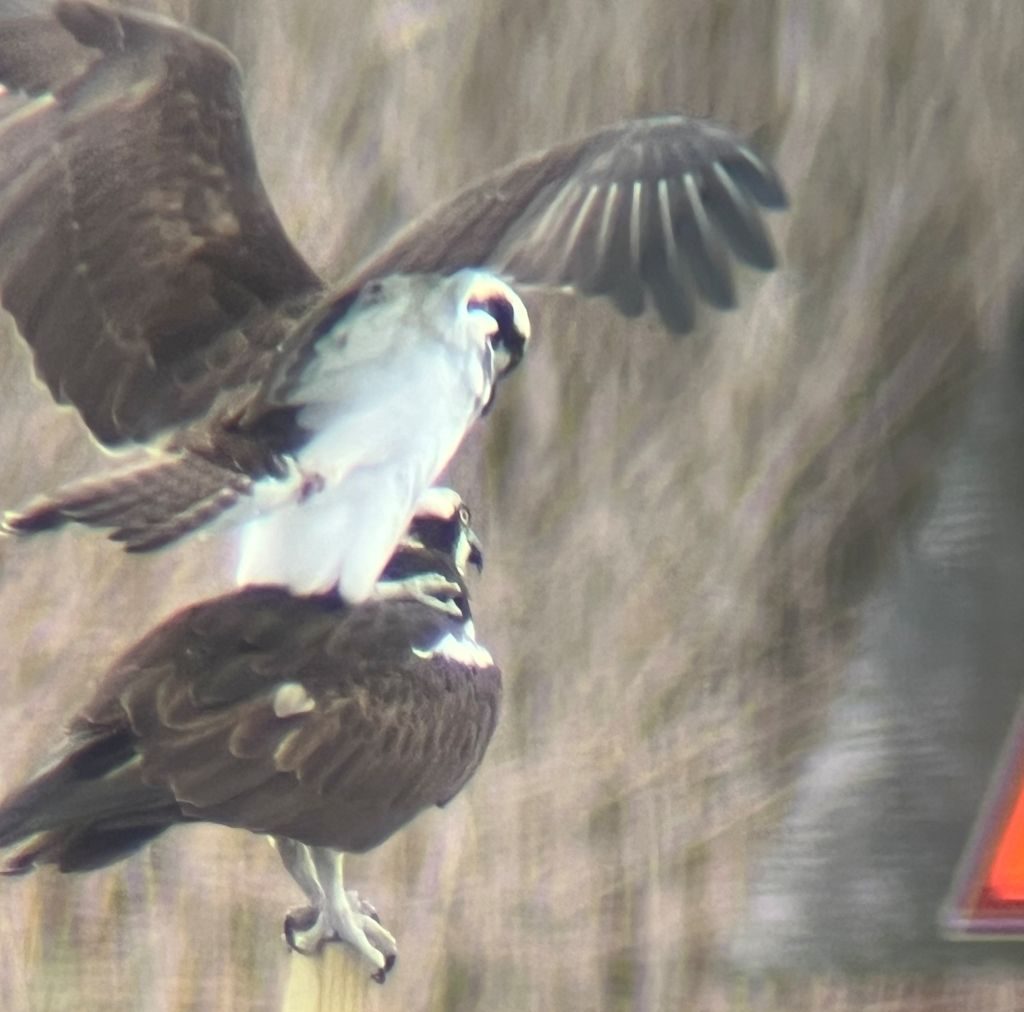
    When Mark-8 zoomed in for a mating attempt—an approach favored by most lower-creek males—he’d have to walk Ethel’s shoulders down to force her tail up. If he succeeded with that, he’d have to walk his way back up to position his tail beneath hers. If all of this was accomplished, Ethel would swish her tail like she was all in, but whenever I caught a glimpse, she was all out of alignment.

    Note: Ornithologists say Osprey do not trade fish for copulation, not in a tit for tat kind of way. The male necessity is to override his own survival instinct and give his fish away. So, while the giving is a huge thing, possibly even tied to his perception of masculinity, the female needs to calculate, Is it enough? He must feed her, her chicks, and himself. A miscalculation could trap her into a lifetime of begging calls and drudgery.

    A new couple arrived in mid-April. I named them George and Martha for no reason at all. George began building a split-level atop a Purple Martin hotel rusted hollow. It was mounted at the toe of the L-shaped pier that separated the old Osprey nests from the new.

    While George’s efforts sometimes appeared within the realm of possibility, they also smacked of the style of Mark-6, who in 2022 continued sliding sticks down Marker 6. George incorporated the sticks that fell off the Purple Martin hotel into the circle of rope, fabric, and various detritus comprising the garden level of his castle sprawled across the pier.

    Just like that, the Bennets got another atypical neighbor, this couple flanking them on the north.

    None of the neighborhood took it well.

    Previous episode: 2022-1: Time Speeds Up

    Upcoming episode 2022-3:  Territorial Negotiations


    All photos by author, taken with iPhone clamped to telescope. Top and bottom versions in post above were “sharpened” by Copilot AI.


  • 2020-3:  Feeding Ospreys

    2020-3:  Feeding Ospreys

    Photo by Paul Leibe, 1991, first Osprey nest installed in Island Creek in front of the island house.

    2020-What I Knew Then, What I Know Now-2026

    The returning Osprey grown-ups in nests out front of the island house performed their traditional seasonal tasks in my peripheral vision, beyond practical reach of the oystering binoculars. I wasn’t taking notes, but mentions of oddities made it to the dinner table.

    Note: The oystering binoculars were too large and heavy to hold steadily, let alone simultaneously focus. The Captain had used them to locate bird activity above water which suggests fish below, which might portend oysters beneath the fish. They were also used in the ancient waterman tradition of spying on the catches of other working boats. Powerful.

    The two nests out front traditionally fledged three chicks. The oldest nest had fledged four chicks a few times over its three occupied decades. The younger nest probably 15 years old by 2020, had fledged four at least once. The Captain insists the oldest nest fledged five one year, with his assistance.

    He’d rigged the top of a now-forbidden Styrofoam cooler to a line threaded through a pulley running from the shore to the nest’s piling. When the workboats landed their various catches at the dock, the Captain took junk fish, the waste from filets, even left over bait if it was fresh enough, and hauled it out to the piling.

    Once, the Captain tells, the Osprey dropped a stick on the head of a Seagull trying to steal the fish off the lid. The Seagull flew, the Osprey retrieved the fish and fed it to the kids.

    I didn’t think to take notes. This was dinner conversation. Like seeing flocks and flocks and flocks of Red-winged Blackbirds above their undulating shadow gliding along the tips of the marsh grass. We noted when they’d dwindled to only flocks. We noticed the Purple Martins return to the little white buckets the Captain strung along the pier, but failed for a long time to notice they no longer provoked crack-of-dawn noise complaints. We noticed the Ospreys return, laughed at their funny fledglings learning to fly, discussed the population increase.

    In 2019 a Bald Eagle made its way across the road to the side yard, appearing uninjured but unable to fly, and placidly waited in the yard as I called for assistance. I had to convince the intake ranger I could discern an Eagle from an Osprey for the dispatch of qualified help, which shortly arrived. Due to an over-abundant population in the region, injured Osprey no longer warranted official rescue.

    Note: Ospreys are going on 2 or 3 years old when they first attempt a return to their imprinted natal region. Ornithologist say only one in three makes it. Survival rate improves significantly after that.

     The jumped-up six-pack at the mouth of Island Creek represented the top third of the banner fledgling classes of 2017 and 2018. They’d contributed nothing to the 2020 fledge class. But in 2021, they will out fledge the older two nests. Among those fledglings will emerge a bully of legendary proportion, who will terrorize all occupants of Osprey nests up and down Island Creek.

    Bully came from Ethel’s nest. She always has the best stories.