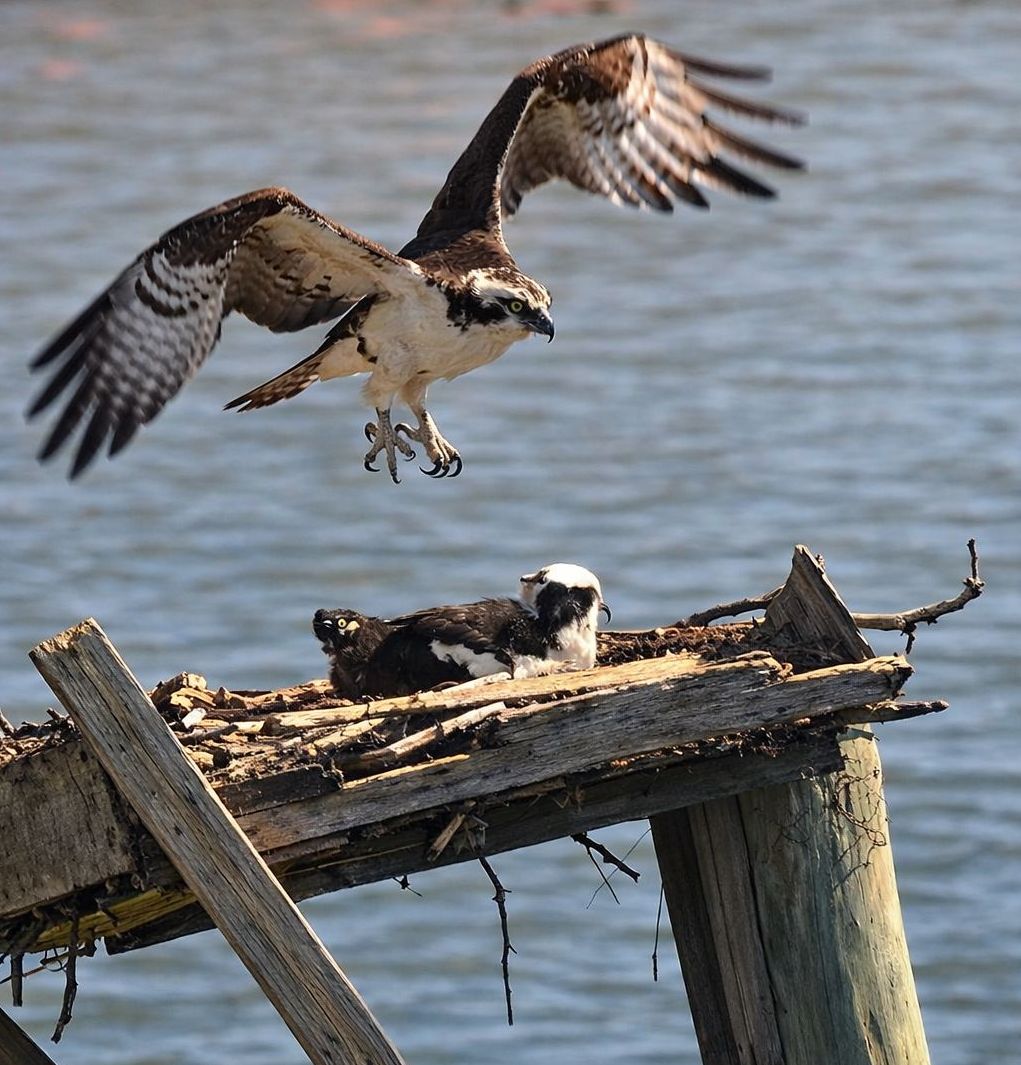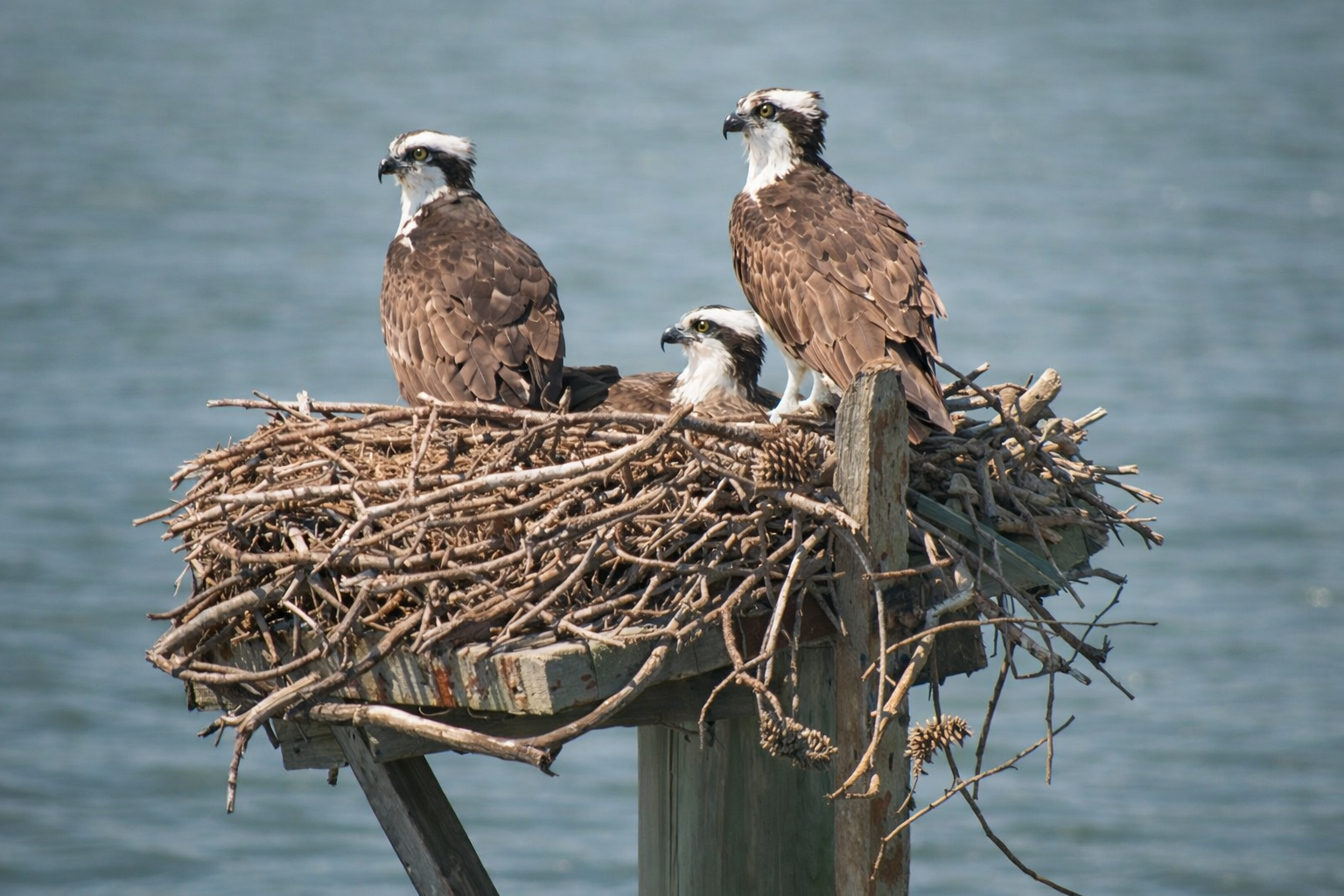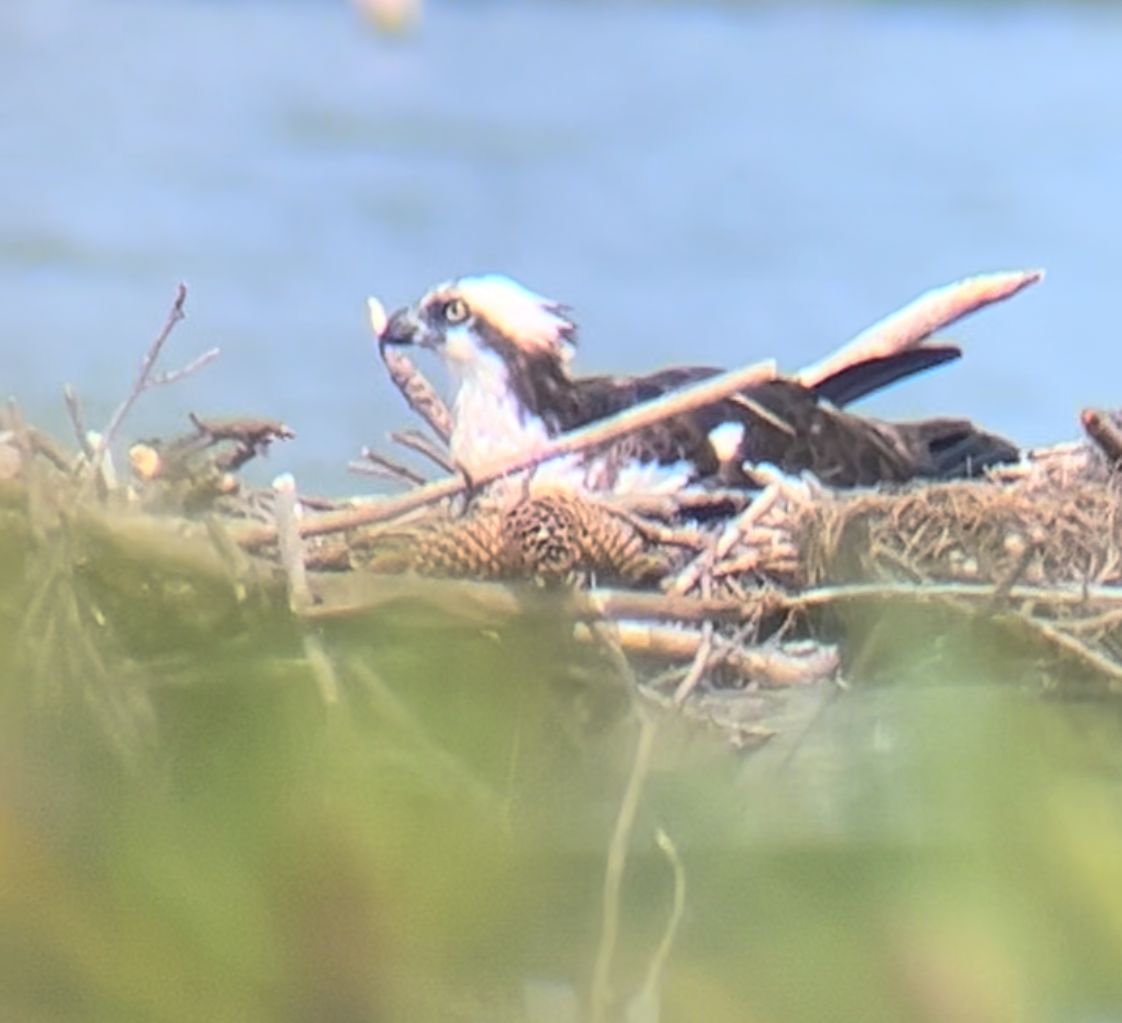
Tag: Mark-8

  • 2022-1: Time Speeds Up for Island Creek Osprey

    2022-1: Time Speeds Up for Island Creek Osprey

    Mrs. Perfect, above, devises a sorting system for her chicks this year, in the vein of Hunger Games or Theseus and the Minotaur.

    2022 – What I Knew Then, What I Know Now – 2026

    2022 took off early and held a fast pace. Some of the named 10 showed up a month ahead of their previous year’s arrival. The Perfects dropped into place March 7, perched side by side as if a single, ceramic unit had been lowered onto the rim of their nest. They hatched four chicks in 2022 and subdivided their nest to jettison the younger two from the feeding schedule, as required.

    Mr. and Mrs. Bennet arrived the day after the Perfects, Mrs. B mid-morning and Mr. B careening up the creek early evening, landing gently on Mrs. B and mating. She greeted him head down, tail high, and their breeding season began.

     Note:  Ospreys don’t carry full-sized reproductive baggage year round. Initial mating efforts—the failures and successes—expand the gear to production size and drop it into place. Experienced couples can pack these preliminaries into seven to 10 days of concentrated and consummated mating to deliver a fertilized egg. Newer pairings take more time. Weeks. Longer. Maybe not until next season. Timing is the essence.
    Big Mama (L) and Big Daddy

    Big Mama arrived the same day as the Bennets. I didn’t clock Big Daddy’s arrival, but he was taking a turn incubating eggs by April 1, so he’d arrived close on Big Mama’s tail.

    Ethel and the two Marks arrived mid-March and resumed skirmishes between the two nests south of the dock; they flew tandem and as a synchronized trio above the creek, they buzzed nests close enough to cause small fracases.

    Ethel and Mark-8 reclaimed Nest 1 and resumed squabbling with Nest 2 using the same old tricks: Mark 8 buzzed the Bennets as they began mating. Mr. B stole stick after stick from Mark-8’s nest.

    Mrs. B, a tenacious and relentless defender of Nest 2, could yet be surprised by Ethel quickly touching down on Nest 1 behind Mrs. Bennet’s back, only to spring over to her own nest as Mrs. B realizes. It drove Mrs. Bennet nuts.

    Mrs. B once rocketed off Nest 2, talons raised, hit Ethel square on the back, tumbling her overboard off Nest 1’s perch.

    The four of them looked more prankish than hazardous. This was their third year back. They worked together to drive off intruders, which I considered to be those I had not named, but their definitions were narrower.

    Matters still looked to be leveling out to a neighborly season. Mrs. B properly settled in and started laying eggs on March 25, still an early bird well ahead of the standard Chesapeake Osprey calendar. She had plenty of time if something should go awry.

    Previous Episode: 2021.6  Mark-8, What Else?

    Upcoming Episode: 2022.2  Building Code Spat over Split-Level

    Photo by author, taken with iPhone clamped to telescope. Version at top was “sharpened” by Copilot AI.
  • 2021-6: Mark-8, What Else?

    2021-6: Mark-8, What Else?

    Mark-8 perches above Ethel, probably sitting on eggs in April 2021.

    2021 – What I Knew Then, What I Know Now – 2026

    Following Osprey etiquette, Ethel’s nest mate perched on Marker 8, close to Nest 1, to decapitate the fish in advance of presenting the meal at his family’s nest. Squeeing, squeeing, squeeing came nonstop from Ethel and then Ethel and chicks as he prepped the meal.

    Note: Ornithologists describe the high pitched, ceaseless, nagging hunger cries of females and chicks as Food Begging Calls, hardwired into the Osprey survival drive. The pitch and intensity rise when delivery is in sight and do not end until the female has fish in her mouth. Noteworthy: Relinquishing food is difficult. It requires overriding the survival instinct. Fishing with talons is also really difficult.

    But Ethel’s mate kept eating the entire fish, again and again. He preened on Marker 8 as if his family’s Begging Calls were Mozart. I saw him twice deliver food to Nest 1 after the chicks could feed themselves, which happens nearer 2 months than 1 month old. Ethel was absent both times.

    What else could his name have been other than Mark-8, right next door to Mark-6, the neighborhood’s first cavalier to leave a lady in the lurch.

    As a first time mother with scant support, Ethel fledged two difficult chicks, increasingly having to feed them by her own fishing efforts. She fledged a bully on the scale of Grendel or Frankenstein. She also kept alive a tortured and malnourished second hatch who fledged 10 days after Bully, finally escaping. Ethel immediately followed.

    Bully had fledged straight into the Bennet’s next door, which startled Jane right out of the nest, forcing her to fledge. Elizabeth Bennet had fledged the day before but wouldn’t conquer a return landing to the natal nest for a few more days. Mr. Bennet, who had been staying near Elizabeth,  joined the fray to remove Bully from Nest 2. And  the accidentally fledged Jane returned with a perfect landing. Through all the commotion, Bully held on and remained.

    Elizabeth nailed her landing and next to Jane found Bully also lined up to be fed by Mrs. B. After that Bully grabbed Mr. B’s deliveries for herself. She stole a fish out of Big Daddy’s talons with bravado and stupendous timing. She ate it, still perched next to Big Daddy, the Bigs’ fledgling begging from the nest below.

    I suspect Bully worked nests all over the island, but when Ethel delivered a fish to her second hatch, Bully landed nearly instantaneously on Nest 1, fought Ethel, and took the fish.

    As the creek emptied of Ospreys headed south, Bully hung around Nest 1 squeeing, then she disappeared too.

    She made the seventh fledgling to migrate in 2021 from four nests in front of the island house. I thought matters were looking up.

    Author’s iPhone via telescope capture of the original photo that was AI “sharpened” by Copilot in the version at the top

    Previous Episode: 2021-5:  Mr. Bennet Was My Favorite

    Upcoming Episode: 2022-1: Time Speeds Up


  • 2021-5: Mr. Bennet Was My Favorite

    2021-5: Mr. Bennet Was My Favorite

    Big Daddy delivers a fish to Big Mama, whose crop looks depleted, so she’s probably hungry.

    2021 – What I Knew Then, What I Know Now – 2026

    The Bennets’ two chicks behaved like characters in a Sesame Street episode about sharing.  One would take a bite from a parent as the other watched and waited for the next bite. They were so considerate of one another I named them Jane and Elizabeth Bennet. Ornithologists would attribute such an idyllic first clutch to Mr. B’s true excellence at fishing.

    Note: Food shortages create bullies, according to ornithologists. Fish provide everything for Ospreys including hydration. Everything. There is no second choice.

    I never saw more than two hatchlings at the Bennets’ nest, but three heads initially popped above the lip at Ethel’s and the Perfects’ nests. The eldest in those two nests bullied and the youngest in each nest quickly perished, a pattern in nests on internet Osprey cams as well. Osplet bullying can become violent and can result in siblicide.

    Note: I think “Osplet” and “nestorations” might be words created by contemporary, online birders. They mean exactly what they sound like they mean.

    Ample food at the Perfects’ nest ultimately allowed the second chick to catch up in size and gradually reduced that bully’s aggression. The nest calmed down and the two surviving Perfect chicks fledged on equal terms.

    Conversely to the other families’ nests, Ethel drudged mostly solo to fledge two chicks from Nest 1. Which led to her ultimately inappropriate name, in honor of Vivian Vance’s character on “I Love Lucy.” Ms. Vance, it was reported, resented Ethel’s characterization as a drudge. But that was the job.

    Ethel’s job, as a young, first-time mother, was to  fledge Osplets with her nest-mate, who didn’t always bring home the fish. That’s not quite accurate. He’d sometimes bring fish home that he could not relinquish to Ethel or his hungry chicks.

    Ethel in Nest 1 with her nest-mate on the perch

    I ended up calling him Mark-8, partially because he resembled Mark-6, taller, leaner, both with pure white chests, minimal and similar dark feather markings on their heads. And I’d seen them fly in tandem as if choreographed, swooping above the creek. And I’d seen Mark-8 fly like that with Ethel, before the eggs arrived. The Marks and Ethel occasionally flew as a trio.

    Nevertheless, Mark-8 just couldn’t let go of his fish.

    Previous Episode 2021-4: Pride and Prejudice 

    Upcoming Episode 2021-6:  Mark-8, What Else?

    these are the original iPhone via telescope photos take by author; versions posted above by AI Copilot

  • 2021-4: Pride and Prejudice

    2021-4: Pride and Prejudice

    Mr. Bennet is landing on Nest 2, probably aiming for Mrs. Bennet’s back.

    2021 – What I Knew Then, What I Know Now – 2026

    The accommodating and unaccommodating Osprey pair of Nest 2 will be named Mr. and Mrs. Bennet, after their chicks hatch. The chicks will look like big, healthy girls when they fledge. But when Natasha dropped in, Mrs. Bennet hadn’t yet laid an egg, though she was ready. She stuck close to the nest except to dine at a nearby piling, within sight of the nest. She ignored the Cuckoo egg.

    Not Mr. B. When he next delivered a fish to the nest, he brooded Natalie’s egg while Mrs. B dined on her piling.

    He carried on like this until Mrs. B began laying eggs a few days later, in the bowl she and Mr. B had carefully prepared, up and apart from the lip where Natasha had laid. Mr. Bennet’s attention transferred quickly to the eggs of the future Misses Bennet.

    Incubation can be pretty dull, viewed at the lip of the nest. The first surmise of a living hatch is an adult with food in its beak leaning into the nest bowl. Counting begins when heads start bobbing, which depending upon nest construction, takes at least a week.

    Big Mama and Big Daddy

    Only one head ever popped above the lip of the Bigs’ nest in 2021. Anyone’s guess the parentage. The Bigs had begun the season on bad terms, Big Daddy a month late, not showing until well into April while Big Mama had battled daily intruders.

    Mrs. Perfect

    Some assistance came occasionally from the upstream neighbors, their nest also attracting intruders. These neighbors to the north were the exception to my 2021 naming. The Captain and I had years before named this pair the Perfects, practically the day they arrived. We named them after family, whose lawn we’d long commented upon.

    In 2021, the experienced Perfects, the novice Bennets, and a beleaguered Ethel fledged two chicks apiece from three vastly different nests.

    Image at top of post is taken from this photo by author via iPhone attached to a middling telescope. Copilot “sharpened” the image used at the top.

    Previous Episode2021.3: Birds Labor Too 

    Upcoming Episode2021.5  Mr. Bennet Was My Favorite

  • 2021-3: Birds Labor Too

    2021-3: Birds Labor Too

    Natasha, between Big Daddy (L) and Big Mama, takes a breather after laying another egg in another Osprey pair’s nest.

    2021-What I Knew Then, What I Know Now-2026

    A bird about to lay an egg resembles most animals going through labor, intensely focused on the pressing situation, jumpy even in the comfort of her own nest. The subsequent melodrama of laying an egg, for the first time, without a nest, looked pitiable and shameful. Wanton. [Refer to anthropomorphism 2021-1.] She needed a notorious name: Natasha.

    I conjured Natasha Fatale, spy of the Moose and Squirrel show, something edgy to offset my awfulness of practicing voyeurism on trauma. This gal deserved a spicy name.

    Natasha’s debacle began at dusk the third week of April when Ethel alerted the neighborhood of disaster. Natasha had landed in Nest 1, Ethel’s nest, ready to lay an egg.

    Ethel hadn’t yet been named nor had the nests been numbered, but well prior to all of that, it was universally known, even by me,  that the bird I would come to call Ethel possessed the nest to later be designated Nest 1. And before Natasha had a chance to push an egg out, Ethel pushed her off it.

    Natasha flapped her way 50 feet to Nest 2, where the accommodating male and less accommodating female backed away. Natasha set upon the platform’s lower edge, closest to Nest 1, and laid her egg. Then the resident Nest 2 female pushed her off that nest, too.

    Three days later—right on Osprey-laying-target, Natasha landed in the oldest nest, occupied for many years by the Bigs. These two remain the biggest, respectively, male and female Ospreys I’ve ever seen. Big Daddy, big and blustering, was easy naming.

    Big Mama seemed a stretch, until both Bigs let Natasha labor, lay her egg, and this older, aggressive female let Natasha incubate alongside her and rest after her ordeal.

    I appended “Mama” because of that kindness. Plus, given her less than traditional mothering behavior, there was a tad of sarcasm.

    Big Mama was aggressive and hair-triggered when repelling intruders from her nest. Much more in character, once Natasha had rested sufficiently to be standing, Big Mama threw her off.

    As soon as Natasha quit circling, Big Mama tidied up and settled into incubating, possibly the Cuckoo egg as well.

    I have no further record of Natasha.

    Big Mama settles in after Natasha quits circling, enhances the nest bowl with a twig and sets to incubating.


    Previous Episode 2021.2: An Exotic Girlfriend

    Upcoming Episode 2021.4: Pride and Prejudice 


  • 2020-3:  Feeding Ospreys

    2020-3:  Feeding Ospreys

    Photo by Paul Leibe, 1991, first Osprey nest installed in Island Creek in front of the island house.

    2020-What I Knew Then, What I Know Now-2026

    The returning Osprey grown-ups in nests out front of the island house performed their traditional seasonal tasks in my peripheral vision, beyond practical reach of the oystering binoculars. I wasn’t taking notes, but mentions of oddities made it to the dinner table.

    Note: The oystering binoculars were too large and heavy to hold steadily, let alone simultaneously focus. The Captain had used them to locate bird activity above water which suggests fish below, which might portend oysters beneath the fish. They were also used in the ancient waterman tradition of spying on the catches of other working boats. Powerful.

    The two nests out front traditionally fledged three chicks. The oldest nest had fledged four chicks a few times over its three occupied decades. The younger nest probably 15 years old by 2020, had fledged four at least once. The Captain insists the oldest nest fledged five one year, with his assistance.

    He’d rigged the top of a now-forbidden Styrofoam cooler to a line threaded through a pulley running from the shore to the nest’s piling. When the workboats landed their various catches at the dock, the Captain took junk fish, the waste from filets, even left over bait if it was fresh enough, and hauled it out to the piling.

    Once, the Captain tells, the Osprey dropped a stick on the head of a Seagull trying to steal the fish off the lid. The Seagull flew, the Osprey retrieved the fish and fed it to the kids.

    I didn’t think to take notes. This was dinner conversation. Like seeing flocks and flocks and flocks of Red-winged Blackbirds above their undulating shadow gliding along the tips of the marsh grass. We noted when they’d dwindled to only flocks. We noticed the Purple Martins return to the little white buckets the Captain strung along the pier, but failed for a long time to notice they no longer provoked crack-of-dawn noise complaints. We noticed the Ospreys return, laughed at their funny fledglings learning to fly, discussed the population increase.

    In 2019 a Bald Eagle made its way across the road to the side yard, appearing uninjured but unable to fly, and placidly waited in the yard as I called for assistance. I had to convince the intake ranger I could discern an Eagle from an Osprey for the dispatch of qualified help, which shortly arrived. Due to an over-abundant population in the region, injured Osprey no longer warranted official rescue.

    Note: Ospreys are going on 2 or 3 years old when they first attempt a return to their imprinted natal region. Ornithologist say only one in three makes it. Survival rate improves significantly after that.

     The jumped-up six-pack at the mouth of Island Creek represented the top third of the banner fledgling classes of 2017 and 2018. They’d contributed nothing to the 2020 fledge class. But in 2021, they will out fledge the older two nests. Among those fledglings will emerge a bully of legendary proportion, who will terrorize all occupants of Osprey nests up and down Island Creek.

    Bully came from Ethel’s nest. She always has the best stories.

  • 2020-2: Rampaging Adolescent Ospreys

    2020-2: Rampaging Adolescent Ospreys

    The new Osprey nest platforms are down stream from the peeler crabs beneath the red roof.  The green Intracoastal Waterway Marker 3 at the edge of the small beach in the background denotes the mouth of Island Creek. The red, triangular markers heading upstream are 4, 6, and 8.

    2020-What I Knew Then, What I Know Now-2026

    St. George Island legend pegs St. Patrick’s as the day Ospreys return. In 2020 that coincided with the pandemic. My office moved to the second-story of the island house overlooking the coveted new platforms. Hard to miss the commotion. I dug out a middling pair of binoculars, climbed to the storage loft above the oyster house, and dragged a stool onto the landing. I went a second morning merely to prove to myself I could. I didn’t bother with the binoculars.

    The Gang of Six blew past that landing exactly like the rampaging, hormone fueled, adolescent hawks they were. Fast and huge. They turned sideways—in flight!—to accommodate the sloping barn roof. They cut corners so tightly the building might as well not have been there at all. I grasped the railing, off balanced. Their wings were huge! Huge! Feathers filled the view. An unbelievable number of feathers, layers and layers. Millions of feathers. The spread wings were four times my breadth. I heard, “whoosh” and felt a rush. It happened again, so fast, another chasing the first, Star Wars on the wing. “Whoosh.” And all those feathers.

    After that I balanced the Captain’s powerful oystering binoculars atop piles of boxes and thick books in my pandemic office and spent half an hour setting the focus on the new platforms.

    Map below so totally not to scale!

    An Osprey nest proved perfect for lazy birdwatching. Everything interesting that birds do, Ospreys do at their nests—courtship, nest building, mating, dining on live prey that is always fish, so not as gross as an eagle’s nest, eagles eat anything and the kids sleep beside the leftovers.

    Then Ospreys produce a 60-day family drama from feeding to fledging followed by prolonged survival training—flying and fishing—for their first migration. Nearly all of this, right there on the nest, binoculars in place and focused.