Tag: Mark-6

  • 2022.2  Building Code Spat over Split-Level

    2022.2  Building Code Spat over Split-Level

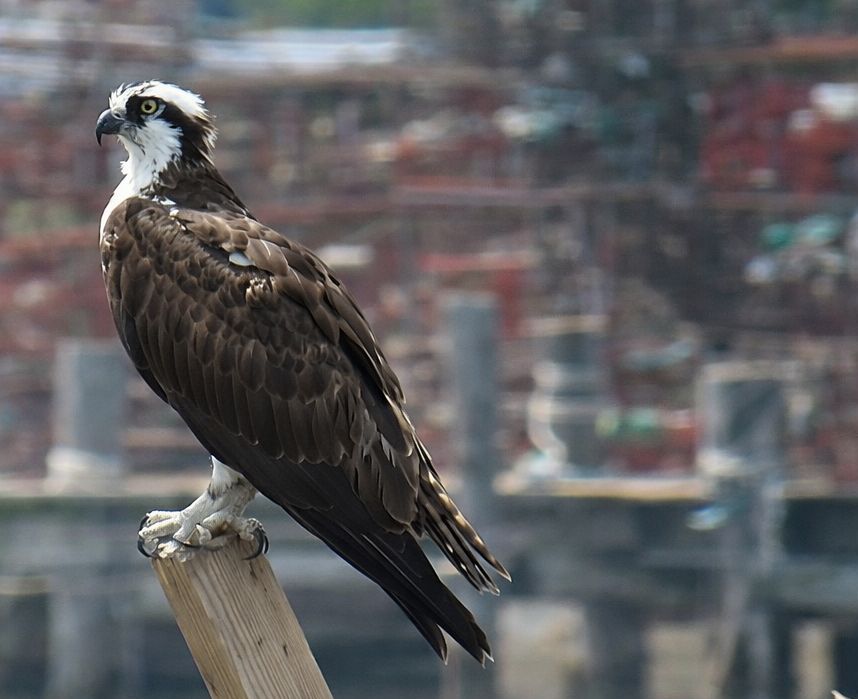
    In 2022 the fledge classes of 2019 and 2020 roared into town, as obstreperous as ever the old Gang of Six. Youngsters canvased Island Creek through the summer, dipping into nests to attempt a claim, some ready to fight then and there.

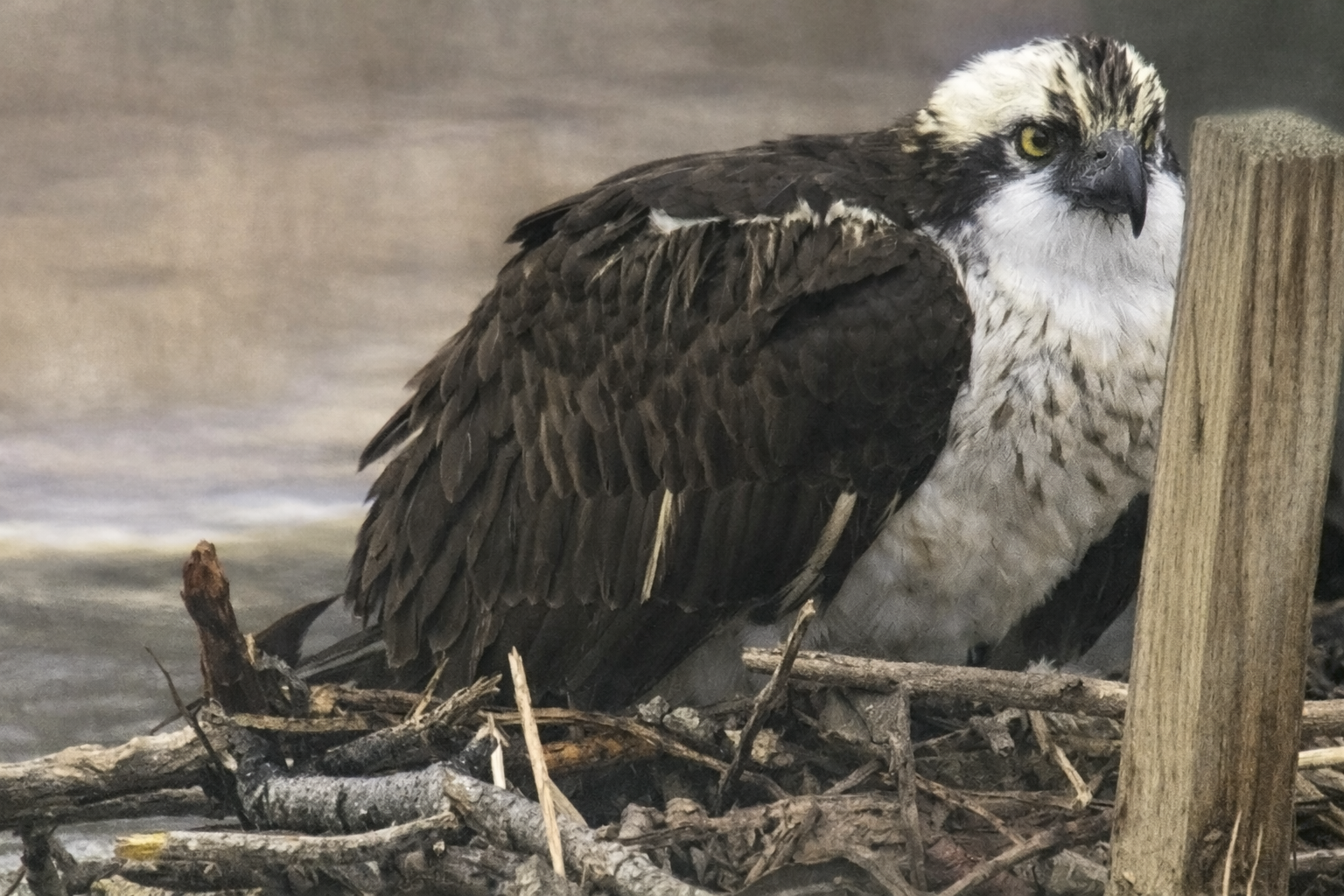
    Mark 8 balancing and Ethel not cooperating.

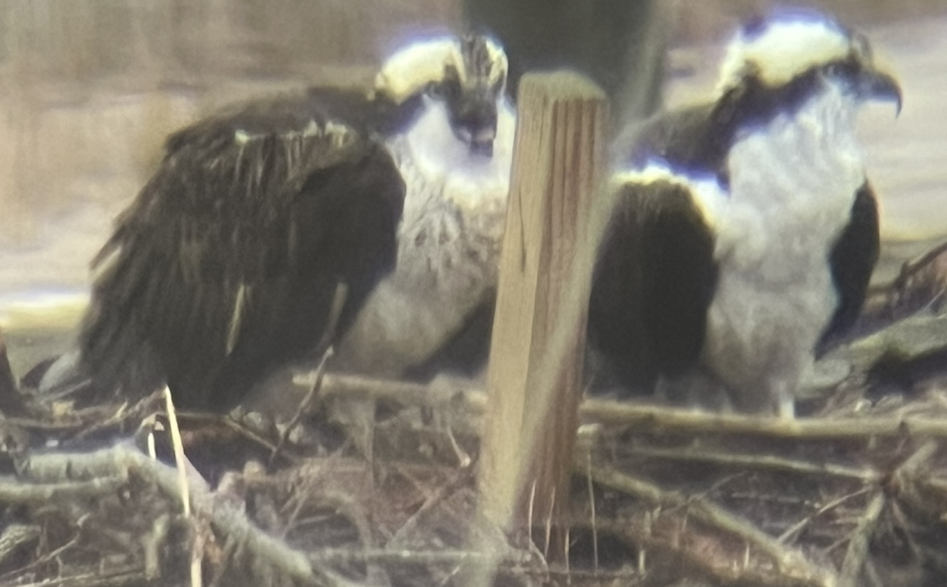
    Mark-8 and Ethel remained adamant about their possession of Nest 1, although neither were into nestorations. They persevered as non-traditionalists. Mark 8 wasn’t into fish delivery. And Ethel wasn’t into mating.

    When Mark-8 zoomed in for a mating attempt—an approach favored by most lower-creek males—he’d have to walk Ethel’s shoulders down to force her tail up. If he succeeded with that, he’d have to walk his way back up to position his tail beneath hers. If all of this was accomplished, Ethel would swish her tail like she was all in, but whenever I caught a glimpse, she was all out of alignment.

    Note: Ornithologists say Osprey do not trade fish for copulation, not in a tit for tat kind of way. The male necessity is to override his own survival instinct and give his fish away. So, while the giving is a huge thing, possibly even tied to his perception of masculinity, the female needs to calculate, Is it enough? He must feed her, her chicks, and himself. A miscalculation could trap her into a lifetime of begging calls and drudgery.

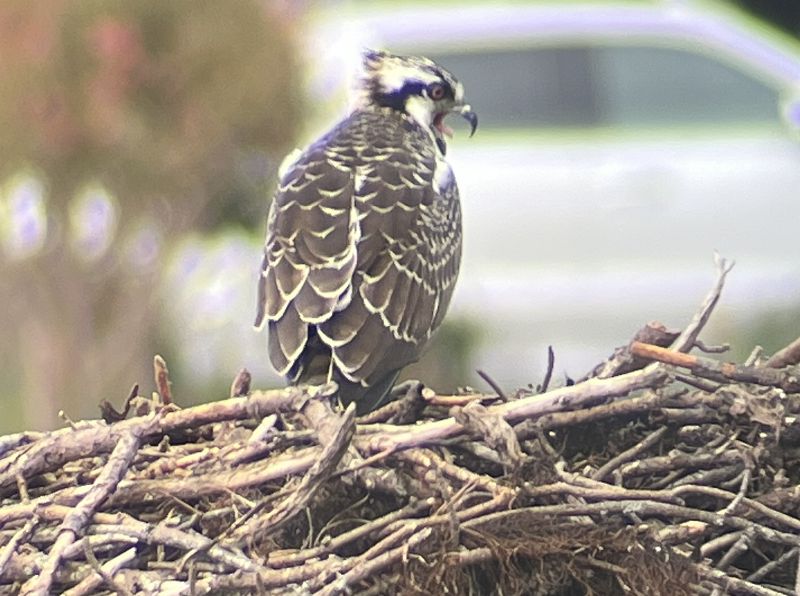
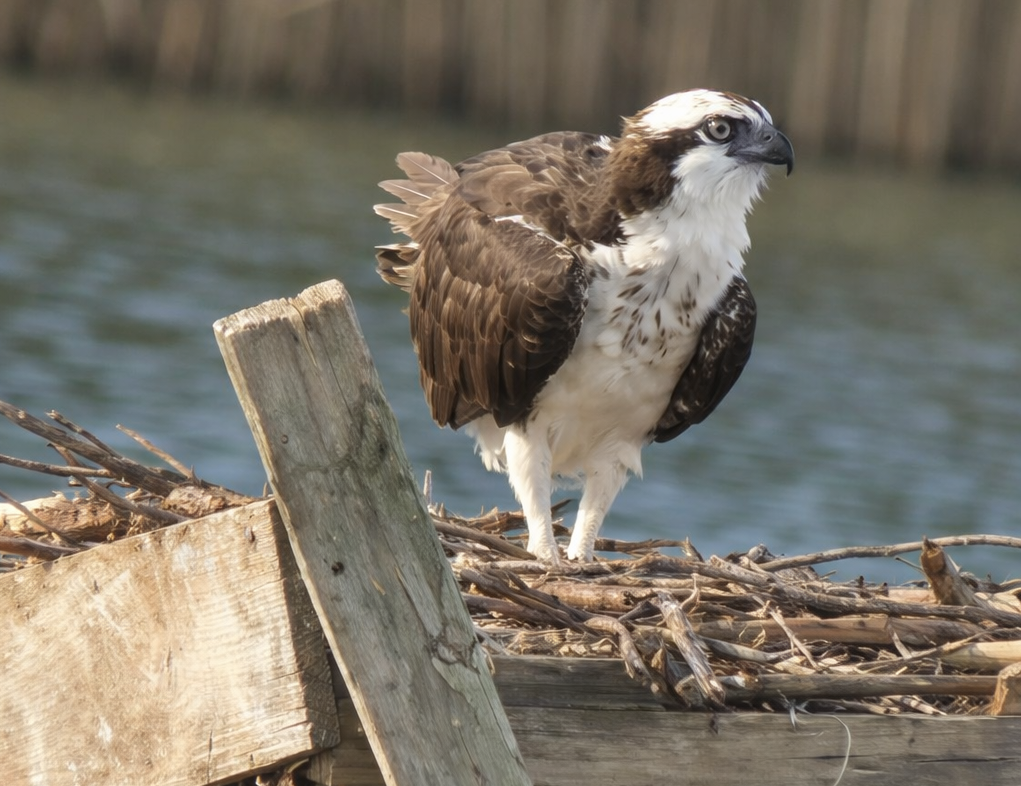
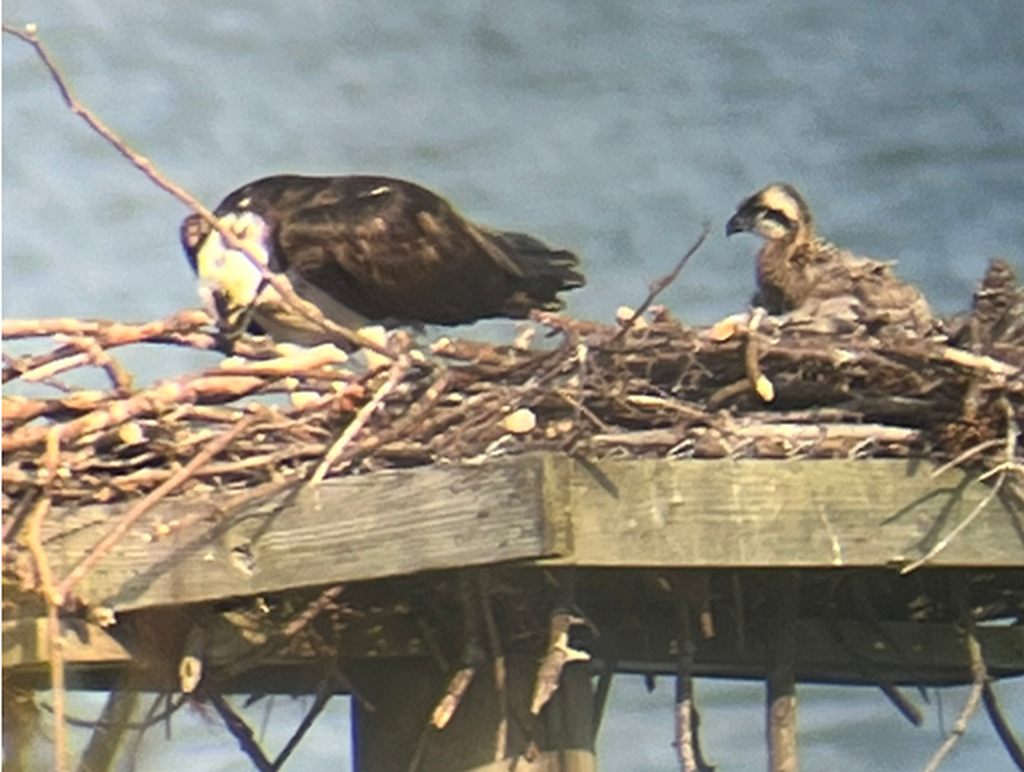
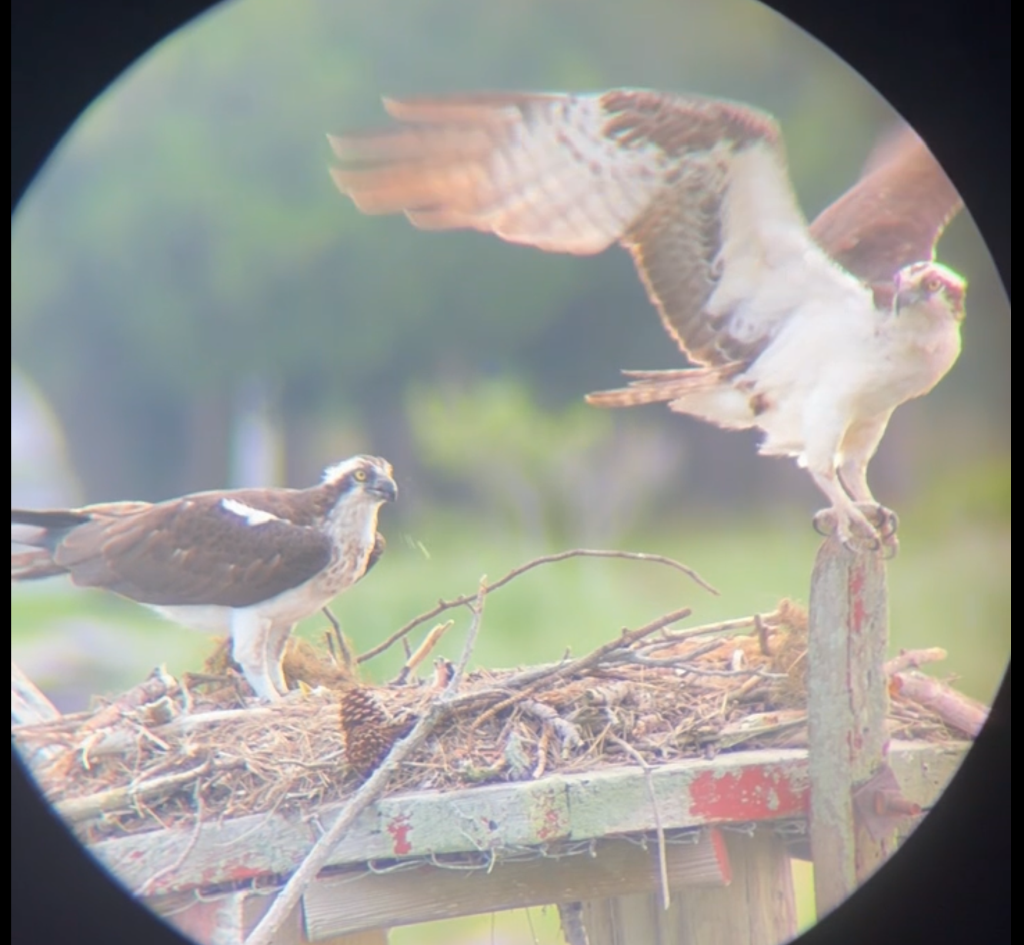
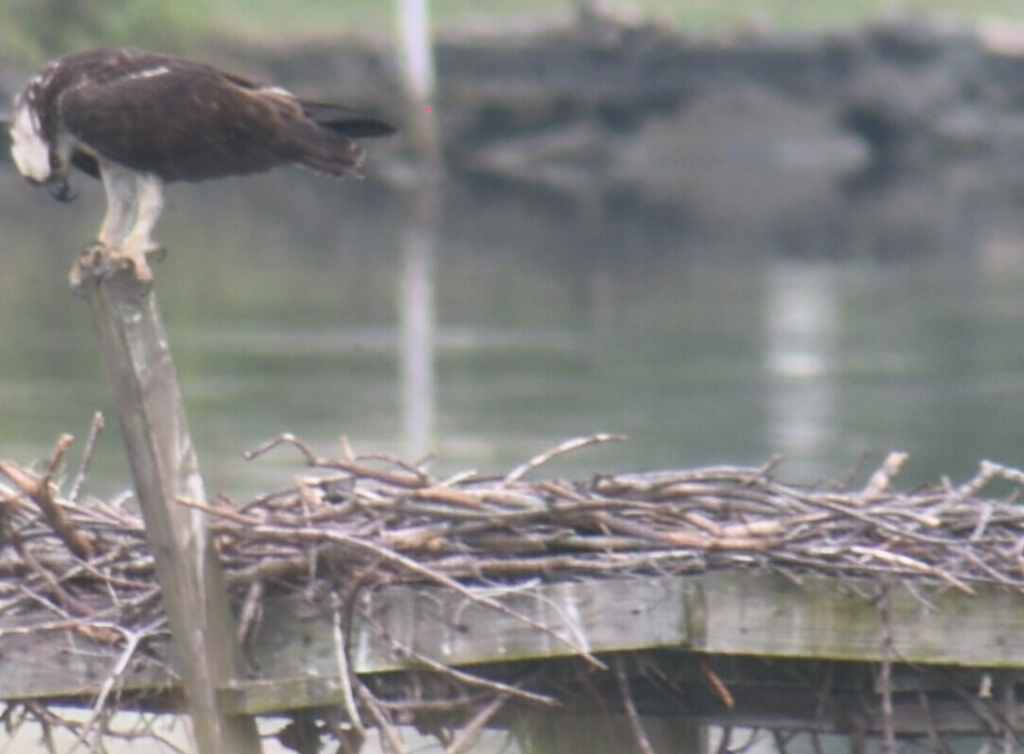
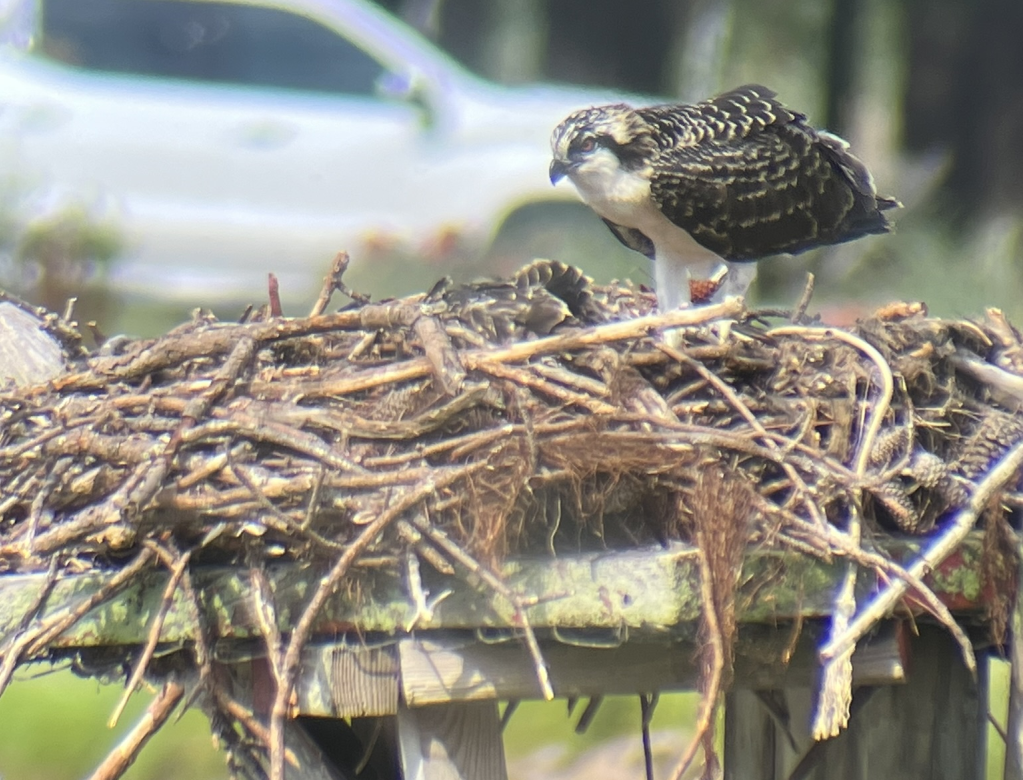
    A new couple arrived in mid-April. I named them George and Martha for no reason at all. George began building a split-level atop a Purple Martin hotel rusted hollow. It was mounted at the toe of the L-shaped pier that separated the old Osprey nests from the new.

    While George’s efforts sometimes appeared within the realm of possibility, they also smacked of the style of Mark-6, who in 2022 continued sliding sticks down Marker 6. George incorporated the sticks that fell off the Purple Martin hotel into the circle of rope, fabric, and various detritus comprising the garden level of his castle sprawled across the pier.

    Just like that, the Bennets got another atypical neighbor flanking them on the north. None of the neighborhood took it well.

    Previous episode: 2022.1 Time Speeds Up

    Upcoming episode 2022.3 Territorial Negotiations

    Photos by author, taken with iPhone clamped to telescope. Versions in post were “sharpened” by Copilot AI.


  • 2022-1: Time Speeds Up for Island Creek Osprey

    2022-1: Time Speeds Up for Island Creek Osprey

    2022 took off early and held a fast pace. Some of the named 10 showed up a month ahead of their previous year’s arrival. The Perfects dropped into place March 7, perched side by side as if a single, ceramic unit had been lowered onto the rim of their nest. They hatched four chicks in 2022 and subdivided their nest to jettison the younger two from the feeding schedule, as required.

    Mr. and Mrs. Bennet arrived the day after the Perfects, Mrs. B mid-morning and Mr. B careening up the creek early evening, landing gently on Mrs. B and mating. She greeted him head down, tail high, and their breeding season began.

     Note:  Ospreys don’t carry full-sized reproductive baggage year round. Initial mating efforts—the failures and successes—expand the gear to production size and drop it into place. Experienced couples can pack these preliminaries into seven to 10 days of concentrated and consummated mating to deliver a fertilized egg. Newer pairings take more time. Weeks. Longer. Maybe not until next season. Timing is the essence.
    Big Mama (L) and Big Daddy

    Big Mama arrived the same day as the Bennets. I didn’t clock Big Daddy’s arrival, but he was taking a turn incubating eggs by April 1, so he’d arrived close on Big Mama’s tail.

    Ethel and the two Marks arrived mid-March and resumed skirmishes between the two nests south of the dock; they flew tandem and even as a synchronized trio above the creek, they buzzed nests close enough to cause small fracases.

    Ethel and Mark-8 reclaimed Nest 1 and resumed squabbling with Nest 2 using the same old tricks: Mark 8 buzzed the Bennets as they began mating. Mr. B stole stick after stick from Mark-8’s nest.

    Mrs. B, a tenacious and relentless defender of Nest 2, could yet be surprised by Ethel quickly touching down on Nest 1 behind Mrs. Bennet’s back, only to spring over to her own nest as Mrs. B realizes. It drove Mrs. Bennet nuts.

    Mrs. B once rocketed off Nest 2, talons raised, hit Ethel square on the back, tumbling her overboard off Nest 1’s perch.

    The four of them looked more prankish than hazardous. This was their third year back. They worked together to drive off intruders, which I considered to be those I had not named, but their definitions were narrower.

    Matters still looked to be leveling out to a neighborly season. Mrs. B properly settled in and started laying eggs on March 25, still an early bird well ahead of the standard Chesapeake Osprey calendar. She had plenty of time if something should go awry. Good thing.

    Previous Episode: 2021.6  Mark-8, What Else?

    Upcoming Episode: 2022.2  Building Code Spat over Split-Level

    Photo by author, taken with iPhone clamped to telescope. Version at top was “sharpened” by Copilot AI.
  • 2021-5: Mr. Bennet Was My Favorite

    2021-5: Mr. Bennet Was My Favorite

    Big Daddy delivers a fish to Big Mama, whose crop looks depleted, so she’s probably hungry.

    The Bennets’ two chicks behaved like characters in a Sesame Street episode about sharing.  One would take a bite from a parent as the other watched and waited for the next bite. They were so considerate of one another I named them Jane and Elizabeth Bennet. Ornithologists would attribute such an idyllic first clutch to Mr. B’s true excellence at fishing.

    Note: Food shortages create bullies, according to ornithologists. Fish provide everything for Ospreys including hydration. Everything. There is no second choice.

    I never saw more than two hatchlings at the Bennets’ nest, but three heads initially popped above the lip at Ethel’s and the Perfects’ nests. The eldest in those two nests bullied and the youngest in each nest quickly perished, a pattern in nests on internet Osprey cams as well. Osplet bullying is violent and will ultimately result in siblicide.

    Note: I think “Osplet” and “nestorations” are words created by contemporary, online birders. They mean what they sound like they mean.

    Ample food at the Perfects’ nest ultimately allowed the second chick to catch up in size and gradually reduced that bully’s aggression. The nest calmed down and the two surviving Perfect chicks fledged on equal terms.

    Conversely to the other families’ nests, Ethel drudged mostly solo to fledge two chicks from Nest 1. Which led to her ultimately inappropriate name, in honor of Vivian Vance’s character on “I Love Lucy.” Ms. Vance, it was reported, resented Ethel’s characterization as a drudge. But that was the job.

    Ethel’s job, as a young, first-time mother, was to  fledge Osplets with her nest-mate, who didn’t bring home the fish. Not quite accurate. He’d bring it home, he just couldn’t let it go.

    Ethel in Nest 1 with her nest-mate on the perch

    He resembled Mark-6, taller, leaner, both with pure white chests, minimal and similar dark feather markings on their heads. They flew in tandem as if choreographed, swooping above the creek. He flew with Ethel before the eggs arrived. They’d occasionally flown as a trio.

    But he just couldn’t let go of his fish.

    Previous Episode 2021.4 Pride and Prejudice 

    Upcoming Episode 2021.6  Ethel as Heroine

    these are the original iPhone via telescope photos take by author; versions posted above by AI Copilot

  • 2021-3: Birds Labor Too

    2021-3: Birds Labor Too

    A bird about to lay an egg resembles most animals going through labor, intensely focused on the pressing situation, jumpy even in the comfort of her own nest. The subsequent melodrama of laying an egg, for the first time, without a nest, looked pitiable and shameful. [Refer to anthropomorphism 2021-1.] She needed a notorious name: Natasha.

    I conjured Natasha Fatale, spy of the Moose and Squirrel show, something edgy to offset the awfulness of practicing voyeurism on victimization. Because that’s what Natasha looked like. Clearly, no one had passed along the news to keep your tail down until you had a nest. And if they had, well, then she deserved a spicy name.


    Natasha’s debacle began at dusk the third week of April when Ethel alerted the neighborhood of disaster. Natasha had landed in Nest 1, Ethel’s nest, ready to lay an egg.

    Ethel hadn’t yet been named nor had the nests been numbered, but well prior to all of that, it was universally known that the bird to be named Ethel possessed the nest to be designated Nest 1. And before Natasha could push, Ethel pushed her off it.

    Natasha flapped the 50 feet to Nest 2, where the accommodating male and less accommodating female backed away. Natasha laid her egg right at the platform’s lower edge, closest to Nest 1, then the resident Nest 2 female pushed Natasha  off.

    Three days later—right on the money in the standard Osprey-egg-laying schedule—Natasha landed in the oldest nest, occupied for many years by the Bigs, who remain the biggest, respectively,  male and female Ospreys I’ve ever seen. They let Natasha labor, lay her egg, and briefly incubate along side Big Mama. I appended Mama because of that kindness shown a younger female. Not much of a hop to cast the big, blustering male Big Daddy when, after Natasha’s brief rest, he tossed her off that nest too.

    I have no further record of Natasha.

    Previous Episode 2021.2: An Exotic Girlfriend

    Upcoming Episode 2021.4: Pride and Prejudice 


  • 2021-2: An Exotic Girlfriend

    2021-2: An Exotic Girlfriend

    Note: It’s all about the nest with Ospreys. Male Ospreys select the site, maybe gussy it up a bit with some sticks, then keen and circle above, advertising. The males plunge toward the nest, swooping out of the dive as near as their nerves allow. At first, in courtship, the dive is to convince a female to lay her eggs there. Once she’s in the nest, dives accompany fish deliveries and announce his prowess as far as his keening can reach. If matters progress to fledging chicks, this nest will imprint an exact address on both of them. They’ll meet back up next spring and the next and the next. Nest Site Fidelity, according to ornithologists, is a bigger deal to Osprey pairs than one another.

    Nest Site Fidelity might define thereafter, but partnering proved the Gang of Six’s winning strategy. The two prevailing males fought for their claim to a platform alongside a female, also staking her claim.

    Mark-6 had a partner. She appeared less aggressive than the two females claiming a nest platform. But there just might not have been room for her. Mark-6’s nest consisted of an occasional bundle of sticks poking from the top of the triangle. His girlfriend gamely visited, but preferred Marker 7 across the creek from the rest of the gang. She perched atop the center piling between the square, odd-numbered marker.

    She was small for a female, compact like Mark 6. And also like him, a beauty. Plus her markings differed from the others, more dark feathers about her face, down her breast and stomach. She looked exotic next to the familiar, whiter faced, lacey necklaced females of Island Creek, including Mrs. Perfect and Mrs. Bennet. Ethel had a more pronounced bib than her neighbors, but it barely feathered her crop, next to nothing compared with the thick, dark feathering of the exotic girlfriend.

    Mating on Marker 6 proved tricky, but possible, unlike nest building or transferring fish, which had a significantly greater failure rate on Marker 6 than atop Marker 7. So they mated there as well. She had even brought a few sticks to the square marker. But Mark-6 did not relocate. So, the inevitable occurred. In late April, the exotic little female went into labor without a nest.

    Previous Episode 2021.1 A Telescope, Anthropomorphism 

    Upcoming Episode 2021.3: Birds Labor Too  

    this photo by author; photo above “sharpened” by Copilot AI
  • 2021-1: A Telescope, Anthropomorphism

    2021-1: A Telescope, Anthropomorphism

    In 2021 I acquired a telescope sufficient to discern particulars above the lips of the four nests out front. The 10 Osprey I’d erratically watched in 2020 returned and became distinct. So, I named them.

    I named them not only with anthropomorphic intent, but ignoble intent, matching an Osprey’s observed behavior to a reductive human stereotype. Speaking for myself, rude nicknames proved a helpful identification nomenclature.

    Note: Anthropomorphism is the attribution of human traits, emotions, or intentions to non-human entities. The inverse is the attribution of non-human entities’ traits, emotions, or intentions to humans, like boxers’ nicknames such as Pitbull and Tiger, according to a Stack Exchange Inc. contribution licensed by CC BY-SA. Then another contribution speculated inverse anthropomorphism was merely a mirror effect of our own anthropomorphism.

    The telescope confirmed three males and three females returned as the Gang of Six. Skirmishes resumed immediately for a nest site and perhaps also for a mate. But, really, I had no idea. Permanent pairing would seem to have gelled, or seemed near gelling, more or less, then everyone switched around. I second-guessed every identification, a rank amateur at birdwatching, at focusing, at all of this. And yet, unskilled, untrained, and undisciplined, even I saw that these birds were not monogamous.

    A good-looking banty male was exceptionally popular. He wound up odd-male out when the partnering and nest sorting did gel. He hightailed over to Intracoastal Marker 6, same side of the channel, centered in the two nests’ viewshed.

    He perched majestically at the tip of a red triangle of Red-Right-Returning fame. He dropped sticks down its 60-degree slope all season. He retrieved some he saw fall overboard, before they waterlogged. He dropped more sticks than all four of the gang members dropped on their two starter nests combined.

    He became Mark-6, as a bit of mockery. Later, learning more about birds’ individualized reproductive controls, I anthropomorphized  Mark-6 of a building strategy to opt-out of fatherhood, which must be thoroughly exhausting. It left time for Mark-6 to visit females on their nests as well as bring fish to a girlfriend of his own.

    His girlfriend could be spotted on Marker 6, making a go of what could be done at the tip of a triangle. And she also spent time on Marker 7, a square marker and stabler. Who knows where else they mated, but the outcome presented a notorious name for Mark-6’s girlfriend. It really wasn’t female shaming. She simply needed something powerful working on her side.

    Photo by author taken with an i-Phone clamped to the eye-piece of a telescope; photo at top is an AI Copilot “sharpened” version of this image

    Previous episode: 2020.3:  Feeding Osprey

    Next episode: 2021.2  An Exotic Girlfriend 


  • 2020-2: Rampaging Adolescent Ospreys

    2020-2: Rampaging Adolescent Ospreys

    The new Osprey nest platforms are down stream from the peeler crabs beneath the red roof.  The green Intracoastal Waterway Marker 3 at the edge of the small beach in the background denotes the mouth of Island Creek. The red, triangular markers heading upstream are 4, 6, and 8.

    St. George Island legend pegs St. Patrick’s as the day Ospreys return. In 2020 that coincided with the pandemic. My office moved to the second-story of the island house overlooking the coveted new platforms. Hard to miss the commotion. I dug out a middling pair of binoculars, climbed to the storage loft above the oyster house, and dragged a stool onto the landing. I went a second morning merely to prove to myself I could. I didn’t bother with the binoculars.
    The Gang of Six blew past that landing exactly like the rampaging, hormone fueled, adolescent hawks they were. Fast and huge. They turned sideways—in flight!—to accommodate the sloping barn roof. They cut corners so tightly the building might as well not have been there at all. I grasped the railing, off balanced. Their wings were huge! Huge! Feathers filled the view. An unbelievable number of feathers, layers and layers. Millions of feathers. The spread wings were four times my breadth. I heard, “whoosh” and felt a rush. It happened again, so fast, another chasing the first, Star Wars on the wing. “Whoosh.” And all those feathers.

    After that I balanced the Captain’s powerful oystering binoculars atop piles of boxes and thick books in my pandemic office and spent half an hour setting the focus on the new platforms.

    Map below so totally not to scale!

    An Osprey nest proved perfect for lazy birdwatching. Everything interesting that birds do, Ospreys do at their nests—courtship, nest building, mating, dining on live prey that is always fish, so not as gross as an eagle’s nest, eagles eat anything and the kids sleep beside the leftovers.

    Then Ospreys produce a 60-day family drama from feeding to fledging followed by prolonged survival training—flying and fishing—for their first migration. Nearly all of this, right there on the nest, binoculars in place and focused.