Tag: Little Boy

  • 2026-03: Island Creek: Hot and Quiet

    2026-03: Island Creek: Hot and Quiet

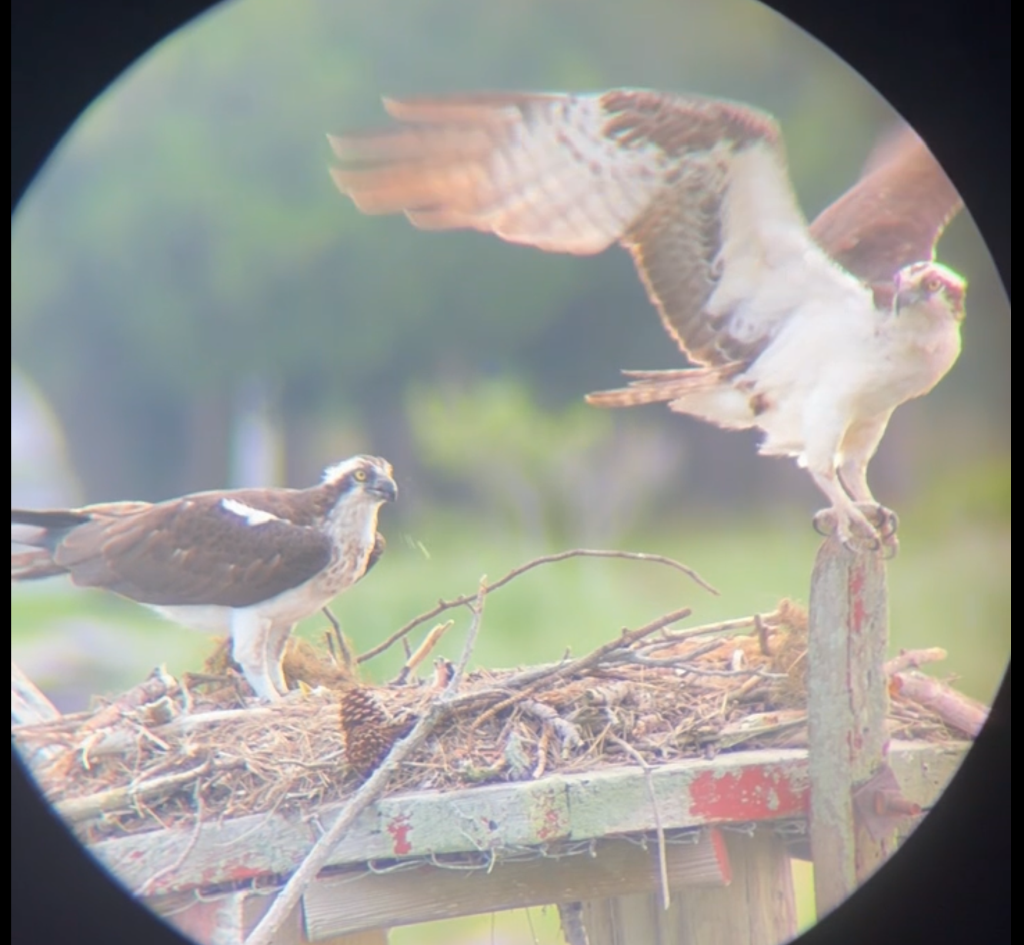
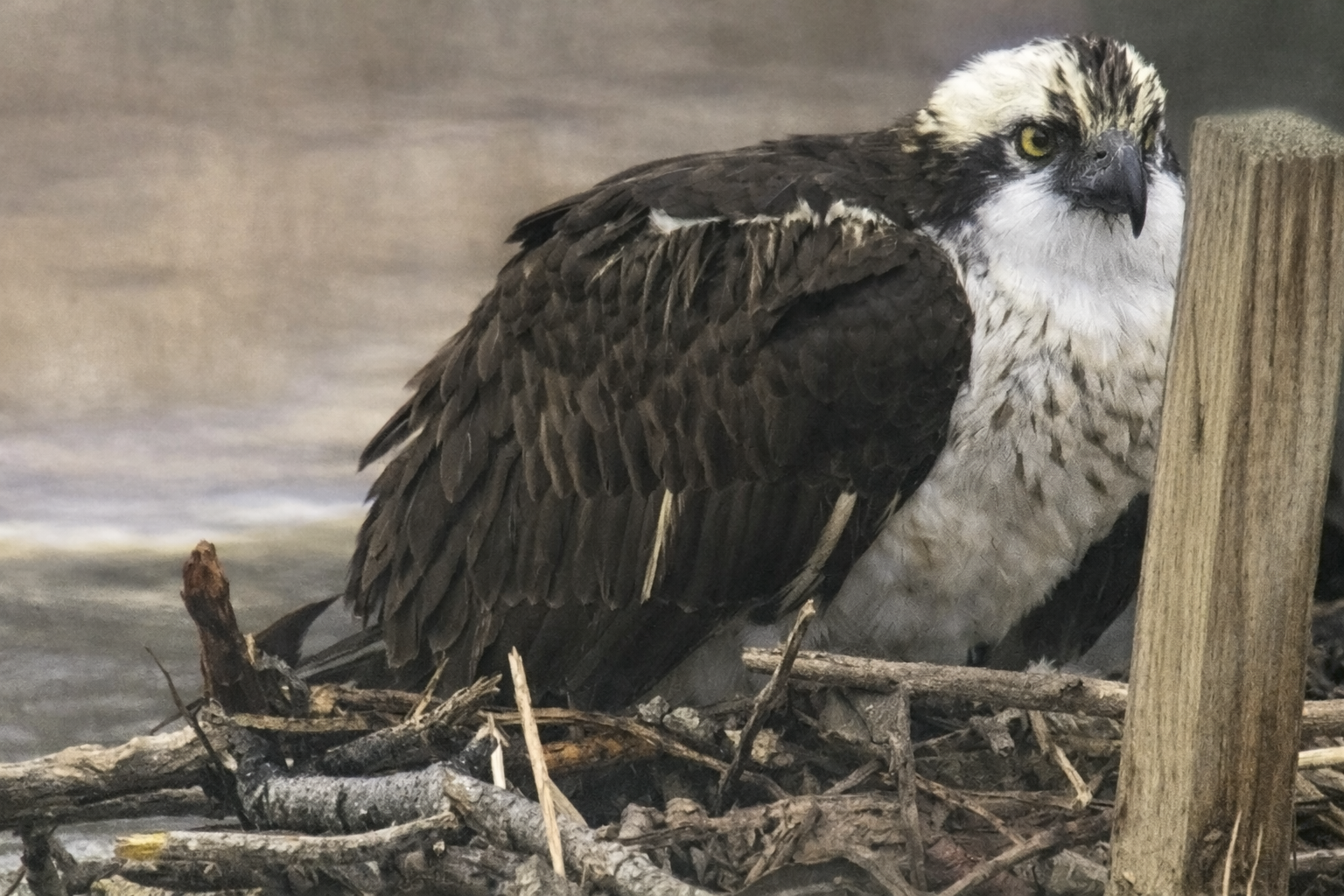
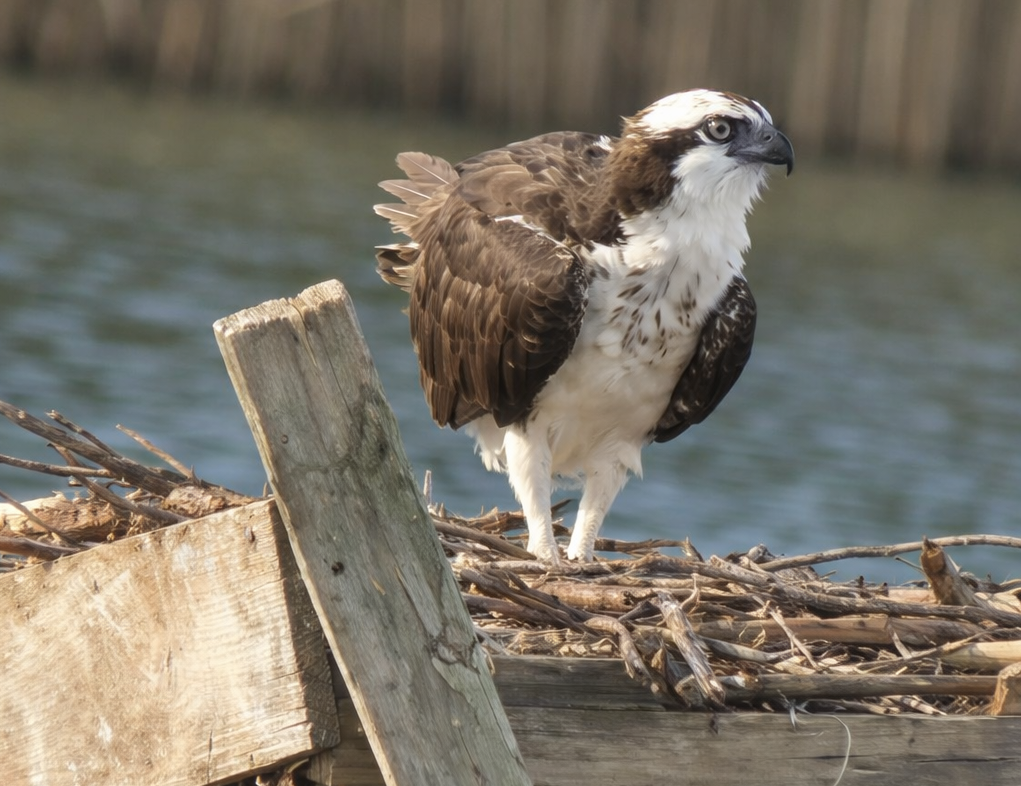
    Ethel, above on Nest 2, out waited the Canada Goose who’d usurped Nest 1, returning after the usurper split and a young, male Osprey began checking it out.

    2026 – What I’m Learning Now – Summer

    Note: There are cautions on nest cam sites warning of potential violence on bird nests and the emotional toll. Life frequently ends unpleasantly on nests.

    The Canada Geese that seized Nest 1 on March 27, didn’t give it up until the first week in May. Ethel dove at the two Geese when they began squatting in her nest, which she’d been tidying a very little bit since arriving March 8. A male Osprey — probably LB, the youngster who ultimately pulls himself together into a successful first-time dad on Nest 4 — offered a few insufficient swoops of assistance, but split after that.

    Ethel brooked no further opposition, took to Nest 2 and behaved as though the Geese did not exist. No stronger ally arrived. Neither Mark-8 nor Mr. Bennet returned. She attracted a male Osprey to Nest 2, but his appearance launched LB across the creek to knock him off Ethel’s nest.

    Ethel, 8 or 9 years old, now possesses both the nests that caused such a ruckus in 2020. Among my named 10, she alone returned this year to this Island Creek address. And the week after the Geese left, she returned to Nest 1 to join up with a male Osprey.

    He looks younger than Ethel and spends a lot of energy revamping the place. Nest 1 now has such a substantial weaving of twigs and sticks that from a distance it can appear level.

    I’ve only caught peripheral suggestions of mating, although with Ethel that should minimally be modified to bonding. Meeting up the last half of May really is too late for eggs. Anthropomorphism suggests Ethel might be explaining this, and other matters, to a youngster so far more into nestorations than fishing.

    LB hasn’t reengaged with Ethel since her new beau arrived.

    Indeed, LB is very busy. He provides fish after fish after fish for the kids. He sometimes hangs out to watch Lily feed them, but doesn’t attempt to feed them himself. He never brooded after they busted their shells.

    Previous Episode 2026-2: Definitely Summer

    Next Episode 2026-4: Fish Disappeared; Ospreys Starving
     

  • 2026-02: Definitely Summer

    2026-02: Definitely Summer

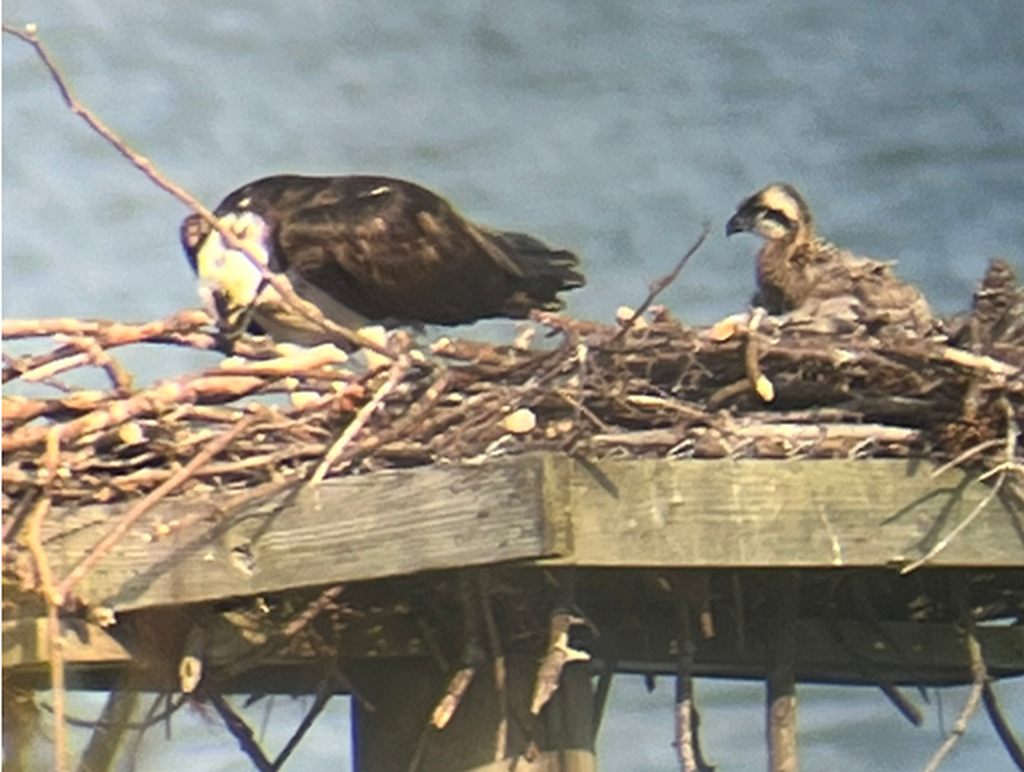
    Mrs. Perfect works on the walls to Nest 5 as her surviving nestling becomes more adventurous. July 5, 2026 photo by author with iPhone clamped to middling telescope.

    2026 – What I’m Learning Now

    Note: There are cautions on nest cam sites warning of potential violence on bird nests and the emotional toll. Life frequently ends unpleasantly on nests.

    The day this is being written, July 5, 2026, at 12:10 EDT, Ospreys in Nest 4  and Nest 5 are busy feeding chicks. In Nest 5 (photo at top) one chick remains, down from at least two hatchlings.

    Lily feeding three chicks on Nest 4, June 23, 2026

    Two chicks remain in Nest 4, although three hatchlings had grown tall enough to be seen above the rim of the nest. But the third  remained small — the tiny white head, to the right of the older siblings.  Chick #3 was last seen June 23. The remaining two had an immediate growth spurt.

    June 26, 2026: A big growth spurt for Chick #1 (center, with a full crop) and also for submissive Chick #2 who will not approach Lily for a bite of food until #1 is done. Chick #3 was last seen three days prior.

    An Osprey nest about a mile up the road and tracked among the 20 nests in the Excel cache, also has two active adult Ospreys that appear to be feeding young.

    Except for a foliage-camouflaged box still holding my unreasonable hopes, that’s the 2026 Osplet count on these 20 nests.

    The pleasure in the proximity of three chicks distracts me from considering those overall numbers. Distractedly thinking about the Captain’s 2022 calculations, there are at least 40 more nests on the island. As I distractedly think, a solitary Red-winged Blackbird visits the birdbath. It has been very hot recently, around the Chesapeake.

    On June 23, Lily twice carried soft material into Next 4 and placed it into the floor, presumably covering Chick #3’s body. That same week, in Nest 5 — more difficult to see into than Nest 4 — was down to one chick.

    Mrs. Perfect’s remaining chick didn’t fit my expectation. I expected a big, bully, which I’d seen ignoring food offered by Mrs. Perfect to continue pecking at the head, back, and wings of an already subdued, if not injured, sibling. The Nest 5 guys were older than Nest 4 chicks, Nest 5 possibly hatched eggs as many as five days before Nest 4, during the last days of May. But the surviving Nest 5 chick was smaller and weaker than than even the bullied Nest 4 chick.


    By June 26, only one chick remained on Nest 5, between 3 and 4 weeks old and just big enough to poke a head above the twigs hiding the west side of the nest.
    By July 2, the Nest 5 chick (silhouette here) is starting to navigate the nest


    Previous Episode 2026-01: Almost Summer

    Next Episode 2026-03: Island Creek: Hot and Dry


  • 2026-01:  Almost Summer

    2026-01: Almost Summer

    The tiny head of a hatchling is barely visible north east of the pine cone in the photo above. Lily has been feeding the hatchling and LB has been watching. LB pushed and shoved and nipped at Lily’s feathers to get a chance to incubate the eggs. But I never saw him one time incubate a chick.

    2026 – What I’m Learning Now

    Note: There are cautions on nest cam sites warning of potential violence on bird nests and the emotional toll. Life frequently ends unpleasantly on nests.

    The day this is being written, June 4, 2026, Ospreys in Nest 4 and Nest 5 are feeding hatchlings, right this very moment, at 12:55 EDT.

    Without the telescope I can see Lily plucking pieces from the fish LB delivered and placing them carefully into the nest cup, well beneath the lip. LB stands to the side and watches intently. He delivered a very small fish.

    It was 10 days later before the tip of the beak barely seen in the photo above appeared.

    The Perfects, with hatches I suspect a day or two ahead of Nest 4, may nevertheless be in a slightly more tenuous position. LB has been a more prolific provisioner than Mr. Perfect, increasingly important as chicks grow.

    Ethel began the season on Nest 2.

    To catch up: In addition to the five nests out front, at least 11 other nests among my Excel cache laid eggs this year and appeared to incubate them in a responsible manner. A nest farther up the creek,  out of my telescope’s reach but visible from the road, appeared to be feeding hatchlings in advance of Nests 4 and 5.

    Ethel laid no eggs this spring. Geese had overtaken Nest 1 by late March and she’d taken to Nest 2 as her primary residence. Mr. Bennet’s beehive of ’23 had weatherized down to little more coverage than 2021-22. It was still in better shape than Nest 1, which has a brace giving way.

    Lily and LB had had an exceptionally energetic mating season, arriving in the first part of March, laying at least three eggs by April 23, which in no way diminished LB’s libido. He began visiting Ethel after Lily quit hoisting herself up from her eggs to lift her tail for a chance of fertilizing another.

    LB had made a couple fish deliveries to Ethel and some tail swishing had gone on, but it stopped the first of May. Lily gave him a dressing down and, also, finally allowed him to incubate the eggs on his own.

    LB loved incubating eggs. It had taken him at least a week to give it a try, circling the nest bowl for days, peering inside as Lily took the fish he delivered to their Nest 3 veranda to dine. But once he tried it, he wanted to incubate all the time. For a while he’d push at Lily to get her to move off the eggs to let him take over.

    Pretty soon he was delivering fish after fish, settling in to incubate until Lily pushed him off. Then he’d go get another fish.

    Previous Episode: 2025-03: Ethel, Solo

    Next Episode: 2026-02: Definitely Summer

  • 2025-3:  Ethel, Solo

    2025-3: Ethel, Solo

    Mark-8 was last sighted at Island Creek on June 2, 2025. This photo from April 2025 with focus sharpened by AI.
    Ethel on Nest 2.

    2025 – What I Knew Then, What I Know Now – 2026

    The loss of his and Ethel’s eggs proved the end of the line for Mark-8. He left within the first few days of June. Mr. Bennet had remained banished and neither male returned to Nest 1 or Nest 2.

    So, around the middle of June, Ethel invited Little Boy over for dinner, which he delivered. They did a bit of Nest 1/Nest 2 hopping, but Ethel preferred her meals delivered to Nest 2.

    LB also kept delivering fish to Lily on Nest 4 for a while, which she accepted, and then immediately threw him off the nest. When those deliveries tapered off, Lily became a self sufficient fisher. She dined on the top branch of the dead loblollies at the southern corner of North Copse, also part of her Nest 3/Nest 4 territory. She handily chased off Ethel, LB, and any other intruder on any piece of her territory.

    LB settled in with Ethel for the rest of the season and delivered fish. Ethel performed her unsynchronized swishing and at one point, after a mating visit with LB, shot out something that didn’t quite look like a regular PS—Poop Shoot, in the vernacular of online bird-cam chatterers.

    Note: Patricia Brennan, Associate Professor of Biological Science at Mount Holyoke, discovered, this century, that some birds have genitals. Previously, scientists believed a “kiss” of the multipurpose cloaca beneath each gender’s tail did the fertilization trick for all birds. The cloaca does it for Ospreys, giving the female significant control over the outcome.
    In response to my query about Ethel’s expulsion, Professor Brennan replied, “[F]emale cloacal control for sure! One of the consequences of most birds lacking a penis is that males really have to convince females to accept sperm and females really have to gape their cloaca. Otherwise they can eject it easily after mating as you have seen.”

    None of the Ospreys I watched acted like they planned to gear-up the reproductive equipment for a second try. They looked like hawks with the summer off. The 24/7 nest confinement had been lifted. They didn’t have to mate, feed chicks, or teach them to fly.


    At the end of 2025, two females held possession of two nests apiece on Island Creek.


    This made for the second year without a fledge class from Island Creek. In 2024, I had plenty of reasons explaining the loss of all the hatchlings. They’d been late hatches, unable to temperature regulate when parching weather hit, already diminishing fish supplies threatened dehydration. Lots of reasons.

    Not in 2025. What would inspire vast numbers of “Chesapeake” imprinted Ospreys, within the same fortnight, to abandoned their eggs?

    I also don’t know about Red-Winged Blackbirds, there were so many they’d cast a 10-acre shadow across the marsh as they readied themselves to feed. Now, a half-dozen are quick to the winter feeders on the back porch.

    Previous Episode 2025-02: Young Female Overturns Tradition
    Next Episode  2026-01: Almost Summer

  • 2020-3:  Feeding Ospreys

    2020-3:  Feeding Ospreys

    Photo by Paul Leibe, 1991, first Osprey nest installed in Island Creek in front of the island house.

    2020-What I Knew Then, What I Know Now-2026

    The returning Osprey grown-ups in nests out front of the island house performed their traditional seasonal tasks in my peripheral vision, beyond practical reach of the oystering binoculars. I wasn’t taking notes, but mentions of oddities made it to the dinner table.

    Note: The oystering binoculars were too large and heavy to hold steadily, let alone simultaneously focus. The Captain had used them to locate bird activity above water which suggests fish below, which might portend oysters beneath the fish. They were also used in the ancient waterman tradition of spying on the catches of other working boats. Powerful.

    The two nests out front traditionally fledged three chicks. The oldest nest had fledged four chicks a few times over its three occupied decades. The younger nest probably 15 years old by 2020, had fledged four at least once. The Captain insists the oldest nest fledged five one year, with his assistance.

    He’d rigged the top of a now-forbidden Styrofoam cooler to a line threaded through a pulley running from the shore to the nest’s piling. When the workboats landed their various catches at the dock, the Captain took junk fish, the waste from filets, even left over bait if it was fresh enough, and hauled it out to the piling.

    Once, the Captain tells, the Osprey dropped a stick on the head of a Seagull trying to steal the fish off the lid. The Seagull flew, the Osprey retrieved the fish and fed it to the kids.

    I didn’t think to take notes. This was dinner conversation. Like seeing flocks and flocks and flocks of Red-winged Blackbirds above their undulating shadow gliding along the tips of the marsh grass. We noted when they’d dwindled to only flocks. We noticed the Purple Martins return to the little white buckets the Captain strung along the pier, but failed for a long time to notice they no longer provoked crack-of-dawn noise complaints. We noticed the Ospreys return, laughed at their funny fledglings learning to fly, discussed the population increase.

    In 2019 a Bald Eagle made its way across the road to the side yard, appearing uninjured but unable to fly, and placidly waited in the yard as I called for assistance. I had to convince the intake ranger I could discern an Eagle from an Osprey for the dispatch of qualified help, which shortly arrived. Due to an over-abundant population in the region, injured Osprey no longer warranted official rescue.

    Note: Ospreys are going on 2 or 3 years old when they first attempt a return to their imprinted natal region. Ornithologist say only one in three makes it. Survival rate improves significantly after that.

     The jumped-up six-pack at the mouth of Island Creek represented the top third of the banner fledgling classes of 2017 and 2018. They’d contributed nothing to the 2020 fledge class. But in 2021, they will out fledge the older two nests. Among those fledglings will emerge a bully of legendary proportion, who will terrorize all occupants of Osprey nests up and down Island Creek.

    Bully came from Ethel’s nest. She always has the best stories.