Tag: Alewives

  • 2026-06:  And That’s a Wrap

    2026-06: And That’s a Wrap

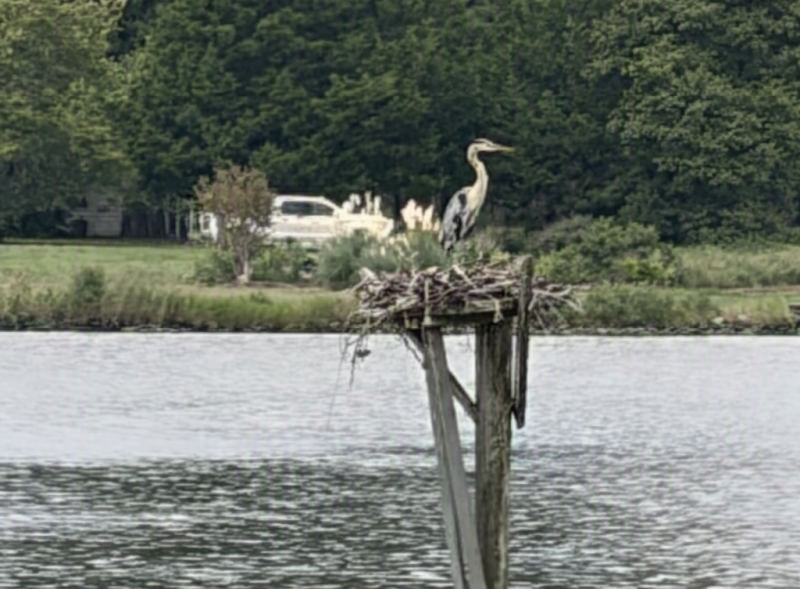
    A Great Blue Heron usurps Island Creek Osprey Nest 4, wrapping up the Osprey season for 2026.

    An Eagle landed on the Perfects’ nest last week, Sept. 17, something of an annual announcement that the Osprey of lower Island Creek have left on their southern migration.

    Junior had not. He perched on a piling across the creek from that nest and erratically cried complaints at the invasion of the Ospreys’ arch enemy. But no other Ospreys joined the complaint, suggesting the few remaining Ospreys circling the upper creek are visitors, heading south as well, looking for a bite to eat.

    LB, Junior’s dad, hadn’t been seen for a week prior to the Eagle’s visit. He’d put migration training into overdrive the week before that and stopped Labor Day weekend bringing fish to the nest for Junior.

    LB had already, patiently, used the floating bait  to demonstrate to Junior how to fish and catch meals for himself. Junior usually looked the opposite direction, kept keening for delivery. Over Labor Day weekend, LB retrieved only an occasional bait fish, but ate it all himself, abandoned the habit of delivering his second retrieval to Junior.  Even so, Junior never dove for a bait fish.

    There had been more fresh fish deliveries by then. The supplemental bait fish sharply fallen from mid-summer when LB would accept up to a dozen bait fish a day to feed himself and Junior.

    By August, LB was supplementing the bait fish with a few, small, live fish. Lily also brought a couple fish to Junior. A few times, in the scarce weeks of July, Lily would take a bait fish for herself, but she never delivered a bait fish to Junior, only fresh.

    A few days of watching his dad retrieve–or not–the bait fish floating by and no bait fish reaching him, Junior stopped visiting his natal nest. LB visited the neighborhood off and on into the second week of September, and most likely Junior got live fish from LB elsewhere. But by mid-September, Junior appeared to be on his own.

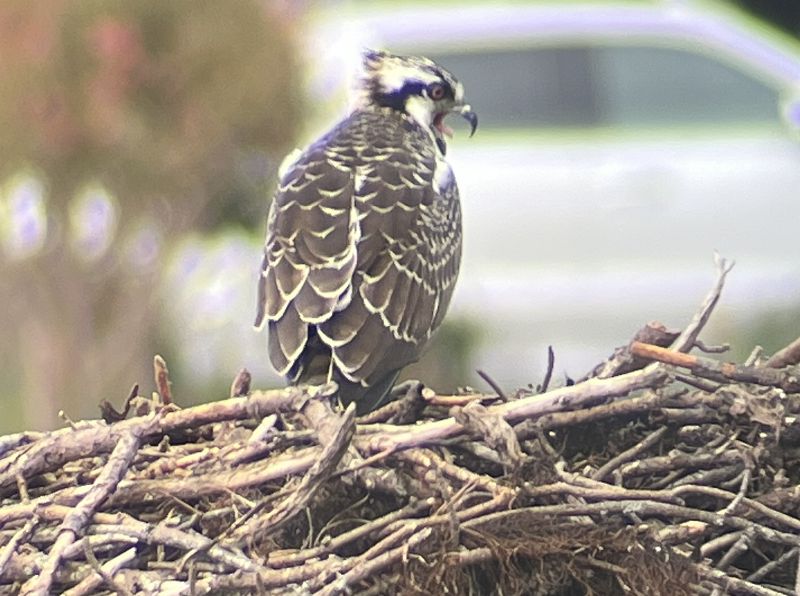
    Junior eating fish in the North Copse. He is likely the only Osprey fledge to make it off St. George Island for the 2026 migration to Central America.

    He stayed nearby, in the loblollies of the North Copse his parents had claimed as Nest 4 territory. He occasionally brought a live fish to eat there. But he wasn’t a regular visitor by the time the Eagle appeared.

    A lone Osprey call still carries across the creek in early morning, but probably not Junior’s. When a Blue Heron perches and preens undisturbed upon an Osprey’s nest, most likely that Osprey is out of town. That happened this week on Junior’s natal nest.

    With Junior gone, it’s a wrap on Island Creek Ospreys 2026.

    This is what I’ve learned, what I know now: Tossing bait fish isn’t going to cut it, for oh so many reasons. Not the least is how little reason there is to imprint an Osprey with a homing instinct for the Chesapeake Bay. The bay can no longer support an Osprey breeding season.

    Here’s Timothy B. Wheeler of The Chesapeake Bay Journal, with a sobering report on  Osprey Nesting Woes in the Chesapeake Bay, published here by Maryland Matters.

    Read it and weep.

    Previous Episode 2026-5 Losing Big Sis, Gaining the Sky
     

  • 2026-05: Losing Big Sis; Gaining the Sky

    2026-05: Losing Big Sis; Gaining the Sky

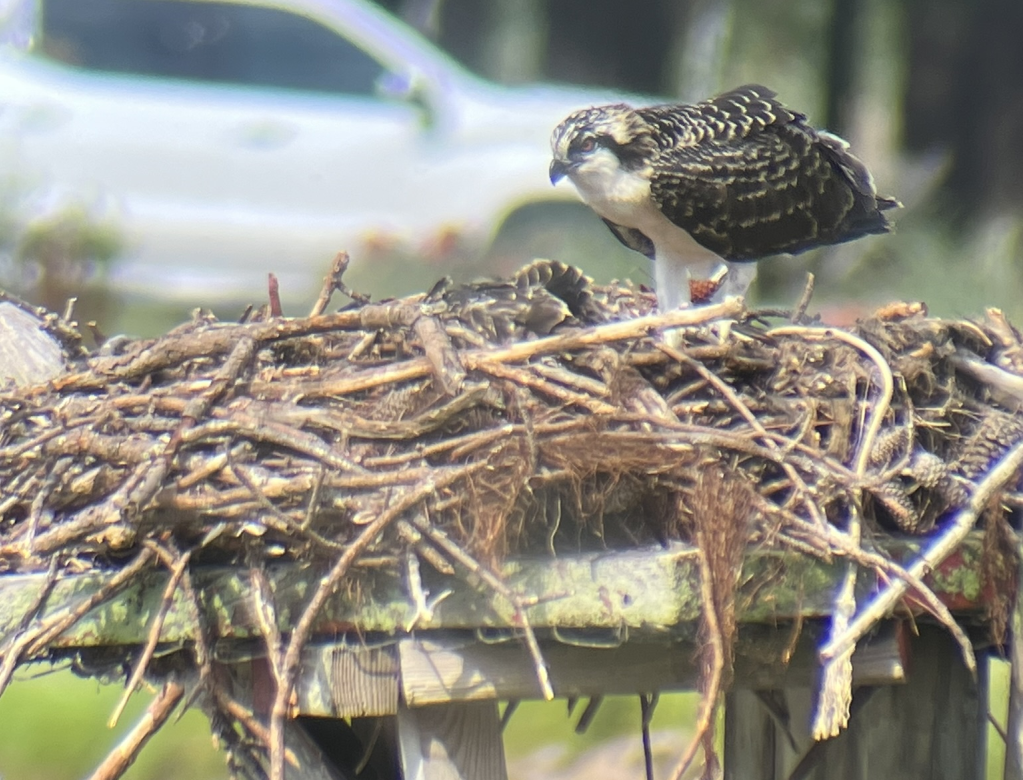
    Junior perched above the remains of Big Sis.

    Note: There are cautions on nest cam sites warning of potential violence on bird nests and the emotional toll. By “emotional toll” I mean “sadness.” Life frequently ends unpleasantly on nests.

    The night following Lily’s grab of a lobbed Alewife, a violent storm left only her youngest chick, Junior, alive. He’d nearly reached his elder sibling’s size with three days of bait-fish supplements. Big Sis had grown so substantial her feathers mounded above the lip for a week before assimilating into the nest.

    LB lands with a fish, Junior goes straight for it. Feathers in the foreground belong to Big Sis.

    LB delivered a frozen Alewife to Junior, the first fish he’d ever faced opening for himself.He’d likely survived on pieces Big Sis dropped while learning to feed herself. It can take an Osprey longer to get the hang of self feeding than of flying. Their beaks grip and tear, they don’t saw or slash. And fish skin is tough.

    The trick to opening a fish, it appears from cams and telescope, is to eat the head first. Dead or alive, fresh or frozen, doesn’t appear to matter. The head is the quickest way in, provides the biggest nutritional hit, and eases the subsequent unzipping of the scales to access the rest of the meat.

    Lily returned to Nest 4 the morning after the storm. Lying next to the pile of feathers she fed pieces of the Alewife to Junior, lying on her other side. Later LB delivered another fish to Junior, which Lily also took, feeding fewer bites to Junior this time.

    The next day, July 23, LB flew his fresh, decent-sized fish over the nest where Lily stood and Junior Fish Called. LB took the fish into North Copse, and on a branch above the nest ate the entire fish.

    Lily hangs around the North Copse, but not Nest 4. She grabs a bait-fish every other day or so. She only shares her fresh catches with Junior, dropping them so quickly I only identify her by knowing that’ not LB’s behavior.

    If LB sees a bait fish tossed into the creek, if he is not already occupied with another fish in his talons, he’ll go for that Alewife. He’ll share what he gets almost 50/50 with Junior. The technique sent Junior flying on July 28, 2026.

    Junior’s first flight was to the dead loblolly in the side yard, then a hop to the live one once I’d spotted him. He headed back to his nest, overshot it for a spot-on landing on Nest 5. No one home at Nest 5. Good thing. A few days later, Mr. Perfect chased Junior who had merely taken a shortcut across air belonging to Nest 5.

    But no trouble om his first flight. Junior flew from Nest 5 to Nest 4 just as soon as LB landed there with a fish. Another quite good landing.

    Junior accomplishes flying and landing July 28, 2026.
  • 2026-4: Fish Disappeared; Ospreys Starving

    2026-4: Fish Disappeared; Ospreys Starving

    2026-4 – What I Know Now – July

    Note: There are cautions on nest cam sites warning of potential violence on bird nests and the emotional toll. Let me be clearer, by “emotional toll” I mean “sadness.”  Life frequently ends unpleasantly on nests.

    July closed with only one Island Creek Osplet alive. He is alive because his dad, LB, will retrieve Alewives peeled from a flash-frozen cube of bait-fish and lobbed into the creek. LB shares his retrievals roughly 50/50 with Junior, the first Island Creek chick since 2022 to live long enough to fly.

    Junior in front and Big Sis behind on July 21, 2026.

    LB has been far and away the best fisher of Island Creek. Unaided, he fed himself and Lily through spring, added chicks in June and kept two alive for 7 weeks, up to the brink of flying. Five other nests in Island Creek hatched chicks and only two chicks, both in Nest 5, ever reached the lip of their nest, where that final survivor perished, emaciated, mid-July.

    LB had looked haggard by then, he was dragging, making fewer and fewer deliveries of smaller and smaller fish. Junior was becoming gaunt, bullied by Big Sis, the larger chick, already actively wingercizing–building muscles to fly.

    LB retrieves an Alewife

    But by July 18, the extended lack of fish had even slowed Big Sis’s hopping and flapping. In late afternoon, Lily left. She did not return that night to the branch overlooking her nest. She was not around the next morning.

    This is what I know now: It is time to ditch anthropomorphism. Nests significantly differ from nurseries. Ospreys perform an egg-to-fledge drama every year and their species survival is not dependent on that nest. Their survival is dependent upon returning next year.

    This is what I know now: Starvation stops the show, no matter if it’s Act One or Three. The survival message is: You cannot fall short of your body’s needs for a successful migration.

    This is what I know now: Fish are jumping in Island Creek from March through May. Males verily crow, circling the lower Potomac with long, fat, tail-waving fish in their talons. Chicks hatch late May through early June. coinciding with an abrupt, devastating reduction of fish.

    LB with Alewife in talons

    The morning after Lily left, LB perched on a loblolly above my porch, looking into his nest with a small fish in his talons. His two squeeing, starving chicks hit a frenzied pitch each time he touched down in the nest. Twice he lurched back out as Big Sis chick went for the fish but the third time she grabbed it and LB released it. Big Sis adapted immediately to self-feeding.

    Junior, by now automatically submissive to Big Sis, didn’t fight for the fish. But he’d kept growing as he reached 7 weeks, so he’d figured out some way to get fed something. All that day and the next day he stood sturdily beside his sister squeeing for more fish. By evening of the second day of squeeing, LB retrieved a frozen Alewife bobbing beneath his nest.

    By the next evening, July 21, LB had bulked-up and so had the kids. Lily, absent for three days, swooped beneath LB as he launched off his North Copse branch to snatch another bobbing Alewife, which she grabbed for herself. She looked awful. She was starving.

    Previous Episode: 2026-3: Island Creek, Hot and Dry

    Next Episode: 2026-5: Losing Big Sis, Gaining the Sky